In On the Unseriousness of Human Affairs, James V. Schall recounts a minor anecdote reported by Boswell in his Life of Johnson. It is Friday, Sept. 19, 1777, and Boswell and Johnson set out in a post-chaise for Derby, a city in the East Midlands about 30 miles north of Birmingham. (Coincidentally, this is also the date of the first Battle of Saratoga, the beginning of the end of the American Revolution.) Along the way, Johnson enjoys the sensation of speed, a proclivity, like the pleasure he takes in rolling down a hill, that always surprises us. He tells Boswell:
“If I had no duties, and no reference to futurity, I would spend my life in driving briskly in a post-chaise with a pretty woman; but she should be one who could understand us, and would add something to the conversation.”
Once in Derby, the pair tour the city, already a center of the Industrial Revolution. For a moment, Boswell forgets Johnson and indulges in a personal digression:
“I felt a pleasure in walking about Derby such as I always have in walking about any town to which I am not accustomed. There is an immediate sensation of novelty; and one speculates on the way in which life is passed in it, which, although there is a sameness every where upon the whole, is yet minutely diversified. The minute diversities in every thing are wonderful.”
Schall glosses Boswell’s observation like this:
“The general constancy of human nature across time and space is recorded here. But the particularities of human existence are, indeed, `wonderful,’ as Boswell remarked. The same sentiment exists in Dante, St. Paul, Aristotle, Plato, and perhaps originally in Herodotus.”
Boswell reveals an essential artistic and moral gift – the capacity to observe and appreciate simultaneously the general and particular, forests and trees, big picture and details. To see only the former is blindness; only the latter, tedium and madness. To consign humans to reductive categories– economic, sexual, racial and so on – erases their “minute diversity,” their irreplaceable singleness in creation. The passage that immediately follows Boswell’s observation above is very human, mundane and comical, and thus typical of Johnson:
“Talking of shaving the other night at Dr. Taylor’s, Dr Johnson said, `Sir, of a thousand shavers, two do not shave so much alike as not to be distinguished.’ I thought this not possible, till he specified so many of the varieties in shaving; -- holding the razor more or less perpendicular; -- drawing long or short strokes; -- beginning at the upper part of the face, or the under – at the right side or the left side. Indeed, when one considers what variety of sounds can be uttered by the wind-pipe, in the compass of a very small aperture, we may be convinced how many degrees of difference there may be in the application of a razor.”
Saturday, October 31, 2009


Friday, October 30, 2009
`A Certain Lightsomeness'
“I think that education in the higher things today is largely a matter of private enterprise.”
That certainly has been my experience. I’m aware of the dangers of autodidacticism, comparable to serving as one’s own attorney in criminal matters, but I earned a college degree 33 years after I matriculated, mostly out of orneriness, and spent most of the intervening years reading widely but unsystematically. I assumed learning was driven by raw curiosity, a hunger to know things, not to pass a test or get a job. As a result, I’m finding James V. Schall’s The Unseriousness of Human Affairs – the source of the quotation above – a satisfying intellectual romp. Father Schall is a Jesuit and professor of government at Georgetown University. He’s also formidably well read, playful and wise. His eyes are on “higher things,” what truly matters, not academic fashion. This comes from the introduction:
“The reader will find many of my friends in this book, both friends that I know and…many whom I have never met, yet know through reading, through having been taught about them and by them. I do not hesitate to cite Charles Brown and Lucy Van Pelt as philosophical authorities alongside real heroes like Aristotle, Augustine, G.K. Chesterton, Samuel Johnson, Josef Pieper…”
I’ll skip the creations of Charles Schulz but emphasize that an attentive reader of the five writers noted by Schall could be judged highly educated. He adds: “I cite these diverse authorities to help me show that the highest things have a certain lightsomeness about them. We sometimes confuse ourselves by thinking that solemn things cannot also be joyful things.” As though in confirmation, Dr, Johnson writes in “The Vanity of Human Wishes”:
“Year chases year, decay pursues decay,
Still drops some joy from withering life away…”
In Chapter V, “On the Mystery of Teachers I Never Met,” Schall returns to the five writers cited above (and adds, in passing, Pascal, Walker Percy and Flannery O’Connor, among others), briefly illuminating their importance to his thinking and life. Imagine a dear friend introducing you to five of his dearest friends. He does Chesterton the honor of quoting him well (from his Short History of England): “I would maintain that thanks are the highest form of thought; and that gratitude is happiness doubled by wonder.” Later, Schall shares an anecdote that I intend to adopt for my own purposes:
“I read something from Boswell’s Life of Johnson almost every day.”
I always feel stronger and healthier after reading Johnson or his biographer, more centered and reassured. In a post earlier this week I argued for the obvious superiority of dead over living writers. Our arrogance toward the past is appalling. While reading Schall’s book I’ve also been reading The Confessions of a Trivialist (1972) by Samuel Rosenberg, another Cleveland-born autodidact, who collects “Things” (the upper case is Rosenberg’s), both objects and facts. He loves minutiae, occult connections and other people’s scorned ideas and possessions. He devotes chapters to Santa Claus, Frankenstein’s monster, Lot’s wife, Albert Schweitzer, Herman Melville and a peridromophile (an obsessive collector of streetcar transfers). Rosenberg, however, distinguishes his passion for trivia from the devotees of “camp” who feast at a “cultural smorgasbord”:
“The people of the past did not live and create and die in order to provide material for our condescension. Many of our ancestors, remote and immediate, were better people than we are and they produced things of greater quality. Who are we to condescend to anyone?”
Schall and Rosenberg are unlikely allies. The former writes:
“The human spirit transcends time and space. And even if one of the great minds is not alive during our days, or if we are not lucky enough to meet such a person, we need not despair. We can still find the great thinkers, can meet them and let them teach us, through books. Indeed, with the new technology, it almost seems that no one is ever really dead.”
That certainly has been my experience. I’m aware of the dangers of autodidacticism, comparable to serving as one’s own attorney in criminal matters, but I earned a college degree 33 years after I matriculated, mostly out of orneriness, and spent most of the intervening years reading widely but unsystematically. I assumed learning was driven by raw curiosity, a hunger to know things, not to pass a test or get a job. As a result, I’m finding James V. Schall’s The Unseriousness of Human Affairs – the source of the quotation above – a satisfying intellectual romp. Father Schall is a Jesuit and professor of government at Georgetown University. He’s also formidably well read, playful and wise. His eyes are on “higher things,” what truly matters, not academic fashion. This comes from the introduction:
“The reader will find many of my friends in this book, both friends that I know and…many whom I have never met, yet know through reading, through having been taught about them and by them. I do not hesitate to cite Charles Brown and Lucy Van Pelt as philosophical authorities alongside real heroes like Aristotle, Augustine, G.K. Chesterton, Samuel Johnson, Josef Pieper…”
I’ll skip the creations of Charles Schulz but emphasize that an attentive reader of the five writers noted by Schall could be judged highly educated. He adds: “I cite these diverse authorities to help me show that the highest things have a certain lightsomeness about them. We sometimes confuse ourselves by thinking that solemn things cannot also be joyful things.” As though in confirmation, Dr, Johnson writes in “The Vanity of Human Wishes”:
“Year chases year, decay pursues decay,
Still drops some joy from withering life away…”
In Chapter V, “On the Mystery of Teachers I Never Met,” Schall returns to the five writers cited above (and adds, in passing, Pascal, Walker Percy and Flannery O’Connor, among others), briefly illuminating their importance to his thinking and life. Imagine a dear friend introducing you to five of his dearest friends. He does Chesterton the honor of quoting him well (from his Short History of England): “I would maintain that thanks are the highest form of thought; and that gratitude is happiness doubled by wonder.” Later, Schall shares an anecdote that I intend to adopt for my own purposes:
“I read something from Boswell’s Life of Johnson almost every day.”
I always feel stronger and healthier after reading Johnson or his biographer, more centered and reassured. In a post earlier this week I argued for the obvious superiority of dead over living writers. Our arrogance toward the past is appalling. While reading Schall’s book I’ve also been reading The Confessions of a Trivialist (1972) by Samuel Rosenberg, another Cleveland-born autodidact, who collects “Things” (the upper case is Rosenberg’s), both objects and facts. He loves minutiae, occult connections and other people’s scorned ideas and possessions. He devotes chapters to Santa Claus, Frankenstein’s monster, Lot’s wife, Albert Schweitzer, Herman Melville and a peridromophile (an obsessive collector of streetcar transfers). Rosenberg, however, distinguishes his passion for trivia from the devotees of “camp” who feast at a “cultural smorgasbord”:
“The people of the past did not live and create and die in order to provide material for our condescension. Many of our ancestors, remote and immediate, were better people than we are and they produced things of greater quality. Who are we to condescend to anyone?”
Schall and Rosenberg are unlikely allies. The former writes:
“The human spirit transcends time and space. And even if one of the great minds is not alive during our days, or if we are not lucky enough to meet such a person, we need not despair. We can still find the great thinkers, can meet them and let them teach us, through books. Indeed, with the new technology, it almost seems that no one is ever really dead.”
Thursday, October 29, 2009
`The Soul is Easily Agitated
The boy I’m assigned to in the special-education center is calmest when walking, perhaps the only quirk we share. For the last six weeks he’s been subject to spontaneous fits of agitation and shrieking, and movement has proven a fairly reliable antidote. We walk the halls and cafeteria (rain keeps us indoors), observing life in a suburban American high school.
Wednesday morning as we neared the music wing, I heard the riffs, runs and scales of someone noodling on a violin. As we rounded the corner the musical hodgepodge turned briefly recognizable: Johann Pachelbel’s Canon in D major. Ubiquity has dulled its piercing wonder but I remember the first time I heard it, late in the summer of 1976. I was living with friends and their 5-year-old daughter in Cleveland, and on a beautiful sunny morning we decided to clean the house. While we swept and dusted with windows open and curtains billowing, my friend put a chamber orchestra recording of the Canon on the turntable. For the first time in my life I felt like dancing. The sound was stately and ethereal. The closest literary analog I can think of is Pope, perhaps Essay on Man, and less for the sense than the sound and tone:
“Hope humbly then; with trembling pinions soar;
Wait the great teacher Death, and God adore.
What future bliss He gives not thee to know,
But gives that hope to be thy blessing now.
Hope springs eternal in the human breast:
Man never is, but always to be, blest.
The soul, uneasy and confin'd from home,
Rests and expatiates in a life to come.”
The violinist in the hall was a Chinese-American kid who stopped when he saw us. “Please,” I said, “keep playing. The Canon,” and he did. Self-consciousness compromised technique but grace was present. Our private concert lasted perhaps 32 bars before the musician bowed and rushed back to his practice room. My student had remained still throughout the performance, swaying almost imperceptibly, whether from the music or medication I can’t say. This is a nonverbal teenage boy virtually without focus who leaps among sensory perceptions like a singed rabbit. For him to give 35 or 40 seconds to a solo violin was an unexpected gift for all of us. The poem I thought of is very un-Popean but lovely in its own way – the late Carl Rakosi’s “Instructions to the Player” (from The Collected Poems of Carl Rakosi):
“Cellist,
easy on that bow.
Not too much weeping.
Remember that the soul
is easily agitated
and has a terror of shapelessness.
It will venture out
but only to a doe's eye.
Let the sound out
inner misterioso
but from a distance
like the forest at night.
And do not forget
the pause between.
That is the sweetest
and has the nature of infinity.”
My charge’s soul is easily agitated, and like many autistics he “has a terror of shapelessness.” He is, in this sense, a formalist, and is equipped to perceive sweetness and “the nature of infinity.”
Wednesday morning as we neared the music wing, I heard the riffs, runs and scales of someone noodling on a violin. As we rounded the corner the musical hodgepodge turned briefly recognizable: Johann Pachelbel’s Canon in D major. Ubiquity has dulled its piercing wonder but I remember the first time I heard it, late in the summer of 1976. I was living with friends and their 5-year-old daughter in Cleveland, and on a beautiful sunny morning we decided to clean the house. While we swept and dusted with windows open and curtains billowing, my friend put a chamber orchestra recording of the Canon on the turntable. For the first time in my life I felt like dancing. The sound was stately and ethereal. The closest literary analog I can think of is Pope, perhaps Essay on Man, and less for the sense than the sound and tone:
“Hope humbly then; with trembling pinions soar;
Wait the great teacher Death, and God adore.
What future bliss He gives not thee to know,
But gives that hope to be thy blessing now.
Hope springs eternal in the human breast:
Man never is, but always to be, blest.
The soul, uneasy and confin'd from home,
Rests and expatiates in a life to come.”
The violinist in the hall was a Chinese-American kid who stopped when he saw us. “Please,” I said, “keep playing. The Canon,” and he did. Self-consciousness compromised technique but grace was present. Our private concert lasted perhaps 32 bars before the musician bowed and rushed back to his practice room. My student had remained still throughout the performance, swaying almost imperceptibly, whether from the music or medication I can’t say. This is a nonverbal teenage boy virtually without focus who leaps among sensory perceptions like a singed rabbit. For him to give 35 or 40 seconds to a solo violin was an unexpected gift for all of us. The poem I thought of is very un-Popean but lovely in its own way – the late Carl Rakosi’s “Instructions to the Player” (from The Collected Poems of Carl Rakosi):
“Cellist,
easy on that bow.
Not too much weeping.
Remember that the soul
is easily agitated
and has a terror of shapelessness.
It will venture out
but only to a doe's eye.
Let the sound out
inner misterioso
but from a distance
like the forest at night.
And do not forget
the pause between.
That is the sweetest
and has the nature of infinity.”
My charge’s soul is easily agitated, and like many autistics he “has a terror of shapelessness.” He is, in this sense, a formalist, and is equipped to perceive sweetness and “the nature of infinity.”
Wednesday, October 28, 2009
`A Feeble Gloria to this Cool Decay'
A retired English professor writes about his recent return to favorite poems of autumn, starting with the obvious, Keats’:
“`To Autumn’ is the masterpiece of the `genre’ with its concentrated tactile imagery, etc, but I didn't think it said it all, so I went to James Thomson's Autumn in `The Seasons.’ I wrote a chapter in my dissertation on Thomson, but hadn't looked into him for some time. I should have because I find him, as they used to say, pleasing. (If you have a copy of his poems look up his wonderful `To the Memory of Sir Isaak Newton,’ written for Newton's State Funeral--the first ever held for a commoner.) Also, Thomson led me to Virgil's Georgics (David Ferry's translation, though my sentimental favorite is still that of Dryden). Then I turned to Spenser's `The Shepheardes Calender’ (I spent much of my first term in graduate school reading Spenser entire, and the one work that puzzled me was the `Calender.’ That was then; I'm an Anglican now and find it great). Finally, I recalled William Collins's `Ode to Evening.’ I recalled wrong. The one line referring to Autumn reads, `While sallow Autumn fills thy lap with leaves.’ Oh well, it's a fine poem anyway.”
What a comfort it must be to have read much and to have done so with sufficient attentiveness to draw upon it freely, in one’s ninth decade, like crystalline water from a spring. Spenser’s poem I don’t know. He remains the major poet in English whose work I know least. I have never read all of The Faerie Queene. Besides obvious poems by Shakespeare, Wordsworth, Keats and Wallace Stevens, my autumnal album includes “Autumn” by R.S. Thomas (from the four-poem suite, “The Seasons,” collected in Mass for Hard Times, 1992):
“Happy the leaves
burnishing their own
downfall. Life dances
upon life’s grave.
It is we who inject
sadness into the migrant’s
cry. We are so long
in dying – time granted
to discover a purpose
in our decay? Could
we be cut open,
would there be more than
the saw’s wound, all
humanity’s rings widening
only toward ageing?
To creep in for shelter
under the bone’s tree
is to be charred by time’s
lightning stroke. The leaves
fall variously as do thought
to reveal the bareness
of the mind’s landscape
through which we must press on
towards the openness of its horizons.”
The poem’s conclusion is a falling-off, but the lines I like best are Thomas’ description of falling leaves: “Life dances / upon life’s grave.” Who would have thought a new and memorable statement of such a hackneyed image was possible? Another favorite, with a similar theme (life-in-death), is from Anthony Hecht, not often judged a “nature poet.” “An Autumnal” was collected in Millions of Strange Shadows, 1977). Here the final two of the poem’s six stanzas:
“A deep, familiar essence of the year:
A sweet fetor, a ghost
Of foison, gently welcoming us near
To humus, mulch, compost.
“The last mosquitoes lazily hum and play
Above the yeasting earth
A feeble Gloria to this cool decay
Or casual dirge of birth.”
For what it’s worth, Hecht takes his volume’s title (and the long title poem within), Millions of Strange Shadows, from Shakespeare’s Sonnet 53:
“What is your substance, whereof are you made,
That millions of strange shadows on you tend?
Since every one hath, every one, one shade,
And you but one, can every shadow lend.
Describe Adonis, and the counterfeit
Is poorly imitated after you;
On Helen's cheek all art of beauty set,
And you in Grecian tires are painted new:
Speak of the spring, and foison of the year,
The one doth shadow of your beauty show,
The other as your bounty doth appear;
And you in every blessed shape we know.
In all external grace you have some part,
But you like none, none you, for constant heart.”
“Foison,” meaning a bountiful harvest, appears in both the sonnet and Hecht’s “An Autumnal.” Shakespeare’s “foison of the year” means harvest time – that is, autumn.
“`To Autumn’ is the masterpiece of the `genre’ with its concentrated tactile imagery, etc, but I didn't think it said it all, so I went to James Thomson's Autumn in `The Seasons.’ I wrote a chapter in my dissertation on Thomson, but hadn't looked into him for some time. I should have because I find him, as they used to say, pleasing. (If you have a copy of his poems look up his wonderful `To the Memory of Sir Isaak Newton,’ written for Newton's State Funeral--the first ever held for a commoner.) Also, Thomson led me to Virgil's Georgics (David Ferry's translation, though my sentimental favorite is still that of Dryden). Then I turned to Spenser's `The Shepheardes Calender’ (I spent much of my first term in graduate school reading Spenser entire, and the one work that puzzled me was the `Calender.’ That was then; I'm an Anglican now and find it great). Finally, I recalled William Collins's `Ode to Evening.’ I recalled wrong. The one line referring to Autumn reads, `While sallow Autumn fills thy lap with leaves.’ Oh well, it's a fine poem anyway.”
What a comfort it must be to have read much and to have done so with sufficient attentiveness to draw upon it freely, in one’s ninth decade, like crystalline water from a spring. Spenser’s poem I don’t know. He remains the major poet in English whose work I know least. I have never read all of The Faerie Queene. Besides obvious poems by Shakespeare, Wordsworth, Keats and Wallace Stevens, my autumnal album includes “Autumn” by R.S. Thomas (from the four-poem suite, “The Seasons,” collected in Mass for Hard Times, 1992):
“Happy the leaves
burnishing their own
downfall. Life dances
upon life’s grave.
It is we who inject
sadness into the migrant’s
cry. We are so long
in dying – time granted
to discover a purpose
in our decay? Could
we be cut open,
would there be more than
the saw’s wound, all
humanity’s rings widening
only toward ageing?
To creep in for shelter
under the bone’s tree
is to be charred by time’s
lightning stroke. The leaves
fall variously as do thought
to reveal the bareness
of the mind’s landscape
through which we must press on
towards the openness of its horizons.”
The poem’s conclusion is a falling-off, but the lines I like best are Thomas’ description of falling leaves: “Life dances / upon life’s grave.” Who would have thought a new and memorable statement of such a hackneyed image was possible? Another favorite, with a similar theme (life-in-death), is from Anthony Hecht, not often judged a “nature poet.” “An Autumnal” was collected in Millions of Strange Shadows, 1977). Here the final two of the poem’s six stanzas:
“A deep, familiar essence of the year:
A sweet fetor, a ghost
Of foison, gently welcoming us near
To humus, mulch, compost.
“The last mosquitoes lazily hum and play
Above the yeasting earth
A feeble Gloria to this cool decay
Or casual dirge of birth.”
For what it’s worth, Hecht takes his volume’s title (and the long title poem within), Millions of Strange Shadows, from Shakespeare’s Sonnet 53:
“What is your substance, whereof are you made,
That millions of strange shadows on you tend?
Since every one hath, every one, one shade,
And you but one, can every shadow lend.
Describe Adonis, and the counterfeit
Is poorly imitated after you;
On Helen's cheek all art of beauty set,
And you in Grecian tires are painted new:
Speak of the spring, and foison of the year,
The one doth shadow of your beauty show,
The other as your bounty doth appear;
And you in every blessed shape we know.
In all external grace you have some part,
But you like none, none you, for constant heart.”
“Foison,” meaning a bountiful harvest, appears in both the sonnet and Hecht’s “An Autumnal.” Shakespeare’s “foison of the year” means harvest time – that is, autumn.
Tuesday, October 27, 2009
`Such Ideal Guests'
A reader writes:
“How many living writers (or what percentage of the total) are represented in your library? I constantly cull my personal library to keep only the `enduring’ who are to my liking. Besides those found in the anthologies, the only living writers in my library are Milan Kundera, William Trevor and Richard Wilbur. All three might kick the bucket at any moment.”
I had never thought about this before but living writers are an embattled minority on my shelves. Percentage? About 20 percent, I suppose, of my roughly 5,000 volumes. I’m surprised by how many contemporaries remain, because like my reader I’m a frequent culler. I assume my dead-to-living ratio is comparable to that found in most serious readers’ personal libraries The past, after all, is a much bigger place than the present and most of what is written in any period, including the present, is not worth reading and certainly not worth buying. By definition, the previous 2,000 years of literary art outweighs the narrow slice of time represented by writers born in the 20th century. One of these old writers, William Hazlitt, shares my tastes in this matter and writes in “On Reading Old Books”:
“…in thus turning to a well-known author, there is not only an assurance that my time will not be thrown away, or my palate nauseated with the most insipid or vilest trash, -- but I shake hands with, and look an old, tried, and valued friend in the face, -- compare notes, and chat the hours away. It is true, we form dear friendships with such ideal guests -- dearer, alas! And more lasting, than those with our most intimate acquaintance. In reading a book which is an old favourite with me (say the first novel I ever read) I not only have the pleasure of imagination and of a critical relish of the work, but the pleasures of memory added to it. It recalls the same feelings and associations which I had in first reading it, and which I can never have again in any other way.”
No reading experience approximates the many-layered pleasure of reacquaintance with “an old favourite,” as Hazlitt says. Here are some of the living writers whose books are on my shelves, most of whom I’ve been reading for years:
Geoffrey Hill, Philip Roth, Cynthia Ozick, Marilynne Robinson, Leon Wieseltier, Terry Teachout, Clive James, Christopher Ricks, Christopher Logue, Greil Marcus, Theodore Dalrymple, Shirley Hazzard, Thomas Pynchon, William H. Gass, Steven Millhauer, Richard Wilbur, Adam Kirsch, Arthur Kirsch, Ron Slate, William Logan, John Berger, Rebecca Goldstein, James Wood, Richard Holmes, Jonathan Bate, Robert D. Richardson and a few others.
The saddest discovery I made in inventorying my shelves are the ranks of the recently dead. The last decade or so has not been kind to writers or readers. Lately gone are Saul Bellow, Guy Davenport, Zbigniew Herbert, Edgar Bowers, Czeslaw Milosz, R.S. Thomas, Alexander Solzhenitsyn, Herbert Morris, Aldo Buzzi, Anthony Hecht, Donald Justice, Thom Gunn, Tom Disch, Hugh Kenner, Whitney Balliett, Anthony Powell, John McGahern and Richard Stark (Donald Westlake). Hazlitt puts it like this in his essay:
“To have lived in the cultivation of an intimacy with such works, and to have familiarly relished such names, is not to have lived quite in vain.”
“How many living writers (or what percentage of the total) are represented in your library? I constantly cull my personal library to keep only the `enduring’ who are to my liking. Besides those found in the anthologies, the only living writers in my library are Milan Kundera, William Trevor and Richard Wilbur. All three might kick the bucket at any moment.”
I had never thought about this before but living writers are an embattled minority on my shelves. Percentage? About 20 percent, I suppose, of my roughly 5,000 volumes. I’m surprised by how many contemporaries remain, because like my reader I’m a frequent culler. I assume my dead-to-living ratio is comparable to that found in most serious readers’ personal libraries The past, after all, is a much bigger place than the present and most of what is written in any period, including the present, is not worth reading and certainly not worth buying. By definition, the previous 2,000 years of literary art outweighs the narrow slice of time represented by writers born in the 20th century. One of these old writers, William Hazlitt, shares my tastes in this matter and writes in “On Reading Old Books”:
“…in thus turning to a well-known author, there is not only an assurance that my time will not be thrown away, or my palate nauseated with the most insipid or vilest trash, -- but I shake hands with, and look an old, tried, and valued friend in the face, -- compare notes, and chat the hours away. It is true, we form dear friendships with such ideal guests -- dearer, alas! And more lasting, than those with our most intimate acquaintance. In reading a book which is an old favourite with me (say the first novel I ever read) I not only have the pleasure of imagination and of a critical relish of the work, but the pleasures of memory added to it. It recalls the same feelings and associations which I had in first reading it, and which I can never have again in any other way.”
No reading experience approximates the many-layered pleasure of reacquaintance with “an old favourite,” as Hazlitt says. Here are some of the living writers whose books are on my shelves, most of whom I’ve been reading for years:
Geoffrey Hill, Philip Roth, Cynthia Ozick, Marilynne Robinson, Leon Wieseltier, Terry Teachout, Clive James, Christopher Ricks, Christopher Logue, Greil Marcus, Theodore Dalrymple, Shirley Hazzard, Thomas Pynchon, William H. Gass, Steven Millhauer, Richard Wilbur, Adam Kirsch, Arthur Kirsch, Ron Slate, William Logan, John Berger, Rebecca Goldstein, James Wood, Richard Holmes, Jonathan Bate, Robert D. Richardson and a few others.
The saddest discovery I made in inventorying my shelves are the ranks of the recently dead. The last decade or so has not been kind to writers or readers. Lately gone are Saul Bellow, Guy Davenport, Zbigniew Herbert, Edgar Bowers, Czeslaw Milosz, R.S. Thomas, Alexander Solzhenitsyn, Herbert Morris, Aldo Buzzi, Anthony Hecht, Donald Justice, Thom Gunn, Tom Disch, Hugh Kenner, Whitney Balliett, Anthony Powell, John McGahern and Richard Stark (Donald Westlake). Hazlitt puts it like this in his essay:
“To have lived in the cultivation of an intimacy with such works, and to have familiarly relished such names, is not to have lived quite in vain.”
Monday, October 26, 2009
`Friendship and Honour and an Abysmal Tenderness'
“In order to have, like Dr. Johnson, a good talk, it is emphatically necessary to be, like Dr. Johnson, a good man – to have friendship and honour and an abysmal tenderness. Above all, it is necessary to be openly and indecently human, to confess with fullness all the primary pities and fears of Adam. Johnson was a clear-headed humorous man, and therefore he did not mind talking seriously about religion. Johnson was a brave man, one of the bravest that ever walked, and therefore he did not mind avowing to any one his consuming fear of death.”
This I found in “On Smart Novelists and the Smart Set,” an essay by G.K. Chesterton collected in Heretics (1905). Johnson too often is mistaken for a ferocious reactionary, a literary bully, and Chesterton sets us straight. He also clarifies the nature of good conversation – “friendship and honour and an abysmal tenderness.” When talk is rant or stand-up comedy, it’s debased monologue, souls shrieking in empty rooms. The same is true of blogging and other forms of writing in which the model is true conversation. A reader and I have a mutual friend who is a retired English professor. I had an update on Sunday:
“[We] had breakfast again yesterday. He's doing pretty well, except for the knee he had operated on a while ago, which is painful enough that he's using a cane. He mentioned your recent posting on autumn; it stimulated him to recall and to look up and to read happily a few favorite poems about autumn (other than Keats' `To Autumn’ I don't remember the several others he listed). He mentioned again that when it comes to poetry he's re-reading favorites rather than reading anything new to him: time is short and he wants a sure thing.”
Here, the human voice and literary art intersect. Poems are pieces of our lives not specimens for dissection in laboratories. I’ve added a link to the web site of the novelist Roger Boylan. We’ve exchanged notes over the years, and this weekend we spoke of Nabokov. Roger writes:
“Yes, I've always found that many of VN's scenes bring a tear to the eye. He has a Shakespearean ability to evoke pity. See, e.g., not only Pale Fire, as you say, but Laughter in the Dark and, of course, Lolita. And, my goodness, Speak, Memory. No one I know can convey longing and pathos as well.”
So much for the purportedly heartless Nabokov. His art is rooted in “abysmal tenderness.” Yet another friend, this one in New York City, writes:
“I was reading from `The Enduring Hemingway’ this weekend and decided all I really want from him is a few of his short stories, just a few. Also A.J. Liebling delighted me with his account of the young Cassius Clay in `Poet and Pedagogue.’ Finally, I especially enjoyed the last part of Montaigne's `On Three Good Wives’ from Book II. Because I've been spending so much on books lately, I've established a moratorium until year's end, at which time I'll resume with a maximum budget of $30 per month. Public library, here I come.”
Today I turn 57 and couldn't hope for better birthday wishes, but let me add something P.G. Wodehouse wrote in My Man Jeeves (1919):
“The lunches of fifty-seven years had caused his chest to slip down to the mezzanine floor.”
This I found in “On Smart Novelists and the Smart Set,” an essay by G.K. Chesterton collected in Heretics (1905). Johnson too often is mistaken for a ferocious reactionary, a literary bully, and Chesterton sets us straight. He also clarifies the nature of good conversation – “friendship and honour and an abysmal tenderness.” When talk is rant or stand-up comedy, it’s debased monologue, souls shrieking in empty rooms. The same is true of blogging and other forms of writing in which the model is true conversation. A reader and I have a mutual friend who is a retired English professor. I had an update on Sunday:
“[We] had breakfast again yesterday. He's doing pretty well, except for the knee he had operated on a while ago, which is painful enough that he's using a cane. He mentioned your recent posting on autumn; it stimulated him to recall and to look up and to read happily a few favorite poems about autumn (other than Keats' `To Autumn’ I don't remember the several others he listed). He mentioned again that when it comes to poetry he's re-reading favorites rather than reading anything new to him: time is short and he wants a sure thing.”
Here, the human voice and literary art intersect. Poems are pieces of our lives not specimens for dissection in laboratories. I’ve added a link to the web site of the novelist Roger Boylan. We’ve exchanged notes over the years, and this weekend we spoke of Nabokov. Roger writes:
“Yes, I've always found that many of VN's scenes bring a tear to the eye. He has a Shakespearean ability to evoke pity. See, e.g., not only Pale Fire, as you say, but Laughter in the Dark and, of course, Lolita. And, my goodness, Speak, Memory. No one I know can convey longing and pathos as well.”
So much for the purportedly heartless Nabokov. His art is rooted in “abysmal tenderness.” Yet another friend, this one in New York City, writes:
“I was reading from `The Enduring Hemingway’ this weekend and decided all I really want from him is a few of his short stories, just a few. Also A.J. Liebling delighted me with his account of the young Cassius Clay in `Poet and Pedagogue.’ Finally, I especially enjoyed the last part of Montaigne's `On Three Good Wives’ from Book II. Because I've been spending so much on books lately, I've established a moratorium until year's end, at which time I'll resume with a maximum budget of $30 per month. Public library, here I come.”
Today I turn 57 and couldn't hope for better birthday wishes, but let me add something P.G. Wodehouse wrote in My Man Jeeves (1919):
“The lunches of fifty-seven years had caused his chest to slip down to the mezzanine floor.”
Sunday, October 25, 2009
`A Hollow, Deep, Engastrimythic Voice'
We wandered the corn maze (maize maze?) on a pumpkin farm, the narrow paths slippery with gray mud. The effect on a cloud-dim day was claustrophobic. Looked at imaginatively, corn stalks where they meet the ground appear ambulatory, capable of pulling themselves from the soil and, well, stalking human prey.
Halloween is number three in importance on the American kid calendar, after Christmas and one’s birthday, though I’m unable to recapture the spirit of late-October anarchy and greed that drove me when young. I’m indifferent to ghost stories, horror movies and candy, though the boys and I enjoyed the pumpkin slingshot (three small pumpkins for a dollar) and pushing the wheel barrow through the fields of mud to harvest our plenty. We visited the gift shop and bypassed the tattoo parlor, doughnut-and-cider bar and portable toilets. Except for elements lifted from Lewis Carroll and J.K. Rowling, the farm’s iconography was traditional – black cats and black-hatted witches on broomsticks. I once knew a self-identified witch living in upstate New York but the only thing scary about him was the intensity of his narcissism.
I’ve been rereading with acute pleasure all the published poetry of Anthony Hecht, including “The Witch of Endor,” a sonnet collected in The Darkness and the Light (2001):
“I had the gift, and arrived at the technique
That called up spirits from the vasty deep
To traffic with our tumid flesh, to speak
Of the unknown regions where the buried keep
Their counsel, but for such talents I was banned
By Saul himself from sortilege and spell
Who banished thaumaturges from the land
Where in their ignorance the living dwell.
“But then he needed me; he was sore afraid,
And begged for forbidden commerce with the dead.
Samuel he sought, and I raised up that shade,
Laggard, resentful, with shawl-enfolded head,
Who spoke a terrible other-wordly curse
In a hollow, deep, engastrimythic voice.”
This is minor Hecht, hardly more than a first-person retelling of a story in the first Book of Samuel, 28: 3-25. The witch’s pairing of “gift” and “technique” might describe a poet’s calling, an impression reinforced by the Shakespeare allusion: Glendower boasts: “I can call spirits from the vasty deep.” Hotspur replies, “Why, so can I, or so can any man; But will they come when you do call for them?” (Henry IV, Part I -- Act 3, Scene 1). “Sortilege” is a form of divination involving the casting of lots (also found in First Samuel, 10: 17-24 and 14: 42). A “thaumaturge” is one who performs miracles or acts of magic. “Sore afraid” is another biblical echo, this time the New Testament – Luke 2: 8-9.
Hecht is renowned for his rich vocabulary. He enjoys resuscitating such deliciously recondite words as “engastrimythic” – literally, speaking from the belly but meaning that which relates to ventriloquism. In this case, “a hollow, deep, engastrimythic voice” is the sort I used to scare the hell out of the kids when they thought we were lost forever in the corn maze.
Halloween is number three in importance on the American kid calendar, after Christmas and one’s birthday, though I’m unable to recapture the spirit of late-October anarchy and greed that drove me when young. I’m indifferent to ghost stories, horror movies and candy, though the boys and I enjoyed the pumpkin slingshot (three small pumpkins for a dollar) and pushing the wheel barrow through the fields of mud to harvest our plenty. We visited the gift shop and bypassed the tattoo parlor, doughnut-and-cider bar and portable toilets. Except for elements lifted from Lewis Carroll and J.K. Rowling, the farm’s iconography was traditional – black cats and black-hatted witches on broomsticks. I once knew a self-identified witch living in upstate New York but the only thing scary about him was the intensity of his narcissism.
I’ve been rereading with acute pleasure all the published poetry of Anthony Hecht, including “The Witch of Endor,” a sonnet collected in The Darkness and the Light (2001):
“I had the gift, and arrived at the technique
That called up spirits from the vasty deep
To traffic with our tumid flesh, to speak
Of the unknown regions where the buried keep
Their counsel, but for such talents I was banned
By Saul himself from sortilege and spell
Who banished thaumaturges from the land
Where in their ignorance the living dwell.
“But then he needed me; he was sore afraid,
And begged for forbidden commerce with the dead.
Samuel he sought, and I raised up that shade,
Laggard, resentful, with shawl-enfolded head,
Who spoke a terrible other-wordly curse
In a hollow, deep, engastrimythic voice.”
This is minor Hecht, hardly more than a first-person retelling of a story in the first Book of Samuel, 28: 3-25. The witch’s pairing of “gift” and “technique” might describe a poet’s calling, an impression reinforced by the Shakespeare allusion: Glendower boasts: “I can call spirits from the vasty deep.” Hotspur replies, “Why, so can I, or so can any man; But will they come when you do call for them?” (Henry IV, Part I -- Act 3, Scene 1). “Sortilege” is a form of divination involving the casting of lots (also found in First Samuel, 10: 17-24 and 14: 42). A “thaumaturge” is one who performs miracles or acts of magic. “Sore afraid” is another biblical echo, this time the New Testament – Luke 2: 8-9.
Hecht is renowned for his rich vocabulary. He enjoys resuscitating such deliciously recondite words as “engastrimythic” – literally, speaking from the belly but meaning that which relates to ventriloquism. In this case, “a hollow, deep, engastrimythic voice” is the sort I used to scare the hell out of the kids when they thought we were lost forever in the corn maze.
Saturday, October 24, 2009
`Alert Exclusions, Keen Selectivities'
After reading what I had written about P.G. Wodehouse on Friday, Dave Lull asked if I knew anything about Will Cuppy, an American writer much admired by Wodehouse. He was only a name to me, a newspaper columnist, I thought, who worked in an era when serious readers read humorists and even bought their books. Dave passed along a column about Cuppy from The University Bookman written by James V. Schall, S.J., which makes Cuppy and his work sound attractive. He sounds, in fact, like yet another newly discovered proto-blogger :
“Cuppy was evidently a great reader, which is how he gets into this series on letters and essays. It seems he would read anything and everything that he could on a topic. Finally, he would write an essay of two or three lucid pages distilling what he learned. Here is a man after my own heart. Some of the greatest things ever said have been said in two or three pages. Aquinas did it all the time.”
A writer who can link a half-forgotten American humorist to Aquinas (and later, St. Augustine), and commend their stylistic kinship, has earned my respect and attention. I like writers with the suppleness of mind to dance nimbly among subjects. Another is Anthony Hecht, whose The Transparent Man (1990) I was reading while eating my lunch in the faculty lounge. Typical of Hecht’s dancing spirit is “Meditation,” which carries an unidentified epigraph, one he borrowed from the last poem Yeats published during his lifetime, “Under Ben Bulben”:
“Quattrocento put in paint
On backgrounds for a God or Saint
Gardens where a soul's at ease;
Where everything that meets the eye,
Flowers and grass and cloudless sky,
Resemble forms that are or seem
When sleepers wake and yet still dream.
And when it's vanished still declare,
With only bed and bedstead there,
That heavens had opened.”
Twice in Hecht’s poem appears the line “Nothing is ever lost,” a consolation, but what I especially admire is the description of an orchestra tuning up, the portion of a concert some find annoying but one I’ve always enjoyed. The poet likens it to chatter at a cocktail party and, finally, imminent mortality:
“The orchestra tunes up, each instrument
In lunatic monologue putting on its airs,
Oblivious, haughty, full of self-regard.
The flute fingers its priceless strand of pearls,
Nasal disdain is eructed by the horn,
The strings let drop thin overtones of malice,
Inchoate, like the dense garbling of voices
At a cocktail party, which the ear sorts out
By alert exclusions, keen selectivities.
A five-way conversation, at its start
Smooth and intelligible as a Brahms quintet,
Disintegrates after one’s third martini
To dull orchestral nonsense, the jumbled fragments
Of domestic friction in a foreign tongue,
Accompanied by a private sense of panic:
This surely must be how old age arrives,
Quite unannounced, when suddenly one fine day
Some trusted faculty has gone forever.”
Hecht and Schall both taught at Georgetown University, and I would have enjoyed their conversation at a cocktail party or in the faculty lounge.
“Cuppy was evidently a great reader, which is how he gets into this series on letters and essays. It seems he would read anything and everything that he could on a topic. Finally, he would write an essay of two or three lucid pages distilling what he learned. Here is a man after my own heart. Some of the greatest things ever said have been said in two or three pages. Aquinas did it all the time.”
A writer who can link a half-forgotten American humorist to Aquinas (and later, St. Augustine), and commend their stylistic kinship, has earned my respect and attention. I like writers with the suppleness of mind to dance nimbly among subjects. Another is Anthony Hecht, whose The Transparent Man (1990) I was reading while eating my lunch in the faculty lounge. Typical of Hecht’s dancing spirit is “Meditation,” which carries an unidentified epigraph, one he borrowed from the last poem Yeats published during his lifetime, “Under Ben Bulben”:
“Quattrocento put in paint
On backgrounds for a God or Saint
Gardens where a soul's at ease;
Where everything that meets the eye,
Flowers and grass and cloudless sky,
Resemble forms that are or seem
When sleepers wake and yet still dream.
And when it's vanished still declare,
With only bed and bedstead there,
That heavens had opened.”
Twice in Hecht’s poem appears the line “Nothing is ever lost,” a consolation, but what I especially admire is the description of an orchestra tuning up, the portion of a concert some find annoying but one I’ve always enjoyed. The poet likens it to chatter at a cocktail party and, finally, imminent mortality:
“The orchestra tunes up, each instrument
In lunatic monologue putting on its airs,
Oblivious, haughty, full of self-regard.
The flute fingers its priceless strand of pearls,
Nasal disdain is eructed by the horn,
The strings let drop thin overtones of malice,
Inchoate, like the dense garbling of voices
At a cocktail party, which the ear sorts out
By alert exclusions, keen selectivities.
A five-way conversation, at its start
Smooth and intelligible as a Brahms quintet,
Disintegrates after one’s third martini
To dull orchestral nonsense, the jumbled fragments
Of domestic friction in a foreign tongue,
Accompanied by a private sense of panic:
This surely must be how old age arrives,
Quite unannounced, when suddenly one fine day
Some trusted faculty has gone forever.”
Hecht and Schall both taught at Georgetown University, and I would have enjoyed their conversation at a cocktail party or in the faculty lounge.
Friday, October 23, 2009
`Torn, Rent, Ragged, Tattered'
No one writes turgidly because life is turgid. The imitative fallacy is a simple-minded cop-out. People write turgidly because: (a.) They do not possess the skills to write with clarity and precision. (b.) They are lazy or indifferent. (c.) They seek to obscure their meaning. (d.)They wish to appear profound and assume (rightly) that some readers are credulous enough to mistake turgidity for profundity. I use “turgidity” as collective shorthand for such related ailments as vagueness, redundancy, pretentiousness and reliance on padding and clichés. Orwell famously described such writing as “gumming together long strips of words which have already been set in order by someone else, and making the results presentable by sheer humbug.”
I was already thinking this way at lunch in the school staff room on Thursday when it occurred to me that the perfect model for students wishing to write uncluttered English prose, and thus learn to think clearly and without clutter, is P.G. Wodehouse. I was reading the Mr. Mulliner stories collected in my ancient copy of Nothing But Wodehouse (edited by Ogden Nash and published in 1932) and marveling again at the grace of his language. He makes it look effortless, and all reports confirm it was nearly effortless for Plum for more than 70 years.
“The Truth About George” disguises its artifice perfectly. Mr. Mulliner relays the story of his nephew, George Mulliner, a crossword puzzle enthusiast who stutters. Plot summary with Wodehouse is futile: it’s never the tale but the manner of telling that makes us laugh. George is attracted to Susan Blake, a fellow crossword devotee, but his stammer hinders his declaration of love. After an ordeal too long and hilariously unlikely to recount, George regains full powers of speech and encounters the object of his affection. Both speak like puzzle obsessives:
“`Why, Mr. Mulliner!’ she exclaimed. `What has been happening? Your clothes are torn, rent, ragged, tattered, and your hair is all disheveled, untrimmed, hanging loose or negligently, at loose ends!’”
“George smiled a wan smile.
“`You are right,’ he said. `And what is more, I am suffering from extreme fatigue, weariness, lassitude, exhaustion, prostration, and languor.’”
George continues:
“`Susan, I am not an eloquent man – I cannot speak fluently as I could wish – but these simple words which you have just heard come from the heart, from the unspotted heart of an English gentleman. Susan, I love you. Will you be my wife, married woman, matron, spouse, helpmeet, consort, partner or better half?”
“`Oh, George!’ said Susan. `Yes, yea, ay, aye! Decidedly, unquestionably, indubitably, incontrovertibly, and past all dispute.’”
All of this is extremely funny and needs no further exegesis (analysis, explanation, interpretation), but ostentatious, puzzle-minded redundancy is a quality found pandemically in academic writing and elsewhere . Once a stutterer, now afflicted with logorrhea (loquacity, prolixity, bombast), George Mulliner might be Wodehouse’s prescient parody of writers, critics, professors and politicians averse to finding pleasure (delight, enchantment, gratification) in elegance and economy of language. In the story’s final sentences, Wodehouse suggests as much:
“[George] is now the chosen orator at all political rallies for miles around; and so offensively self-confident has his manner become that only last Friday he had his eye blacked by a hay-corn-and-feed merchant of the name of Stubbs. It just shows you, doesn’t it?”
I was already thinking this way at lunch in the school staff room on Thursday when it occurred to me that the perfect model for students wishing to write uncluttered English prose, and thus learn to think clearly and without clutter, is P.G. Wodehouse. I was reading the Mr. Mulliner stories collected in my ancient copy of Nothing But Wodehouse (edited by Ogden Nash and published in 1932) and marveling again at the grace of his language. He makes it look effortless, and all reports confirm it was nearly effortless for Plum for more than 70 years.
“The Truth About George” disguises its artifice perfectly. Mr. Mulliner relays the story of his nephew, George Mulliner, a crossword puzzle enthusiast who stutters. Plot summary with Wodehouse is futile: it’s never the tale but the manner of telling that makes us laugh. George is attracted to Susan Blake, a fellow crossword devotee, but his stammer hinders his declaration of love. After an ordeal too long and hilariously unlikely to recount, George regains full powers of speech and encounters the object of his affection. Both speak like puzzle obsessives:
“`Why, Mr. Mulliner!’ she exclaimed. `What has been happening? Your clothes are torn, rent, ragged, tattered, and your hair is all disheveled, untrimmed, hanging loose or negligently, at loose ends!’”
“George smiled a wan smile.
“`You are right,’ he said. `And what is more, I am suffering from extreme fatigue, weariness, lassitude, exhaustion, prostration, and languor.’”
George continues:
“`Susan, I am not an eloquent man – I cannot speak fluently as I could wish – but these simple words which you have just heard come from the heart, from the unspotted heart of an English gentleman. Susan, I love you. Will you be my wife, married woman, matron, spouse, helpmeet, consort, partner or better half?”
“`Oh, George!’ said Susan. `Yes, yea, ay, aye! Decidedly, unquestionably, indubitably, incontrovertibly, and past all dispute.’”
All of this is extremely funny and needs no further exegesis (analysis, explanation, interpretation), but ostentatious, puzzle-minded redundancy is a quality found pandemically in academic writing and elsewhere . Once a stutterer, now afflicted with logorrhea (loquacity, prolixity, bombast), George Mulliner might be Wodehouse’s prescient parody of writers, critics, professors and politicians averse to finding pleasure (delight, enchantment, gratification) in elegance and economy of language. In the story’s final sentences, Wodehouse suggests as much:
“[George] is now the chosen orator at all political rallies for miles around; and so offensively self-confident has his manner become that only last Friday he had his eye blacked by a hay-corn-and-feed merchant of the name of Stubbs. It just shows you, doesn’t it?”
Thursday, October 22, 2009
`The Dusty Gleam of Temporary Wealth'
A poem can alter the past or at least one’s memories, and I suspect paintings and photographs possess similar magic. Here’s an example: Anthony Hecht’s “Memory” from The Light and the Darkness, his final book of poems, published three years before his death in 2004:
“Sepia oval portraits of the family,
Black framed, adorned the small brown-papered hall,
But the parlor was kept unused, never disturbed.
Under a glass bell, the dried hydrangeas
Had bleached to the hue of ancient newspaper,
Though once, someone affirmed, they had been pink.
Pink still were the shining curling orifices
Of matching seashells stationed on the mantel
With mated, spiked, wrought-iron candlesticks.
The room contained a tufted ottoman,
A large elephant-foot umbrella stand
With two malacca canes, and two peacock
Tail feathers sprouting from a small-necked vase.
On a teak side table lay, side by side,
A Bible and a magnifying glass.
Green velvet drapes kept the room dark and airless
Until on sunny days toward midsummer
The brass andirons caught a shaft of light
For twenty minutes in late afternoon
In a radiance dimly akin to happiness –
The dusty gleam of temporary wealth.”
In 21 lines of blank verse, the first 16 of which inventory the contents of an old-fashioned parlor, Hecht creates a world that mingles irrevocably with memories of my maternal grandparents’ houses and apartments. They were peripatetic, moving every few years, sometimes just a few blocks at a time. Their furniture and other possessions were not as uniformly Victorian as those Hecht describes. There was an oversized sewing machine with a cast-iron frame but also a “Hi-Fi” with a wooden cabinet, circa 1959, stocked with Mitch Miller and Burl Ives LPs. I remember dried hydrangeas under a bell jar but don’t know if my memory borrowed them from Hecht, and it’s the same with canes in the umbrella stand and feathers in the vase.
My grandmother died in 1972, age 84; my grandfather, three years later. My parents, too, are dead, and all of my mother’s brothers, and my brother is almost three years younger than I am, and his earliest memories are correspondingly attenuated. My confusion has no solution. Much of the past will remain a puzzle or vacuum. Hecht, in his final lines, seems to recognize this. His “radiance dimly akin to happiness” might be mistaken for gilding the past – that is, for nostalgia and its dubious pleasures. The last line seems to refute this: “The dusty gleam of temporary wealth.” I take “temporary wealth” to mean the possessions described but also the memories that contain them.
Tuesday was the fifth anniversary of Hecht’s death at age 81.
“Sepia oval portraits of the family,
Black framed, adorned the small brown-papered hall,
But the parlor was kept unused, never disturbed.
Under a glass bell, the dried hydrangeas
Had bleached to the hue of ancient newspaper,
Though once, someone affirmed, they had been pink.
Pink still were the shining curling orifices
Of matching seashells stationed on the mantel
With mated, spiked, wrought-iron candlesticks.
The room contained a tufted ottoman,
A large elephant-foot umbrella stand
With two malacca canes, and two peacock
Tail feathers sprouting from a small-necked vase.
On a teak side table lay, side by side,
A Bible and a magnifying glass.
Green velvet drapes kept the room dark and airless
Until on sunny days toward midsummer
The brass andirons caught a shaft of light
For twenty minutes in late afternoon
In a radiance dimly akin to happiness –
The dusty gleam of temporary wealth.”
In 21 lines of blank verse, the first 16 of which inventory the contents of an old-fashioned parlor, Hecht creates a world that mingles irrevocably with memories of my maternal grandparents’ houses and apartments. They were peripatetic, moving every few years, sometimes just a few blocks at a time. Their furniture and other possessions were not as uniformly Victorian as those Hecht describes. There was an oversized sewing machine with a cast-iron frame but also a “Hi-Fi” with a wooden cabinet, circa 1959, stocked with Mitch Miller and Burl Ives LPs. I remember dried hydrangeas under a bell jar but don’t know if my memory borrowed them from Hecht, and it’s the same with canes in the umbrella stand and feathers in the vase.
My grandmother died in 1972, age 84; my grandfather, three years later. My parents, too, are dead, and all of my mother’s brothers, and my brother is almost three years younger than I am, and his earliest memories are correspondingly attenuated. My confusion has no solution. Much of the past will remain a puzzle or vacuum. Hecht, in his final lines, seems to recognize this. His “radiance dimly akin to happiness” might be mistaken for gilding the past – that is, for nostalgia and its dubious pleasures. The last line seems to refute this: “The dusty gleam of temporary wealth.” I take “temporary wealth” to mean the possessions described but also the memories that contain them.
Tuesday was the fifth anniversary of Hecht’s death at age 81.
Wednesday, October 21, 2009
`Know the Copies'
I learned a new word on Tuesday, one I feel foolish not having known long ago. My benefactor was a grade-school music teacher who wrote it on the blackboard: solfège (minus the accent grave). It sounded French but I could make no sense of it until he added do, re, mi, fa, sol, la, ti and do in the traditional staircase arrangement and sang the ascending and descending tones of the scale.
Why is learning a new word, in particular one referring to a long-familiar object or concept, so satisfying? It fills a hole in the world or at least in my understanding of the world. I’m tidy and admire precision. I like nuance and have a neurotic urge to express myself with concision. The rest is persiflage, as Mencken might put it. The man who wrote the dictionary put it like this in The Idler #70 (August 18, 1759):
“Difference of thoughts will produce difference of language. He that thinks with more extent than another, will want words of a larger meaning; he that thinks with more subtilty will seek for terms of more nice discrimination; and where is the wonder, since words are but the images of things, that he who never knew the original should not know the copies?”
I flatter myself to think I think “with more subtilty” than some others. To “know the copies” is not to settle for some smeary Platonic carbon copy. I would rather say solfège than sing you a scale. The music teacher, by the way, possessed an excellent baritone.
Why is learning a new word, in particular one referring to a long-familiar object or concept, so satisfying? It fills a hole in the world or at least in my understanding of the world. I’m tidy and admire precision. I like nuance and have a neurotic urge to express myself with concision. The rest is persiflage, as Mencken might put it. The man who wrote the dictionary put it like this in The Idler #70 (August 18, 1759):
“Difference of thoughts will produce difference of language. He that thinks with more extent than another, will want words of a larger meaning; he that thinks with more subtilty will seek for terms of more nice discrimination; and where is the wonder, since words are but the images of things, that he who never knew the original should not know the copies?”
I flatter myself to think I think “with more subtilty” than some others. To “know the copies” is not to settle for some smeary Platonic carbon copy. I would rather say solfège than sing you a scale. The music teacher, by the way, possessed an excellent baritone.
Tuesday, October 20, 2009
`Diversion Comes in Many Forms'
Nige delivered an invigorating start to the work week with a post devoted to his reading of The Man Who Loved Children. If a literary despot came to power and ordered citizens to read but a single piece of fiction for life, I would likely choose Christina Stead’s novel from 1940. Its only rival in my case would be Proust’s better-known (though no better-read) masterwork, and only for its sheer bulk, six or seven times the length of Stead’s ample text. Each novel is a world, and only a world will suffice for a lifetime. One of Nige’s readers, Gaw, writes reasonably:
“But what I struggle to understand is why one would want go through an experience that is `emotionally lacerating, at times very nearly unbearable.’ Hasn't life got enough potential for this sort of thing without going out of your way to find it? Personally, I think fiction should provide diversion, consolation or education. But not laceration.”
Ah, there goes Sophocles, Shakespeare and Beckett. My suspicion is that our species thrives on stories -- happy, lacerating or otherwise. They compel our interest and sustain us. We possess the capacity to “identify” with characters utterly unlike ourselves – thus giving the lie to so much “identity” writing. We’re forever telling ourselves stories to make sense of things and keep our momentum rolling. A story, even the bleakest (The Unnamable?) implies a future (“…I’ll go on.”). Life is a story we tell ourselves, often with the aid of interpolated narrators. Consciousness may, in fact, be a sort of story-generating engine. Nige’s response to Gaw’s objection is superbly precise:
“…diversion comes in many forms - as do consolation and education. I think you're confusing subject matter - in this case it is indeed that of a misery memoir - and the art made from it, which transforms that material into something else altogether. Reading this book was diverting - not in the sense of amusing, though there certainly is a kind of black comedy in it (I may have underplayed that) - but in terms of diverting me from my normal life into another world…It was educational about the human soul, and indeed about how not to bring up children, or conduct a marriage. And it was consoling in the way that all real art ultimately is - and all bad or phony art absolutely isn't. There - it passes your test - read it!”
The title character, Sam Pollitt, is no demonized other. All of us know Sams, and may well be Sams, at least on occasion. Sams are big smiling monsters who judge themselves by their intensions and the rest of us by our actions. Like all utopians, they are absolute dictators. Their self-knowledge is nil, their belief in their own righteousness unquestioning. They are solipsists – a species I came to recognize, in part, thanks to reading Stead’s novel for the first time more than 30 years ago.
Like Nige, I have no objection to pure literary diversion. Who would wish to foreswear P.G. Wodehouse and Raymond Chandler? By the way, I find Nige’s likening of Stead’s novel to those of Ivy Compton Burnett utterly intriguing, one that has never occurred to me. As to Gaw’s objection to that which “lacerates,” please consider Yeats’ translation from the Latin of Swift’s self-composed epitaph:
“Swift has sailed into his rest;
Savage indignation there
Cannot lacerate his breast.
Imitate him if you dare,
World-besotted traveler; he
Served human liberty.”
Many thanks, Nige, yet again.
“But what I struggle to understand is why one would want go through an experience that is `emotionally lacerating, at times very nearly unbearable.’ Hasn't life got enough potential for this sort of thing without going out of your way to find it? Personally, I think fiction should provide diversion, consolation or education. But not laceration.”
Ah, there goes Sophocles, Shakespeare and Beckett. My suspicion is that our species thrives on stories -- happy, lacerating or otherwise. They compel our interest and sustain us. We possess the capacity to “identify” with characters utterly unlike ourselves – thus giving the lie to so much “identity” writing. We’re forever telling ourselves stories to make sense of things and keep our momentum rolling. A story, even the bleakest (The Unnamable?) implies a future (“…I’ll go on.”). Life is a story we tell ourselves, often with the aid of interpolated narrators. Consciousness may, in fact, be a sort of story-generating engine. Nige’s response to Gaw’s objection is superbly precise:
“…diversion comes in many forms - as do consolation and education. I think you're confusing subject matter - in this case it is indeed that of a misery memoir - and the art made from it, which transforms that material into something else altogether. Reading this book was diverting - not in the sense of amusing, though there certainly is a kind of black comedy in it (I may have underplayed that) - but in terms of diverting me from my normal life into another world…It was educational about the human soul, and indeed about how not to bring up children, or conduct a marriage. And it was consoling in the way that all real art ultimately is - and all bad or phony art absolutely isn't. There - it passes your test - read it!”
The title character, Sam Pollitt, is no demonized other. All of us know Sams, and may well be Sams, at least on occasion. Sams are big smiling monsters who judge themselves by their intensions and the rest of us by our actions. Like all utopians, they are absolute dictators. Their self-knowledge is nil, their belief in their own righteousness unquestioning. They are solipsists – a species I came to recognize, in part, thanks to reading Stead’s novel for the first time more than 30 years ago.
Like Nige, I have no objection to pure literary diversion. Who would wish to foreswear P.G. Wodehouse and Raymond Chandler? By the way, I find Nige’s likening of Stead’s novel to those of Ivy Compton Burnett utterly intriguing, one that has never occurred to me. As to Gaw’s objection to that which “lacerates,” please consider Yeats’ translation from the Latin of Swift’s self-composed epitaph:
“Swift has sailed into his rest;
Savage indignation there
Cannot lacerate his breast.
Imitate him if you dare,
World-besotted traveler; he
Served human liberty.”
Many thanks, Nige, yet again.
Monday, October 19, 2009
`A Bunch of Poor Scholars'
Probably the first Chinese poetry I read was Burton Watson’s translation of Cold Mountain: 100 Poems by the T’ang Poet Han-shan, published in 1962 by Grove Press. I read it around 1967. Though I may already have encountered Pound’s Cathay and A.C. Graham’s Poems of the Late T’ang, it’s Cold Mountain I remember best, for its one-poem-per-page layout, the owlish photo of Watson on the back cover and the detail from Mokuan’s Four Sleepers on the front. I’ve found a copy in the library and have had the increasingly familiar experience of rereading a fondly recalled book with doubled pleasure.
The poet we know as Han-shan (“Cold Mountain” or “Cold Cliff”) and his friend Shih-te (“The Foundling”) may be myths, though I like Watson’s description of them in his introduction – “two grotesque little men guffawing in the wilderness.” If they lived, it was in the eighth century A.D., in the mountains along the seacoast in the northeastern corner of Chekiang Province, south of the Bay of Hangchow. How pleased I was to discover myself in a poem attributed to a poet who may or may not have existed. In the poem numbered “10” by Watson is a description of a life similar to my own but exaggerated for comic effect:
“Here we languish, a bunch of poor scholars,
Battered by extremes of hunger and cold.
Out of work, our only joy is poetry:
Scribble, scribble, we wear out our brains.
Who will read the works of such men?
On that point you can save your sighs.
We could inscribe our poems on biscuits
And homeless dogs wouldn't deign to nibble.”
He might be talking about bloggers. The final lines remind me of the old Stanley Brothers song “False-Hearted Lover Blues”:
“They'll bite the hand that feeds them
Spend all the money you can save
From your heart strings weave silk garters
Build a dog house on your grave.”
Less ridiculously, Han-shan’s poem reminds me of many passages in the poems and ficciones of Borges and the essays and letters of Charles Lamb. In “The Superannuated Man” (collected in The Last Essays of Elia), the latter writes:
“If Time were troublesome, I could read it away, but I do not read in that violent measure, with which, having no Time my own but candle-light Time, I used to weary out my head and eyesight in by-gone winters. I walk, read or scribble (as now) just when the fit seizes me. I no longer hunt after pleasure; I let it come to me.”
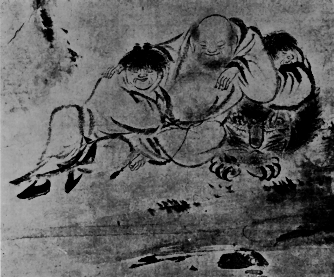
The poet we know as Han-shan (“Cold Mountain” or “Cold Cliff”) and his friend Shih-te (“The Foundling”) may be myths, though I like Watson’s description of them in his introduction – “two grotesque little men guffawing in the wilderness.” If they lived, it was in the eighth century A.D., in the mountains along the seacoast in the northeastern corner of Chekiang Province, south of the Bay of Hangchow. How pleased I was to discover myself in a poem attributed to a poet who may or may not have existed. In the poem numbered “10” by Watson is a description of a life similar to my own but exaggerated for comic effect:
“Here we languish, a bunch of poor scholars,
Battered by extremes of hunger and cold.
Out of work, our only joy is poetry:
Scribble, scribble, we wear out our brains.
Who will read the works of such men?
On that point you can save your sighs.
We could inscribe our poems on biscuits
And homeless dogs wouldn't deign to nibble.”
He might be talking about bloggers. The final lines remind me of the old Stanley Brothers song “False-Hearted Lover Blues”:
“They'll bite the hand that feeds them
Spend all the money you can save
From your heart strings weave silk garters
Build a dog house on your grave.”
Less ridiculously, Han-shan’s poem reminds me of many passages in the poems and ficciones of Borges and the essays and letters of Charles Lamb. In “The Superannuated Man” (collected in The Last Essays of Elia), the latter writes:
“If Time were troublesome, I could read it away, but I do not read in that violent measure, with which, having no Time my own but candle-light Time, I used to weary out my head and eyesight in by-gone winters. I walk, read or scribble (as now) just when the fit seizes me. I no longer hunt after pleasure; I let it come to me.”
Sunday, October 18, 2009
`The Ragweed of Covetousness'
In 1962, Time Inc., parent corporation of Time magazine, launched the Time Reading Program, inexpensive reissues of books, eventually almost 100 titles, some of literary worth. One can hardly imagine a news magazine sponsoring such an endeavor today. In these editions, with their kitschy cover art, I first read Nabokov’s Bend Sinister, Eric Hoffer’s The True Believers, Marquand’s The Late George Apley and J.F. Powers’ Lions, Hearts, Leaping Does and Other Stories. Many of the volumes came with new introductions by the author or an admirer. Nabokov was in classic ornery form when he wrote:
“There exist few things more tedious than a discussion of general ideas inflicted by author or reader upon a work of fiction. The purpose of this foreword is not to show that Bend Sinister belongs or does not belong to `serious literature’ (which is a euphemism for the hollow profundity and the ever-welcome commonplace). I have never been interested in what is called the literature of social comment (in journalistic and commercial parlance: `great books’). I am not `sincere.’ I am not `provocative,’ I am not `satirical.’”
The Powers volume is a selection of his stories about Roman Catholic priests in the Midwest culled from two earlier collections, Prince of Darkness (1947) and The Presence of Grace (1956). I’m not certain I concur with Joseph Bottum in First Things --
“The finest Catholic writer of the twentieth century was also, in some very important way, a failure. Who now reads J.F. Powers?”
-- but I suspect Powers may have been the century’s finest American writer of short stories, better even than his coreligionist Flannery O’Connor. Such distinctions are less significant than the fact that readers have so many contenders to choose from.
The introduction to Lions, Harts, Etc. was written by another forgotten writer, one also very funny, interested in religion and associated with The New Yorker – Peter De Vries (about whom Nige has written enthusiastically). De Vries disputes Evelyn Waugh’s claim that Powers’ “whole art is everywhere infused and directed by his Faith.” Instead, he argues that “religion is not the portrait that Mr. Powers paints; it is the frame for the portrait.” The dispute is pointless. One need not be a Catholic or a believer of any species to love and admire Powers’ art. Few writers are funnier (not even De Vries).
Let me cite an example from his first novel, Morte D’Urban (1962), which I reread this week. About midway through the book, Father Urban, already banished to Minnesota, is temporarily assigned to a rural parish. In Chicago, he was a popular speaker and minor media celebrity. Now, for the first time, from the pulpit of rural St. Monica’s, we hear him deliver a sermon. He calls God “the Great Cartographer” who alone knows the “`true nature of the spiritual universe that is this parish, of the little world that is your soul’”:
“`…as a priest, one of God’s poor surveyors, I beg you keep your rivers and lakes unpolluted. If swamps there be, drain them, for God’s sake and yours, and do not wait. Where swamps were before, let there be gardens and orchards. Gardens and orchards and parks! How does your garden grow? With the silverbells and cockleshells of faith, hope, and charity? Rid yours gardens of the ragweed of covetousness, the dandelions of pride, the crabgrass of indifference! And clear your orchards of the rusty tin cans and broken glass of avarice, the old rubber tires of self-indulgence! If necessary, plow up your gardens and orchards! Plant your gardens and orchards with the good seed and the green saplings of pious works, attendance at Holy Mass, regular confession, frequent reception of the Sacrament of Sacraments! Do these things, and leave the rest to God!”
Fulsome rhetoric is hardly confined to clerics or Catholics.
“There exist few things more tedious than a discussion of general ideas inflicted by author or reader upon a work of fiction. The purpose of this foreword is not to show that Bend Sinister belongs or does not belong to `serious literature’ (which is a euphemism for the hollow profundity and the ever-welcome commonplace). I have never been interested in what is called the literature of social comment (in journalistic and commercial parlance: `great books’). I am not `sincere.’ I am not `provocative,’ I am not `satirical.’”
The Powers volume is a selection of his stories about Roman Catholic priests in the Midwest culled from two earlier collections, Prince of Darkness (1947) and The Presence of Grace (1956). I’m not certain I concur with Joseph Bottum in First Things --
“The finest Catholic writer of the twentieth century was also, in some very important way, a failure. Who now reads J.F. Powers?”
-- but I suspect Powers may have been the century’s finest American writer of short stories, better even than his coreligionist Flannery O’Connor. Such distinctions are less significant than the fact that readers have so many contenders to choose from.
The introduction to Lions, Harts, Etc. was written by another forgotten writer, one also very funny, interested in religion and associated with The New Yorker – Peter De Vries (about whom Nige has written enthusiastically). De Vries disputes Evelyn Waugh’s claim that Powers’ “whole art is everywhere infused and directed by his Faith.” Instead, he argues that “religion is not the portrait that Mr. Powers paints; it is the frame for the portrait.” The dispute is pointless. One need not be a Catholic or a believer of any species to love and admire Powers’ art. Few writers are funnier (not even De Vries).
Let me cite an example from his first novel, Morte D’Urban (1962), which I reread this week. About midway through the book, Father Urban, already banished to Minnesota, is temporarily assigned to a rural parish. In Chicago, he was a popular speaker and minor media celebrity. Now, for the first time, from the pulpit of rural St. Monica’s, we hear him deliver a sermon. He calls God “the Great Cartographer” who alone knows the “`true nature of the spiritual universe that is this parish, of the little world that is your soul’”:
“`…as a priest, one of God’s poor surveyors, I beg you keep your rivers and lakes unpolluted. If swamps there be, drain them, for God’s sake and yours, and do not wait. Where swamps were before, let there be gardens and orchards. Gardens and orchards and parks! How does your garden grow? With the silverbells and cockleshells of faith, hope, and charity? Rid yours gardens of the ragweed of covetousness, the dandelions of pride, the crabgrass of indifference! And clear your orchards of the rusty tin cans and broken glass of avarice, the old rubber tires of self-indulgence! If necessary, plow up your gardens and orchards! Plant your gardens and orchards with the good seed and the green saplings of pious works, attendance at Holy Mass, regular confession, frequent reception of the Sacrament of Sacraments! Do these things, and leave the rest to God!”
Fulsome rhetoric is hardly confined to clerics or Catholics.
Saturday, October 17, 2009
`An Early, Innocent Lust'
“The barbed-wire fences rust
As their cedar uprights blacken
After a night of rain.
Some early, innocent lust
Gets me outdoors to smell
The teasle, the pelted bracken,
The cold, mossed-over well,
Rank with its iron chain…”
Rain falls after months of near-drought. Dust is mud, grass is green, leaves decoupage sidewalks. In the courtyard of the grade school where I worked Friday, two crows harvested shiny green grass, buffered from kids and competition. On the way home, waiting for the light, I saw last summer’s teasle, now brown, growing along the guard rail, wet and swaying in the rain, and I thought of the opening lines, quoted above, of Anthony Hecht’s “After the Rain” (collected in Millions of Strange Shadows, 1977).
Teasle, sometimes spelled teasel, from the Old English tæsel -- “large thistle used in teasing cloth.” “To tease” means “to disturb or annoy by persistent irritating or provoking action” -- the fourth definition in Webster’s Third. The first is “to disentangle and lay parallel by combing or carding.” Girls I knew in junior high school teased their bouffants into cotton candy, teasing the boys.
The wind, rain and low skies are a strip tease, a stripping away of the year's inessentials. I saw my name in print for the first time as a high-school sophomore. An English teacher submitted one of my essays, "November," to the school literary magazine, Lit Bits. I described the sky as “pewter-colored” and aped Thomas Wolfe’s prose. Here is the final stanza of “After the Rain”:
“Yet what puzzles me the most
Is my unwavering taste
For these dim, weathery ghosts,
And how, from the very first,
An early, innocent lust
Delighted in such wastes,
Sought with a reckless thirst
A light so pure and just.”
As their cedar uprights blacken
After a night of rain.
Some early, innocent lust
Gets me outdoors to smell
The teasle, the pelted bracken,
The cold, mossed-over well,
Rank with its iron chain…”
Rain falls after months of near-drought. Dust is mud, grass is green, leaves decoupage sidewalks. In the courtyard of the grade school where I worked Friday, two crows harvested shiny green grass, buffered from kids and competition. On the way home, waiting for the light, I saw last summer’s teasle, now brown, growing along the guard rail, wet and swaying in the rain, and I thought of the opening lines, quoted above, of Anthony Hecht’s “After the Rain” (collected in Millions of Strange Shadows, 1977).
Teasle, sometimes spelled teasel, from the Old English tæsel -- “large thistle used in teasing cloth.” “To tease” means “to disturb or annoy by persistent irritating or provoking action” -- the fourth definition in Webster’s Third. The first is “to disentangle and lay parallel by combing or carding.” Girls I knew in junior high school teased their bouffants into cotton candy, teasing the boys.
The wind, rain and low skies are a strip tease, a stripping away of the year's inessentials. I saw my name in print for the first time as a high-school sophomore. An English teacher submitted one of my essays, "November," to the school literary magazine, Lit Bits. I described the sky as “pewter-colored” and aped Thomas Wolfe’s prose. Here is the final stanza of “After the Rain”:
“Yet what puzzles me the most
Is my unwavering taste
For these dim, weathery ghosts,
And how, from the very first,
An early, innocent lust
Delighted in such wastes,
Sought with a reckless thirst
A light so pure and just.”
Friday, October 16, 2009
`Trying to Get Interested in the Trees'
Like any simulation of noble savagery by members of the middle-class, nature mysticism is always an amusing spectacle. I was led to this site by its misguided reference to Thomas Traherne’s Centuries of Meditation. The author also refers to that well-known spiritual adept Lord Byron:
“The words of Byron express the oneness with nature, which has, since Rousseau, been the obsession of nature mystics: `I live not in myself, but I became a portion of all around me, and to me high mountains are a feeling...’”
No, high mountains are very large rocks. When poets go slumming in nature they tend to turn into windbags. The phrase “oneness with nature” reminds me of the old joke:
Q: “What did the Buddhist say to the hot dog vendor?”
A: “Make me one with everything.”
Few writers are so densely ironic and deeply funny as the late J.F. Powers. His wit was not a matter of verbal pyrotechnics. His prose is colloquial, precise and highly polished, and he’s often mistaken for a satirist. I’ve asked this question before but never received a satisfactory explanation: Why are so many of the funniest fiction writers – Joyce, Waugh, Flann O’Brien, Flannery O’Connor, Powers – Roman Catholic?
I’m rereading the first of Powers’ two novels, Morte D’Urban, published in 1962. Father Urban, a sort of Babbitt-as-Roman-Catholic-priest, has been exiled from Chicago to the frozen prairies of Minnesota. Shortly after his arrival he tours the grounds of the former sanitarium occupied by the Order of St. Clement:
“Later that afternoon, he pulled himself together and took a walk around the grounds, keeping an eye out for wildlife (and seeing none), and trying to get interested in the trees, which were numerous. They could be broken down into three main groups, red oaks, evergreens, and trees. Here his investigations ended, on account of the cold.”
Out of boredom and hurt pride, Father Urban, no mystic, briefly seeks solace in nature. What he gets instead is a head cold and a lecture on long underwear.
“The words of Byron express the oneness with nature, which has, since Rousseau, been the obsession of nature mystics: `I live not in myself, but I became a portion of all around me, and to me high mountains are a feeling...’”
No, high mountains are very large rocks. When poets go slumming in nature they tend to turn into windbags. The phrase “oneness with nature” reminds me of the old joke:
Q: “What did the Buddhist say to the hot dog vendor?”
A: “Make me one with everything.”
Few writers are so densely ironic and deeply funny as the late J.F. Powers. His wit was not a matter of verbal pyrotechnics. His prose is colloquial, precise and highly polished, and he’s often mistaken for a satirist. I’ve asked this question before but never received a satisfactory explanation: Why are so many of the funniest fiction writers – Joyce, Waugh, Flann O’Brien, Flannery O’Connor, Powers – Roman Catholic?
I’m rereading the first of Powers’ two novels, Morte D’Urban, published in 1962. Father Urban, a sort of Babbitt-as-Roman-Catholic-priest, has been exiled from Chicago to the frozen prairies of Minnesota. Shortly after his arrival he tours the grounds of the former sanitarium occupied by the Order of St. Clement:
“Later that afternoon, he pulled himself together and took a walk around the grounds, keeping an eye out for wildlife (and seeing none), and trying to get interested in the trees, which were numerous. They could be broken down into three main groups, red oaks, evergreens, and trees. Here his investigations ended, on account of the cold.”
Out of boredom and hurt pride, Father Urban, no mystic, briefly seeks solace in nature. What he gets instead is a head cold and a lecture on long underwear.
Thursday, October 15, 2009
`The Miracle of a Few Written Signs'
I've been working with a woman in a high school special-education class whose favorite novel is Harper Lee’s To Kill a Mockingbird. She’s read it many times, knows the movie by heart and as a student had a minor role in her high school’s production of the play. She’s been reading the book aloud, a few pages daily, to our students. Some are attentive, at least periodically. For others, she might as well be reading the phone book. Though sincere, she’s not a good reader, alternately droning and shrill, and makes no effort to simulate an Alabama drawl or differentiate characters’ voices.
On Tuesday, even more short-staffed than usual, she asked me to take over reading duties. I’m a ham about reading aloud, mostly because I find dull, indifferent reading unbearable. Though I don’t like the novel, and find the narrator’s faux-naïve voice irritating, I tried to read enthusiastically and with humor. The kids seemed more interested than usual, less distracted, and I got to pronounce a word I love to say – scuppernong. Lunch was approaching and not wanting to interrupt the reading I glanced at a supervisor who gave me the “keep going” signal. I went on for another 10 minutes or so and started to feel like Atticus Finch or at least Gregory Peck.
Two staff members complimented the performance, though one of them, a nurse, said something baffling: “Of course, you were a journalist so you know how to read good.” After lunch, one of the students said, “I like the way you read. I like that little girl [the narrator, six-year-old Scout Finch].”
Lee published To Kill a Mockingbird in 1960. I happened to be rereading a very different sort of novel published two years later – Nabokov’s Pale Fire. Rereading it is always an exercise in undiluted pleasure. Late in the novel, in a note to line 991 of John Shade’s poem ("Somewhere horseshoes are being tossed. Click, Clunk."), mad Charles Kinbote, some of whose strong opinions he shares with his creator, writes:
“We are absurdly accustomed to the miracle of a few written signs being able to contain immortal imagery, involutions of thought, new worlds with live people, speaking, weeping, laughing. We take it for granted so simply that in a sense, by the very act of brutish routine acceptance, we undo the work of the ages, the history of the gradual elaboration of poetical description and construction, from the treeman to Browning, from the caveman to Keats. What if we awake one day, all of us, and find ourselves utterly unable to read? I wish you to gasp not only at what you read but at the miracle of its being readable (so I used to tell my students).”
On Tuesday, even more short-staffed than usual, she asked me to take over reading duties. I’m a ham about reading aloud, mostly because I find dull, indifferent reading unbearable. Though I don’t like the novel, and find the narrator’s faux-naïve voice irritating, I tried to read enthusiastically and with humor. The kids seemed more interested than usual, less distracted, and I got to pronounce a word I love to say – scuppernong. Lunch was approaching and not wanting to interrupt the reading I glanced at a supervisor who gave me the “keep going” signal. I went on for another 10 minutes or so and started to feel like Atticus Finch or at least Gregory Peck.
Two staff members complimented the performance, though one of them, a nurse, said something baffling: “Of course, you were a journalist so you know how to read good.” After lunch, one of the students said, “I like the way you read. I like that little girl [the narrator, six-year-old Scout Finch].”
Lee published To Kill a Mockingbird in 1960. I happened to be rereading a very different sort of novel published two years later – Nabokov’s Pale Fire. Rereading it is always an exercise in undiluted pleasure. Late in the novel, in a note to line 991 of John Shade’s poem ("Somewhere horseshoes are being tossed. Click, Clunk."), mad Charles Kinbote, some of whose strong opinions he shares with his creator, writes:
“We are absurdly accustomed to the miracle of a few written signs being able to contain immortal imagery, involutions of thought, new worlds with live people, speaking, weeping, laughing. We take it for granted so simply that in a sense, by the very act of brutish routine acceptance, we undo the work of the ages, the history of the gradual elaboration of poetical description and construction, from the treeman to Browning, from the caveman to Keats. What if we awake one day, all of us, and find ourselves utterly unable to read? I wish you to gasp not only at what you read but at the miracle of its being readable (so I used to tell my students).”
Wednesday, October 14, 2009
`Because They Can't Help Themselves'
Randall Jarrell was that rarest of mutations -- a critic one reads for pleasure. His poetry, I regret saying after decades of readerly devotion, is mostly dull but many of his essays and reviews remain incisive and funny. Best known for the gleeful savagery of his negative reviews, he was more influentially a generous celebrator who championed the reputations of Whitman, Kipling, Frost, Moore, Stevens, Auden, Bishop, Lowell and Stead, often when their critical reputations were ebbing or ebbed. One of my favorite passages – call it a hymn of praise – is from “Some Lines from Whitman.” It follows a selection from “Song of Myself”:
''There are faults in this passage, and they do not matter: the serious truth, the complete realization of these last lines make us remember that few poets have shown more of the tears of things, and the joy of things, and of the reality beneath either tears or joy.''
One of Jarrell’s unremarked strengths as a critic is his willingness to stand speechless before work that pleases him. Sometimes excellence is self-evident. To push the issue seems vulgar. It’s enough to shake your head and whisper, “Look at that, will you?” As he writes of Moore: “It might be better to say…`Words fail me, my lords,’ and to go through [Moore’s poems] pointing.”
If a reader were to ask, “Are there any critics you trust?” I would send him to No Other Book: Selected Essays, the Jarrell collection edited 10 years ago by Brad Leithauser. All the best pieces are included. I can’t think of another critical work at once so reliable and laugh-out-loud funny. In his most recent collection of critical essays and reviews, Our Savage Art: Poetry and the Civil Tongue, William Logan – our Jarrell -- admits wanting to channel the poet-critic’s spirit:
“Critics get things wrong all the time; if a critic ever suffered insomnia, it would be because he had dismissed the Emily Dickinson of his day. Yet critics know the future may pluck up some writer they think a nonentity and say, `Here, here, the critics were blind to genius!’ Randall Jarrell said something similar fifty years ago, but Randall Jarrell often said fifty years ago the very things I want to say about poetry now.”
Forty-four years ago today, Jarrell, age 51, was struck and killed by an automobile as he walked at dusk along a highway near Chapel Hill, N.C. His biographer, William Pritchard, believes the death was not a suicide. Others, including his old friend Robert Lowell, were convinced it was, and the reality of what happened that night probably will never be inarguably known. As readers, we’re left with the enthusiasm of Jarrell’s best prose, including his novel Pictures from an Institution. When demoralized by the state of literature, the preponderance of dreary poems and fiction beyond resuscitation, Jarrell is my cheerleader. Or rather, as in his introduction to Stead’s The Man Who Loved Children, he is literature’s cheerleader:
“As Wordsworth and Proust say, a good enough book in the long run makes its own readers, people who believe in it because they can’t help themselves.”
''There are faults in this passage, and they do not matter: the serious truth, the complete realization of these last lines make us remember that few poets have shown more of the tears of things, and the joy of things, and of the reality beneath either tears or joy.''
One of Jarrell’s unremarked strengths as a critic is his willingness to stand speechless before work that pleases him. Sometimes excellence is self-evident. To push the issue seems vulgar. It’s enough to shake your head and whisper, “Look at that, will you?” As he writes of Moore: “It might be better to say…`Words fail me, my lords,’ and to go through [Moore’s poems] pointing.”
If a reader were to ask, “Are there any critics you trust?” I would send him to No Other Book: Selected Essays, the Jarrell collection edited 10 years ago by Brad Leithauser. All the best pieces are included. I can’t think of another critical work at once so reliable and laugh-out-loud funny. In his most recent collection of critical essays and reviews, Our Savage Art: Poetry and the Civil Tongue, William Logan – our Jarrell -- admits wanting to channel the poet-critic’s spirit:
“Critics get things wrong all the time; if a critic ever suffered insomnia, it would be because he had dismissed the Emily Dickinson of his day. Yet critics know the future may pluck up some writer they think a nonentity and say, `Here, here, the critics were blind to genius!’ Randall Jarrell said something similar fifty years ago, but Randall Jarrell often said fifty years ago the very things I want to say about poetry now.”
Forty-four years ago today, Jarrell, age 51, was struck and killed by an automobile as he walked at dusk along a highway near Chapel Hill, N.C. His biographer, William Pritchard, believes the death was not a suicide. Others, including his old friend Robert Lowell, were convinced it was, and the reality of what happened that night probably will never be inarguably known. As readers, we’re left with the enthusiasm of Jarrell’s best prose, including his novel Pictures from an Institution. When demoralized by the state of literature, the preponderance of dreary poems and fiction beyond resuscitation, Jarrell is my cheerleader. Or rather, as in his introduction to Stead’s The Man Who Loved Children, he is literature’s cheerleader:
“As Wordsworth and Proust say, a good enough book in the long run makes its own readers, people who believe in it because they can’t help themselves.”
Tuesday, October 13, 2009
`But I Have Read a Great Deal'
A paragraph from the “Epilogue” to his 1960 prose/poetry hybrid, The Maker (El hacedor), ranks among Jorge Luis Borges’ best-known productions:
“A man sets himself the task of portraying the world. Over the years he fills a given surface with images of provinces and kingdoms, mountains, bays, ships, islands, fish, rooms, instruments, heavenly bodies, horses, and people. Shortly before he dies he discovers that his patient labyrinth of lines is a drawing of his own face.”
The most compelling self-portraits – Keats in his letters, Thoreau in his journal, Chekhov in nearly everything he wrote – are inadvertent, beside-the-point. They begin as chronicles of the world (or a world) and end as revelations of personality – but remain chronicles of the world. Most formal memoirs or autobiographies have the stagey stiffness of a police mug shot and feel ghost-written even when they are not. Self-consciousness muffles self-revelation. Forgotten is the sentence by Borges that precedes the passage quoted above:
“Little has happened in my life, but I have read a great deal, which is to say I have found few things more memorable than Schopenhauer’s ideas and the verbal music of England.”
That is the most complete and attractive one-sentence autobiography I know.
“A man sets himself the task of portraying the world. Over the years he fills a given surface with images of provinces and kingdoms, mountains, bays, ships, islands, fish, rooms, instruments, heavenly bodies, horses, and people. Shortly before he dies he discovers that his patient labyrinth of lines is a drawing of his own face.”
The most compelling self-portraits – Keats in his letters, Thoreau in his journal, Chekhov in nearly everything he wrote – are inadvertent, beside-the-point. They begin as chronicles of the world (or a world) and end as revelations of personality – but remain chronicles of the world. Most formal memoirs or autobiographies have the stagey stiffness of a police mug shot and feel ghost-written even when they are not. Self-consciousness muffles self-revelation. Forgotten is the sentence by Borges that precedes the passage quoted above:
“Little has happened in my life, but I have read a great deal, which is to say I have found few things more memorable than Schopenhauer’s ideas and the verbal music of England.”
That is the most complete and attractive one-sentence autobiography I know.
Monday, October 12, 2009
`A Swatch of Consequence the Mind Weaves'
My first word-association with the verb “to glean” is not literary but artistic – Millet’s The Gleaners. I think of gleaning as culling the choice from the mediocre, gold from the dross, and vaguely associate it, perhaps because of Millet’s painting, with agriculture. The Online Etymological Dictionary confirms the linkage:
“c.1330, from O.Fr. glener, from L.L. glennare `make a collection,’ from Gaulish (cf. O.Ir. do-glinn `he collects, gathers,’ Celt. glan `clean, pure’). Figurative sense was earlier in Eng. than the literal one of `gather grain left by the reapers’ (c.1385).”
I happened upon a young poet new to me, Morri Creech, and his 2006 collection Field Knowledge. His verse is formal and luxuriant, like the late Anthony Hecht’s, without being fulsome. The final poem in the book, dedicated to Creech’s daughter Hattie, is “Gleanings”:
“To see them for what they are, not to make
more of them than the afternoon allows:
starlings among the sweet gum limbs, a rake
propped beneath those leaves the wind will take,
my child gathering feathers beside the house –
a sleight of season, when some moment scatters
its riches across the lawn. Nothing to do
with dates or futures and, I’d guess, small matter
in the year’s turning.
“But I remember, too,
a thousand starlings in my father’s yard,
his Chevy in the drive, a smell of leaves
clear as the feather in my daughter’s hand –
a swatch of consequence the mind weaves
from history and chance, so that it’s hard,
watching it all, not to construe some meaning
from starling, rake, limb, leaf, the child who stands
gathering feathers beneath the shade of wings.”
I sense in Creech the urge to paint a still life with materials – objects, people, memories – that refuse to remain still. Life is motion; art, stasis (or simulated motion). Thus, that lovely line: “a swatch of consequence the mind weaves / from history and chance.” And he’s right: From such things, inconsequential and precious, we strive “to construe some meaning.” How will Creech, who is 39, read this poem in the future when his daughter is a woman, perhaps a mother?
Writing and reading are acts of gleaning. On the day I read Creech’s poem, two readers independently suggested poems by Thomas Hardy. I pulled out the Bible concordance-sized Complete Poems, read them (“The Darkling Thrush,” “I Looked Up from My Writing”) and browsed amidst the bounty (947 poems, 954 pages). It’s tough to stop reading Hardy’s poems (unlike his fiction) once you’ve started. I enjoyed his villanelle, “The Caged Thrush Freed and Home Again,” and found these central stanzas in his six-stanza poem:
“`When I was borne from yonder tree
In bonds to them, I hoped to glean
How happy days are made to be,
“`And want and wailing turned to glee;
Alas, despite their mighty mien
Men know but little more than we!’”
“c.1330, from O.Fr. glener, from L.L. glennare `make a collection,’ from Gaulish (cf. O.Ir. do-glinn `he collects, gathers,’ Celt. glan `clean, pure’). Figurative sense was earlier in Eng. than the literal one of `gather grain left by the reapers’ (c.1385).”
I happened upon a young poet new to me, Morri Creech, and his 2006 collection Field Knowledge. His verse is formal and luxuriant, like the late Anthony Hecht’s, without being fulsome. The final poem in the book, dedicated to Creech’s daughter Hattie, is “Gleanings”:
“To see them for what they are, not to make
more of them than the afternoon allows:
starlings among the sweet gum limbs, a rake
propped beneath those leaves the wind will take,
my child gathering feathers beside the house –
a sleight of season, when some moment scatters
its riches across the lawn. Nothing to do
with dates or futures and, I’d guess, small matter
in the year’s turning.
“But I remember, too,
a thousand starlings in my father’s yard,
his Chevy in the drive, a smell of leaves
clear as the feather in my daughter’s hand –
a swatch of consequence the mind weaves
from history and chance, so that it’s hard,
watching it all, not to construe some meaning
from starling, rake, limb, leaf, the child who stands
gathering feathers beneath the shade of wings.”
I sense in Creech the urge to paint a still life with materials – objects, people, memories – that refuse to remain still. Life is motion; art, stasis (or simulated motion). Thus, that lovely line: “a swatch of consequence the mind weaves / from history and chance.” And he’s right: From such things, inconsequential and precious, we strive “to construe some meaning.” How will Creech, who is 39, read this poem in the future when his daughter is a woman, perhaps a mother?
Writing and reading are acts of gleaning. On the day I read Creech’s poem, two readers independently suggested poems by Thomas Hardy. I pulled out the Bible concordance-sized Complete Poems, read them (“The Darkling Thrush,” “I Looked Up from My Writing”) and browsed amidst the bounty (947 poems, 954 pages). It’s tough to stop reading Hardy’s poems (unlike his fiction) once you’ve started. I enjoyed his villanelle, “The Caged Thrush Freed and Home Again,” and found these central stanzas in his six-stanza poem:
“`When I was borne from yonder tree
In bonds to them, I hoped to glean
How happy days are made to be,
“`And want and wailing turned to glee;
Alas, despite their mighty mien
Men know but little more than we!’”
Sunday, October 11, 2009
`Coraggio'
William Villacella, The Maverick Philosopher, titles one of his recent posts with a beautiful Italian word – “Coraggio.” That is, courage, bravery, valor. Villacella’s post is comparably pithy:
“One can always get through one day to the next — except for one day. And one will get through that one too.”
Some readers may say: “Did you really have to remind me?” Others: “True enough. Carry on.” I thought of Philip Larkin’s “Aubade,” first published in the Times Literary Supplement in time for Christmas, on Dec. 23, 1977. The daily-ness of death, death as its own memento mori, is sounded in the first stanza:
“Unresting death, a whole day nearer now,
Making all thought impossible but how
And where and when I shall myself die.”
I had forgotten that Larkin addresses coraggio directly in the poem:
“Courage is no good:
It means not scaring others. Being brave
Lets no one off the grave.
Death is no different whined at than withstood.”
Sometimes memory unwraps like a botched Christmas present, too much paper and tape: I remembered Vallicella had sniffed at Larkin’s “boozy self-indulgence” in “Aubade.” He’s mistaken to think Larkin a nihilist. I hear regret, not glee, in his words, as in the final stanza of “Church Going”:
“A serious house on serious earth it is,
In whose blent air all our compulsions meet,
Are recognized, and robed as destinies.
And that much never can be obsolete,
Since someone will forever be surprising
A hunger in himself to be more serious,
And gravitating with it to this ground,
Which, he once heard, was proper to grow wise in,
If only that so many dead lie round.”
“One can always get through one day to the next — except for one day. And one will get through that one too.”
Some readers may say: “Did you really have to remind me?” Others: “True enough. Carry on.” I thought of Philip Larkin’s “Aubade,” first published in the Times Literary Supplement in time for Christmas, on Dec. 23, 1977. The daily-ness of death, death as its own memento mori, is sounded in the first stanza:
“Unresting death, a whole day nearer now,
Making all thought impossible but how
And where and when I shall myself die.”
I had forgotten that Larkin addresses coraggio directly in the poem:
“Courage is no good:
It means not scaring others. Being brave
Lets no one off the grave.
Death is no different whined at than withstood.”
Sometimes memory unwraps like a botched Christmas present, too much paper and tape: I remembered Vallicella had sniffed at Larkin’s “boozy self-indulgence” in “Aubade.” He’s mistaken to think Larkin a nihilist. I hear regret, not glee, in his words, as in the final stanza of “Church Going”:
“A serious house on serious earth it is,
In whose blent air all our compulsions meet,
Are recognized, and robed as destinies.
And that much never can be obsolete,
Since someone will forever be surprising
A hunger in himself to be more serious,
And gravitating with it to this ground,
Which, he once heard, was proper to grow wise in,
If only that so many dead lie round.”
Saturday, October 10, 2009
`Simple, Homely, True and Tender'
Without realizing it I inherited, without question, the arrogance of Modernism. Pound, Eliot and Joyce represented uncontested victories over – what? Sentimentality, vagueness and verbal effusion, I suppose. There’s something to this, of course, and the latter two writers remain among those I most respect, but I disposed of too many novels and poems, unexamined, in the process. Why can’t I enjoy Tennyson and a hundred other poets whose work I dismissed, when young, impressionable and less literate than I thought, as fossils?
In the January 1951 issue of Poetry, Elizabeth Bishop reviewed Come Hither: A Collection of Rhymes and Poems for the Young of All Ages. First published in 1923 (one year after Ulysses and The Waste Land), the anthology was edited by Walter de la Mare (1873-1956), the English poet, novelist and writer for children. Bishop opens her review with a declaration of quietly unfashionable defiance:
“Although much of the poetry I happen to admire is not to be found in it, I shall think this is the best anthology I know of.”
I had never touched Come Hither before reading Bishop’s review, collected in Poems, Prose, and Letters. There’s a quaintness to de la Mare’s selection, to the introduction – Bishop calls it “a de la Mareish allegorical account of how he discovered poetry as a boy” – and to the woodblock engravings at the head of each chapter, that may be off-putting at first even to readers of good will. It’s a book for children, but the sort of children they hardly make anymore. Best of all are de la Mare’s notes, almost 300 pages of them, included at the back of the book in a section called “About and Round About.” Of the notes, Bishop writes
“…the book is well worth buying for them alone. It is a Luna Park of stray and straying information. He quotes journals, letters, samplers, gravestones, and his friends; then throws in a few recipes.”
It’s a ragbag of enthusiastic learning. De la Mare, for example, includes in the chapter titled “Mother, Home and Sweetheart” two poems by William Cowper, “Lines on Receiving His Mother’s Picture” and “The Poplar-Field.” I’ve rediscovered Cowper in recent months and read him often. The copse of poplars behind the house where I grew up is now a grove of rotting stumps overshadowed by hardwoods that were saplings half a century ago. I miss seeing the poplar’s buttery yellow leaves in October. Here’s Cowper’s poem:
“The poplars are fell'd, farewell to the shade
And the whispering sound of the cool colonnade,
The winds play no longer, and sing in the leaves,
Nor Ouse on his bosom their image receives.
“Twelve years have elaps'd since I first took a view
Of my favourite field and the bank where they grew,
And now in the grass behold they are laid,
And the tree is my seat that once lent me a shade.
“The blackbird has fled to another retreat
Where the hazels afford him a screen from the heat,
And the scene where his melody charm'd me before,
Resounds with his sweet-flowing ditty no more.
“My fugitive years are all hasting away,
And I must ere long lie as lowly as they,
With a turf on my breast, and a stone at my head,
Ere another such grove shall arise in its stead.
“'Tis a sight to engage me, if any thing can,
To muse on the perishing pleasures of man;
Though his life be a dream, his enjoyments, I see,
Have a being less durable even than he.”
A conventional English poem for the 18th century, with intimations of the Romantics soon to arrive. The syntax is relaxed, discursive, almost conversational. “My fugitive years” is memorable, a glimpse of Cowper the troubled soul. The final stanza reads powerfully for any reader who accepts that more than half his life has been lived. Here’s what de la Mare writes in his notes to the poem:
“The first and third stanzas of this poem were (and are) my particular favourites, and especially the second line in each. Such poems are like wayside pools, or little well-springs of water. It does not matter how many wayfarers come thither to quench their thirst, there is abundance for all.
“The craftsmanship of the poem seems simplicity itself. But the closer we examine it the more clearly we see the intricate devices that are responsible for its triumph. To express truth, and to express one’s heart, need extreme care and skill – though the intense wish to do so may supply them almost without effort.
“Listen here to the lingering chime of the vowels: `Nor Ouse on his bosom,’ `The poplars are felled; farewell’; to the echoing of retreat, screen, heat, scene, sweet of the third stanza. How delightful throughout is the ease to throat and ear, to mind and spirit, effected by the interweaving alliteration of the f’s and v’s – felled, farewell, faint, field fled, afford, before, fugitive, fading away at last in turf, if, life, grove and even. The z’s too and the m’s – melody charmed me – and finally the dream and durable in the last stanza.
“Not that this particular poem is either profound, subtle, or elaborate. It is simple, homely, true and tender. But it could not have proved itself so (and particularly in this particular metre) if the words, which are its all, had been clumsily put together, ill-matched, and art-less.”
There’s little to argue with here, unless our supposed sophistication gets in the way. A poem is not a war with past or future poems. Sometimes we’re too sophisticated for our own pleasure.
In the January 1951 issue of Poetry, Elizabeth Bishop reviewed Come Hither: A Collection of Rhymes and Poems for the Young of All Ages. First published in 1923 (one year after Ulysses and The Waste Land), the anthology was edited by Walter de la Mare (1873-1956), the English poet, novelist and writer for children. Bishop opens her review with a declaration of quietly unfashionable defiance:
“Although much of the poetry I happen to admire is not to be found in it, I shall think this is the best anthology I know of.”
I had never touched Come Hither before reading Bishop’s review, collected in Poems, Prose, and Letters. There’s a quaintness to de la Mare’s selection, to the introduction – Bishop calls it “a de la Mareish allegorical account of how he discovered poetry as a boy” – and to the woodblock engravings at the head of each chapter, that may be off-putting at first even to readers of good will. It’s a book for children, but the sort of children they hardly make anymore. Best of all are de la Mare’s notes, almost 300 pages of them, included at the back of the book in a section called “About and Round About.” Of the notes, Bishop writes
“…the book is well worth buying for them alone. It is a Luna Park of stray and straying information. He quotes journals, letters, samplers, gravestones, and his friends; then throws in a few recipes.”
It’s a ragbag of enthusiastic learning. De la Mare, for example, includes in the chapter titled “Mother, Home and Sweetheart” two poems by William Cowper, “Lines on Receiving His Mother’s Picture” and “The Poplar-Field.” I’ve rediscovered Cowper in recent months and read him often. The copse of poplars behind the house where I grew up is now a grove of rotting stumps overshadowed by hardwoods that were saplings half a century ago. I miss seeing the poplar’s buttery yellow leaves in October. Here’s Cowper’s poem:
“The poplars are fell'd, farewell to the shade
And the whispering sound of the cool colonnade,
The winds play no longer, and sing in the leaves,
Nor Ouse on his bosom their image receives.
“Twelve years have elaps'd since I first took a view
Of my favourite field and the bank where they grew,
And now in the grass behold they are laid,
And the tree is my seat that once lent me a shade.
“The blackbird has fled to another retreat
Where the hazels afford him a screen from the heat,
And the scene where his melody charm'd me before,
Resounds with his sweet-flowing ditty no more.
“My fugitive years are all hasting away,
And I must ere long lie as lowly as they,
With a turf on my breast, and a stone at my head,
Ere another such grove shall arise in its stead.
“'Tis a sight to engage me, if any thing can,
To muse on the perishing pleasures of man;
Though his life be a dream, his enjoyments, I see,
Have a being less durable even than he.”
A conventional English poem for the 18th century, with intimations of the Romantics soon to arrive. The syntax is relaxed, discursive, almost conversational. “My fugitive years” is memorable, a glimpse of Cowper the troubled soul. The final stanza reads powerfully for any reader who accepts that more than half his life has been lived. Here’s what de la Mare writes in his notes to the poem:
“The first and third stanzas of this poem were (and are) my particular favourites, and especially the second line in each. Such poems are like wayside pools, or little well-springs of water. It does not matter how many wayfarers come thither to quench their thirst, there is abundance for all.
“The craftsmanship of the poem seems simplicity itself. But the closer we examine it the more clearly we see the intricate devices that are responsible for its triumph. To express truth, and to express one’s heart, need extreme care and skill – though the intense wish to do so may supply them almost without effort.
“Listen here to the lingering chime of the vowels: `Nor Ouse on his bosom,’ `The poplars are felled; farewell’; to the echoing of retreat, screen, heat, scene, sweet of the third stanza. How delightful throughout is the ease to throat and ear, to mind and spirit, effected by the interweaving alliteration of the f’s and v’s – felled, farewell, faint, field fled, afford, before, fugitive, fading away at last in turf, if, life, grove and even. The z’s too and the m’s – melody charmed me – and finally the dream and durable in the last stanza.
“Not that this particular poem is either profound, subtle, or elaborate. It is simple, homely, true and tender. But it could not have proved itself so (and particularly in this particular metre) if the words, which are its all, had been clumsily put together, ill-matched, and art-less.”
There’s little to argue with here, unless our supposed sophistication gets in the way. A poem is not a war with past or future poems. Sometimes we’re too sophisticated for our own pleasure.
Friday, October 09, 2009
Aldo Buzzi, R.I.P
Aldo Buzzi, born the year Twain and Tolstoy died, has joined them. The sad news comes from his translator and admirer, James Marcus at House of Mirth. I’m sorry for your loss, James, and ours. Now let's read his books.
`Speaking of Books'
On July 24, 1965, less than three months before his death, Randall Jarrell published “Speaking of Books,” ostensibly a list of suggestions for summer reading, in The New York Times Book Review. The essay, in fact, is a distillation of a life’s engagement with books. Read with the knowledge of Jarrell’s imminent death, it’s a poignant human document but we shouldn’t allow poignancy to diminish its worth as a paean to passionate reading:
“I have trouble knowing what to do at parties. Prisoners tame mice, or make rings out of spoons: I analyze people's handwriting -- Pierre Emmanuel taught me, saying: `It will help you’ -- or else ask you to tell me what you read when you were a child. (People speak unusually well of the books of their childhood, don't they? Or is this one more life-giving illusion?) I love to see a hard eye grow soft over Little Women, or The Black Arrow, or Grandma Elsie -- yes, Elsie Dinsmore became a grandmother. And, I've found, there's no children's book so bad that I mind your having liked it: about the tastes of dead children there is no disputing.”
Frustratingly, I remember few titles from my earliest reading years. I’ve salvaged a studio photograph of myself, in jumper and white high-tops, holding Baby Animal Friends. Was the book mine or a photographer’s prop? Some early titles: Blueberries for Sal and Paddle-to-the-Sea. Street Rod. The Hardy Boys and the Mystery of the Chinese Junk, A Child’s Garden of Verses. Edgar Rice Burroughs, American history, a biography of Davy Crockett, Jules Verne, field guides and books about the American presidents. A little later, Robinson Crusoe (allow me to recommend it still, and Elizabeth Bishop’s “Crusoe in England”), H.G. Wells, science fiction -- but in general I was a committed non-fiction man.
“The live grown-ups are different. Readers, real readers, are always telling other readers what to read; and according to what it is, they use a different tone -- they know that they are about to be judged. `Always speak your mind and base men will avoid you,’ Blake said. Always say what you like and readers who know what they should like will look at you silently and then tell you what you should like, too. Once I told a critic -- since he was standing in a railway station, wearing a cream-colored corduroy suit, he looked remarkably like that Disraeli-ish figure, dressed all in newspapers, whom you see in Through the Looking Glass -- about a wonderful novel named The Man Who Loved Children. (I've been getting people to read it for ten years, with the most dazzling results; so many have bought it for themselves that Simon & Schuster wrote one a letter, saying: `Would you be kind enough to tell us how you happened to order this particular book? In recent years there has been a small but steady demand for it.’ A sort of despairing contempt filled the critic's eyes, and he cried: `But -- but -- but that's absurd! That isn't a good novel, it couldn't be! I haven't read it, but I know the sort of author she is, and it couldn't be. Why, she's a Stalinist!’”
I hope I never tell anyone what to read. A highly regarded novel by a writer I admire came out last year and I bought a copy but still haven’t read it because so many people told me I had to. Jarrell’s advocacy for Stead’s novel (it was republished in 1965, 25 years after its first appearance, with his introduction) first moved me to read it. Stead was certainly, for periods of her life, a sui generis species of Marxist but you would never know that from reading The Man Who Loved Children (or Letty Fox: Her Luck, or House of All Nations, which I also recommend).
“This may have been a great injustice to Christina Stead, and it was a small injustice to me: if we jump on readers who recommend to us some unlikely thing they've liked, they get apologetic -- soon the gentler ones will only say to themselves softly, in bed that night: `I wish I'd told him about The Man Who Loved Children.' But there is a Pope in the breast of each of us whom it is hard to silence. Long ago a lady said to me, when I asked her the composers she liked: `Dvorak.’ I said before I could stop myself: `Dvorak!’ How many times, and with what shame, I've remembered it! And now I like Dvorak and Tchaikovsky and, even, the creator of the `Weihnachtsbaum,’ the `Vallee d'Obermann,’ and the `Hungarian Rhapsodies’ which Edith Farnadi plays so beautifully -- that banal and individual genius Liszt.”
One pleasant byproduct of growing older is the waning potency of one’s snobbery. I don’t care what other people choose to enjoy, so long as they don’t inflict it on me. I love Dvorak (and I would recommend Josef Skvorecky’s novel Dvorak in Love: A Light-Hearted Dream).
“`Liszt!’ I know, I know; it was because of the `Liszt!’ that I used that periphrasis, those adjectives -- I should have told you that my favorite quartet is Opus 130 (with the `Grosse Fugue’ as the last movement, of course) in a very different tone. And yet, what good tone is there for Beethoven and Shakespeare and Spinoza and Proust and Rilke? They are no better, and we no better thought of, for our admiration; but still we admire. And when I recommend the second book of `The Excursion,’ or speak of Wordsworth as one of the three or four greatest of English poets, I don't mind having the remark thought either a truism or an absurdity: I feel Matthew Arnold's approving breath at my shoulder, and see out before me, smiling bewitchingly, the nations of the not-yet-born.”
This is where Jarrell’s essay turns intensely personal for me. Except for Liszt, all the names he cites in this paragraph hover somewhere in my private pantheon. One of the things, besides his sense of humor (allow me to recommend Pictures from an Institution), that attracted me to Jarrell’s essays is the heavy overlap of our tastes. In my experience, that’s rare with critics, though Christopher Ricks is another such kindred spirit (I recommend Beckett’s Dying Words). “The nations of the not-yet-born” cracks me up.
“I regularly recommend Saltykov-Shchedrin's The Golovlyov Family; it makes me feel like Chaliapin just to say it. And recommending Kant's The Critique of Judgment, reader, is its own reward. A fresh, candid tone is best. Strauss told conductors to play Elektra `as if it were A Midsummer Night's Dream -- like fairy music’; that is how I recommend The Critique of Judgment.”
I first read The Golovlyov Family while sick with food poisoning in a Philadelphia hotel room, and loved it. I would recommend it, though Jarrell loses me with Kant.
“May I finish by recommending -- in no tone -- some books for summer reading? Giradoux's Electra; Bemelman's Hotel Splendide; Kim; Saint-Simon's Memoirs; Elizabeth Bishop's North and South; the new edition of A.L. Kroeber's textbook of anthropology, and Ralph Linton's The Study of Man; Turgenev's A Sportsman's Sketches; Colette's Julie de Carneilhan and The Last of Cheri; Pirandello's Henry IV; Freud's Collected Papers; Peter Taylor's The Widows of Thornton; Isak Dinesen's Out of Africa; Goethe's aphorisms; Blake's "The Marriage of Heaven and Hell"; Gerard Manley Hopkins' Letters to Robert Bridges; Rilke's The Notebooks of Malte Laurid Brigge, and Chekhov's plays, stories, letters -- anything.”
The only bookish things that leave me more indifferent than “best-of” lists are the winners of literary prizes and awards. But I love reading lists like Jarrell’s. I want to know a serious reader’s favorite books, the ones he would suggest other serious readers read, the ones he rereads himself. On Jarrell’s list, I’ve not read the Giradoux, Kroeber, Linton and most of the Freud. I like the variety of his choices. How many poet’s today, assembling a comparable list, would recommend so few poets? I love the Turgenev, Colette, Taylor and Hopkins. I love Kim. And Chekhov, of course – “anything.”
Allow me to recommend Because I Was Flesh, Rasselas, The Death of Adam, Watt, The Collected Prose of Marianne Moore, Dead Souls, Loving, Specimen Days, Sakhalin Island, Son of the Morning Star, Sabbatai Sevi: The Mystical Messiah, The Belly of Paris, “Mary Postgate,” The Sweet Science, Stoner, A Woman of Means, Enthusiasm: A Chapter in the History of Religion, Seize the Day, Parade's End, The Poems of J.V. Cunningham, The Third Policeman, Praeterita, The Habit of Being, A Sentimental Journey Through France and Italy, The Noise of Time, “What Maisie Knew,” Jakob von Guten, the stories of J.F. Powers, Mercian Hymns, The Radetzky March, Put Out More Flags, Millions of Strange Shadows, The Second Life of Art, Centuries of Meditation, My Century, The Voyage of the Beagle, Poor White, “The Spinoza of Market Street” and a thousand more.
“I have trouble knowing what to do at parties. Prisoners tame mice, or make rings out of spoons: I analyze people's handwriting -- Pierre Emmanuel taught me, saying: `It will help you’ -- or else ask you to tell me what you read when you were a child. (People speak unusually well of the books of their childhood, don't they? Or is this one more life-giving illusion?) I love to see a hard eye grow soft over Little Women, or The Black Arrow, or Grandma Elsie -- yes, Elsie Dinsmore became a grandmother. And, I've found, there's no children's book so bad that I mind your having liked it: about the tastes of dead children there is no disputing.”
Frustratingly, I remember few titles from my earliest reading years. I’ve salvaged a studio photograph of myself, in jumper and white high-tops, holding Baby Animal Friends. Was the book mine or a photographer’s prop? Some early titles: Blueberries for Sal and Paddle-to-the-Sea. Street Rod. The Hardy Boys and the Mystery of the Chinese Junk, A Child’s Garden of Verses. Edgar Rice Burroughs, American history, a biography of Davy Crockett, Jules Verne, field guides and books about the American presidents. A little later, Robinson Crusoe (allow me to recommend it still, and Elizabeth Bishop’s “Crusoe in England”), H.G. Wells, science fiction -- but in general I was a committed non-fiction man.
“The live grown-ups are different. Readers, real readers, are always telling other readers what to read; and according to what it is, they use a different tone -- they know that they are about to be judged. `Always speak your mind and base men will avoid you,’ Blake said. Always say what you like and readers who know what they should like will look at you silently and then tell you what you should like, too. Once I told a critic -- since he was standing in a railway station, wearing a cream-colored corduroy suit, he looked remarkably like that Disraeli-ish figure, dressed all in newspapers, whom you see in Through the Looking Glass -- about a wonderful novel named The Man Who Loved Children. (I've been getting people to read it for ten years, with the most dazzling results; so many have bought it for themselves that Simon & Schuster wrote one a letter, saying: `Would you be kind enough to tell us how you happened to order this particular book? In recent years there has been a small but steady demand for it.’ A sort of despairing contempt filled the critic's eyes, and he cried: `But -- but -- but that's absurd! That isn't a good novel, it couldn't be! I haven't read it, but I know the sort of author she is, and it couldn't be. Why, she's a Stalinist!’”
I hope I never tell anyone what to read. A highly regarded novel by a writer I admire came out last year and I bought a copy but still haven’t read it because so many people told me I had to. Jarrell’s advocacy for Stead’s novel (it was republished in 1965, 25 years after its first appearance, with his introduction) first moved me to read it. Stead was certainly, for periods of her life, a sui generis species of Marxist but you would never know that from reading The Man Who Loved Children (or Letty Fox: Her Luck, or House of All Nations, which I also recommend).
“This may have been a great injustice to Christina Stead, and it was a small injustice to me: if we jump on readers who recommend to us some unlikely thing they've liked, they get apologetic -- soon the gentler ones will only say to themselves softly, in bed that night: `I wish I'd told him about The Man Who Loved Children.' But there is a Pope in the breast of each of us whom it is hard to silence. Long ago a lady said to me, when I asked her the composers she liked: `Dvorak.’ I said before I could stop myself: `Dvorak!’ How many times, and with what shame, I've remembered it! And now I like Dvorak and Tchaikovsky and, even, the creator of the `Weihnachtsbaum,’ the `Vallee d'Obermann,’ and the `Hungarian Rhapsodies’ which Edith Farnadi plays so beautifully -- that banal and individual genius Liszt.”
One pleasant byproduct of growing older is the waning potency of one’s snobbery. I don’t care what other people choose to enjoy, so long as they don’t inflict it on me. I love Dvorak (and I would recommend Josef Skvorecky’s novel Dvorak in Love: A Light-Hearted Dream).
“`Liszt!’ I know, I know; it was because of the `Liszt!’ that I used that periphrasis, those adjectives -- I should have told you that my favorite quartet is Opus 130 (with the `Grosse Fugue’ as the last movement, of course) in a very different tone. And yet, what good tone is there for Beethoven and Shakespeare and Spinoza and Proust and Rilke? They are no better, and we no better thought of, for our admiration; but still we admire. And when I recommend the second book of `The Excursion,’ or speak of Wordsworth as one of the three or four greatest of English poets, I don't mind having the remark thought either a truism or an absurdity: I feel Matthew Arnold's approving breath at my shoulder, and see out before me, smiling bewitchingly, the nations of the not-yet-born.”
This is where Jarrell’s essay turns intensely personal for me. Except for Liszt, all the names he cites in this paragraph hover somewhere in my private pantheon. One of the things, besides his sense of humor (allow me to recommend Pictures from an Institution), that attracted me to Jarrell’s essays is the heavy overlap of our tastes. In my experience, that’s rare with critics, though Christopher Ricks is another such kindred spirit (I recommend Beckett’s Dying Words). “The nations of the not-yet-born” cracks me up.
“I regularly recommend Saltykov-Shchedrin's The Golovlyov Family; it makes me feel like Chaliapin just to say it. And recommending Kant's The Critique of Judgment, reader, is its own reward. A fresh, candid tone is best. Strauss told conductors to play Elektra `as if it were A Midsummer Night's Dream -- like fairy music’; that is how I recommend The Critique of Judgment.”
I first read The Golovlyov Family while sick with food poisoning in a Philadelphia hotel room, and loved it. I would recommend it, though Jarrell loses me with Kant.
“May I finish by recommending -- in no tone -- some books for summer reading? Giradoux's Electra; Bemelman's Hotel Splendide; Kim; Saint-Simon's Memoirs; Elizabeth Bishop's North and South; the new edition of A.L. Kroeber's textbook of anthropology, and Ralph Linton's The Study of Man; Turgenev's A Sportsman's Sketches; Colette's Julie de Carneilhan and The Last of Cheri; Pirandello's Henry IV; Freud's Collected Papers; Peter Taylor's The Widows of Thornton; Isak Dinesen's Out of Africa; Goethe's aphorisms; Blake's "The Marriage of Heaven and Hell"; Gerard Manley Hopkins' Letters to Robert Bridges; Rilke's The Notebooks of Malte Laurid Brigge, and Chekhov's plays, stories, letters -- anything.”
The only bookish things that leave me more indifferent than “best-of” lists are the winners of literary prizes and awards. But I love reading lists like Jarrell’s. I want to know a serious reader’s favorite books, the ones he would suggest other serious readers read, the ones he rereads himself. On Jarrell’s list, I’ve not read the Giradoux, Kroeber, Linton and most of the Freud. I like the variety of his choices. How many poet’s today, assembling a comparable list, would recommend so few poets? I love the Turgenev, Colette, Taylor and Hopkins. I love Kim. And Chekhov, of course – “anything.”
Allow me to recommend Because I Was Flesh, Rasselas, The Death of Adam, Watt, The Collected Prose of Marianne Moore, Dead Souls, Loving, Specimen Days, Sakhalin Island, Son of the Morning Star, Sabbatai Sevi: The Mystical Messiah, The Belly of Paris, “Mary Postgate,” The Sweet Science, Stoner, A Woman of Means, Enthusiasm: A Chapter in the History of Religion, Seize the Day, Parade's End, The Poems of J.V. Cunningham, The Third Policeman, Praeterita, The Habit of Being, A Sentimental Journey Through France and Italy, The Noise of Time, “What Maisie Knew,” Jakob von Guten, the stories of J.F. Powers, Mercian Hymns, The Radetzky March, Put Out More Flags, Millions of Strange Shadows, The Second Life of Art, Centuries of Meditation, My Century, The Voyage of the Beagle, Poor White, “The Spinoza of Market Street” and a thousand more.
Thursday, October 08, 2009
`It May Sink Later But It Hasn't Yet'
Miss Shaker, our third-grade teacher, used the inauguration of John F. Kennedy as a pretext for introducing us to Robert Frost. As a class we watched the ceremony on television and I remember Frost fumbling with his papers and memory. I don’t remember which poems Miss Shaker gave us – “Birches,” probably – but I know she coupled Frost with Carl Sandburg, both of whom were deemed sufficiently folksy and all-American, I suppose, to be introduced safely to third-graders. I’m certain we read Sandburg’s war horse "Fog." The pairing of these poets now seems ridiculous. Sandburg is a joke and we’re still coming to terms with Frost’s austere greatness, but I thought of them again as a matching set while reading Kay Ryan’s “The Paw of the Cat” in the Oct. 12 issue of The New Yorker:
“The first trickle
of water down
a dry ditch stretches
like the paw
of a cat, slightly
tucked at the front,
unambitious
about auguring
wet. It may sink
later but it hasn’t
yet.”
Writing a non-ironic, saccharine-free poem about a cat (even a metaphorical cat) has been difficult since Christopher Smart gave us Jeoffry, “the servant of the Living God duly and daily serving him,” in “Jubilate Agno.” Ryan writes of water in a parched arroyo, and Sandburg makes fog, but both see something feline in the aqueous. Ryan’s visual acuity, as always, is first-rate, as with the cat’s paw “slightly / tucked at the front.” The internal rhyme of “wet” and “yet” is a Ryan trademark, as is the way she plays with a cliché: A cat “sinks his claws in you” and the water “may sink / later.” My favorite phrase is “unambitious / about auguring / wet.” Augur is from the Old French – “divination from the flight of birds.” We imagine cat stalking bird and remember Blake’s “Auguries of Innocence.”
Ryan’s poem also reminded me of her review of The Notebooks of Robert Frost in the September 2007 issue of Poetry. After Dickinson and Moore, Frost is the poet who most often comes to mind when I’m reading Ryan’s poems. Here’s what she says in the review about Frost’s use of metaphor:
“Predictably, where we find the biggest quantity of the subtlest thinking in the notebooks is in Frost's writing about poetry. Regarding poetry, Frost speaks with profound and fascinating authority and cannot be tiresome. His double vision of metaphor alone—calling it the foundation of all understanding and at the same time counting on it to fail (`Every metaphor breaks down')—gives a nicely mystical crack to his poetical systems. He's always trying to catch the elusive cross-forces of sound and sense working within the poem…”
So too with Ryan. A poem is potent if its 11 skinny lines, 33 words, can spark so many thoughts, memories and associations in a solitary reader.
“The first trickle
of water down
a dry ditch stretches
like the paw
of a cat, slightly
tucked at the front,
unambitious
about auguring
wet. It may sink
later but it hasn’t
yet.”
Writing a non-ironic, saccharine-free poem about a cat (even a metaphorical cat) has been difficult since Christopher Smart gave us Jeoffry, “the servant of the Living God duly and daily serving him,” in “Jubilate Agno.” Ryan writes of water in a parched arroyo, and Sandburg makes fog, but both see something feline in the aqueous. Ryan’s visual acuity, as always, is first-rate, as with the cat’s paw “slightly / tucked at the front.” The internal rhyme of “wet” and “yet” is a Ryan trademark, as is the way she plays with a cliché: A cat “sinks his claws in you” and the water “may sink / later.” My favorite phrase is “unambitious / about auguring / wet.” Augur is from the Old French – “divination from the flight of birds.” We imagine cat stalking bird and remember Blake’s “Auguries of Innocence.”
Ryan’s poem also reminded me of her review of The Notebooks of Robert Frost in the September 2007 issue of Poetry. After Dickinson and Moore, Frost is the poet who most often comes to mind when I’m reading Ryan’s poems. Here’s what she says in the review about Frost’s use of metaphor:
“Predictably, where we find the biggest quantity of the subtlest thinking in the notebooks is in Frost's writing about poetry. Regarding poetry, Frost speaks with profound and fascinating authority and cannot be tiresome. His double vision of metaphor alone—calling it the foundation of all understanding and at the same time counting on it to fail (`Every metaphor breaks down')—gives a nicely mystical crack to his poetical systems. He's always trying to catch the elusive cross-forces of sound and sense working within the poem…”
So too with Ryan. A poem is potent if its 11 skinny lines, 33 words, can spark so many thoughts, memories and associations in a solitary reader.
Wednesday, October 07, 2009
`A Gold Light in Certain Old Paintings'
The final poem in Donald Justice’s final book, Collected Poems, published days after the poet’s death on Aug. 6, 2004, takes its title from the first line of the first of its three stanzas. The theme – appropriate to what appears to be a dying poet’s concluding report to the world he is about to leave – is how humans might endure unhappiness and suffering.
1
“There is a gold light in certain old paintings
That represents a diffusion of sunlight.
It is like happiness, when we are happy.
It comes from everywhere and from nowhere at once, this light,
And the poor soldiers sprawled at the foot of the cross
Share in its charity equally with the cross.”
I find this stanza sadly moving in light of Justice’s death. It stands as a poem complete unto itself. Justice was gentlest of poets, without being the sort who wants us to notice and laud his gentleness. I think of his “gold light” as grace descending on all of us, even the Roman soldiers. In “Old Masters,” Zbigniew Herbert writes of Renaissance painters:
“they drowned without a trace
in golden firmaments
with no cry of fright
or call to be remembered
“the surfaces of their paintings
are smooth as a mirror
they aren’t mirrors for us
they are mirrors for the chosen”
Justice was more forgiving and hopeful. “Charity” is a word monstrously compromised through misuse. Justice reminds us of 1 Corinthians 13:13, in the King James Bible: “And now abideth faith, hope, charity, these three; but the greatest of these is charity.”
2
“Orpheus hesitated beside the black river.
With so much to look forward to he looked back.
We think he sang then, but the song is lost.
At least he had seen once more the beloved back.
I say the song went this way: O prolong
Now the sorrow if that is all there is to prolong.”
From the Christian world we move to the classical. Orpheus turns to look at the doomed Eurydice. Orpheus/Justice (surname-turned-allegory) will sing of loss and grief – or nothing.
3
“The world is very dusty, uncle. Let us work.
One day the sickness shall pass from the earth for good.
The orchard will bloom; someone will play the guitar.
Our work will be seen as strong and clean and good.
And all that we suffered through having existed
Shall be forgotten as though it had never existed.”
This is Sonya Alexandrovna Serebryakov speaking in the final scene of Uncle Vanya. Chekhov, who considered all of his play comedies, published it in 1899 and based it heavily on another play he had published a decade earlier, The Wood Demon. Sonya describes a vision of the afterlife – as do the Old Masters and Orpheus. Suffering is real but will be forgotten “as though it had never existed.” On Dec. 3, 1898, Chekhov (already ill with the tuberculosis that would kill him in five years) wrote in a letter to Gorky that he had never seen a production of Uncle Vanya:
“In the past few years it has had a good many performances in the provinces, possibly because I published it in a complete edition of my plays. In general I am not now particularly warmly disposed towards my plays; I lost interest in the theatre some time ago and no longer have any desire to write for it.”
Chekhov lived long enough after his renunciation to write Three Sisters and The Cherry Orchard, not to mention “The Lady with the Little Dog,” “In the Ravine,” “The Bishop” and “The Fiancée.”
1
“There is a gold light in certain old paintings
That represents a diffusion of sunlight.
It is like happiness, when we are happy.
It comes from everywhere and from nowhere at once, this light,
And the poor soldiers sprawled at the foot of the cross
Share in its charity equally with the cross.”
I find this stanza sadly moving in light of Justice’s death. It stands as a poem complete unto itself. Justice was gentlest of poets, without being the sort who wants us to notice and laud his gentleness. I think of his “gold light” as grace descending on all of us, even the Roman soldiers. In “Old Masters,” Zbigniew Herbert writes of Renaissance painters:
“they drowned without a trace
in golden firmaments
with no cry of fright
or call to be remembered
“the surfaces of their paintings
are smooth as a mirror
they aren’t mirrors for us
they are mirrors for the chosen”
Justice was more forgiving and hopeful. “Charity” is a word monstrously compromised through misuse. Justice reminds us of 1 Corinthians 13:13, in the King James Bible: “And now abideth faith, hope, charity, these three; but the greatest of these is charity.”
2
“Orpheus hesitated beside the black river.
With so much to look forward to he looked back.
We think he sang then, but the song is lost.
At least he had seen once more the beloved back.
I say the song went this way: O prolong
Now the sorrow if that is all there is to prolong.”
From the Christian world we move to the classical. Orpheus turns to look at the doomed Eurydice. Orpheus/Justice (surname-turned-allegory) will sing of loss and grief – or nothing.
3
“The world is very dusty, uncle. Let us work.
One day the sickness shall pass from the earth for good.
The orchard will bloom; someone will play the guitar.
Our work will be seen as strong and clean and good.
And all that we suffered through having existed
Shall be forgotten as though it had never existed.”
This is Sonya Alexandrovna Serebryakov speaking in the final scene of Uncle Vanya. Chekhov, who considered all of his play comedies, published it in 1899 and based it heavily on another play he had published a decade earlier, The Wood Demon. Sonya describes a vision of the afterlife – as do the Old Masters and Orpheus. Suffering is real but will be forgotten “as though it had never existed.” On Dec. 3, 1898, Chekhov (already ill with the tuberculosis that would kill him in five years) wrote in a letter to Gorky that he had never seen a production of Uncle Vanya:
“In the past few years it has had a good many performances in the provinces, possibly because I published it in a complete edition of my plays. In general I am not now particularly warmly disposed towards my plays; I lost interest in the theatre some time ago and no longer have any desire to write for it.”
Chekhov lived long enough after his renunciation to write Three Sisters and The Cherry Orchard, not to mention “The Lady with the Little Dog,” “In the Ravine,” “The Bishop” and “The Fiancée.”
Tuesday, October 06, 2009
`Unsurrendering Amber'
Here’s a name to rile the sophisticates: Phyllis McGinley (1905-1978), who wrote poetry as though Ezra Pound had never been born. Her Times Three: Selected Verse from Three Decades came with a forward by W.H. Auden and won the Pulitzer Prize in 1961. Her command of and devotion to meter and rhyme was absolute. If your idea of a poet is Charles Olson, McGinley will read like a joke. If your idea of a poet is someone who sometimes writes memorable verse – “light verse,” to be patronizing about it – you’ll find pleasure in some of McGinley’s work. I’ve been reading Times Three and enjoying myself, and here’s a sample, “The 5:32”:
“She said, If tomorrow my world were torn in two,
Blacked out, dissolved, I think I would remember
(As if transfixed in unsurrendering amber)
This hour best of all the hours I knew:
“When cars came backing into the shabby station,
Children scuffing the seats, and the women driving
With ribbons around their hair, and the trains arriving,
And the men getting off with tired but practiced motion.
“Yes, I would remember my life like this, she said:
Autumn, the platform red with Virginia creeper,
And a man coming toward me, smiling, the evening paper
Under his arm, and his hat pushed back on his head;
“And wood smoke lying like haze on the quiet town,
And dinner waiting, and the sun not yet gone down.”
The poem, an early suburban pastoral, was published in The New Yorker on Oct. 25, 1941. “Unsurrendering amber” is excellent, especially as an off-rhyme for “remember.” “Creeper” and “paper,” too, are comically pleasing. The poem is a hymn of praise for middle-class prosperity and security – a theme anathema to most American poets today, despite their own prosperity and security. I make no great claims for it, but find it touching. The war in Europe had started two years earlier and Pearl Harbor is six weeks away. “The 5:32” is a prewar vision of happiness, golden as though cased in “unsurrendering amber.”
Antimatter to McGinley’s matter is another work with the departure time of a commuter train as its title -- John Cheever’s “The Five-Forty-Eight,” first published in The New Yorker on April 10, 1954. Its protagonist, Blake, is a resident of Shady Hill, a middle-class monster, a cold, tyrannical father and husband. He hires a mentally disturbed secretary in the city, arranges a one-night stand and has her fired from the company. Armed with a handgun, she stalks him onto a commuter train. She is sad and pitiable; he, a sociopath. Except for the setting of a suburban train station (which McGinley and Cheever both describes as “shabby”), and publication in the same magazine, the poem and story share nothing. Try to hold both works in your mind at once and triangulate the distance between them. They are the creations of two very different writers, of course, but more than 12 years of global war, Holocaust, atomic weapons and cold war separate them.
Cheever, by the way, appeared on the cover of the March 27, 1964, issue of Time. He had just published The Wapshot Scandal. McGinley appeared on the cover of the same magazine on June 18, 1965. Three days earlier, Bob Dylan had recorded “Like a Rolling Stone.”
“She said, If tomorrow my world were torn in two,
Blacked out, dissolved, I think I would remember
(As if transfixed in unsurrendering amber)
This hour best of all the hours I knew:
“When cars came backing into the shabby station,
Children scuffing the seats, and the women driving
With ribbons around their hair, and the trains arriving,
And the men getting off with tired but practiced motion.
“Yes, I would remember my life like this, she said:
Autumn, the platform red with Virginia creeper,
And a man coming toward me, smiling, the evening paper
Under his arm, and his hat pushed back on his head;
“And wood smoke lying like haze on the quiet town,
And dinner waiting, and the sun not yet gone down.”
The poem, an early suburban pastoral, was published in The New Yorker on Oct. 25, 1941. “Unsurrendering amber” is excellent, especially as an off-rhyme for “remember.” “Creeper” and “paper,” too, are comically pleasing. The poem is a hymn of praise for middle-class prosperity and security – a theme anathema to most American poets today, despite their own prosperity and security. I make no great claims for it, but find it touching. The war in Europe had started two years earlier and Pearl Harbor is six weeks away. “The 5:32” is a prewar vision of happiness, golden as though cased in “unsurrendering amber.”
Antimatter to McGinley’s matter is another work with the departure time of a commuter train as its title -- John Cheever’s “The Five-Forty-Eight,” first published in The New Yorker on April 10, 1954. Its protagonist, Blake, is a resident of Shady Hill, a middle-class monster, a cold, tyrannical father and husband. He hires a mentally disturbed secretary in the city, arranges a one-night stand and has her fired from the company. Armed with a handgun, she stalks him onto a commuter train. She is sad and pitiable; he, a sociopath. Except for the setting of a suburban train station (which McGinley and Cheever both describes as “shabby”), and publication in the same magazine, the poem and story share nothing. Try to hold both works in your mind at once and triangulate the distance between them. They are the creations of two very different writers, of course, but more than 12 years of global war, Holocaust, atomic weapons and cold war separate them.
Cheever, by the way, appeared on the cover of the March 27, 1964, issue of Time. He had just published The Wapshot Scandal. McGinley appeared on the cover of the same magazine on June 18, 1965. Three days earlier, Bob Dylan had recorded “Like a Rolling Stone.”
Monday, October 05, 2009
`What Might Be There Beyond the Scrim'
“The three qualities I admire in the poetry I like best are: Accuracy, Spontaneity, Mystery.”
Alice Quinn, the editor of Elizabeth Bishop’s Edgar Allan Poe & the Juke Box: Uncollected Poems, Drafts, and Fragments, tells us the poet wrote this in the late fifties or early sixties, in a notebook entry that begins “Writing poetry is an unnatural act. It takes great skill to make it seem natural.” Bishop praised one of her three “`favorite poets’” (“favorite in the sense of one’s `best friends’”), George Herbert, for the “naturalness” of his language, and cites the opening of his “Love Unknown”:
“Dear Friend, sit down, the tale is long and sad:
And in my faintings, I presume, your love
Will more comply than help. A Lord I had…”
I associate Bishop’s trinity of poetic virtues -- Accuracy, Spontaneity, Mystery – with a handful of poets, including Herbert and Bishop’s other “best friends,” Baudelaire and Hopkins, not to forget Bishop herself. This level of accomplishment is always rare, and no poet sustains it in every line of every poem, not even Shakespeare or Donne. Among living poets the remnant is pitiably small – Geoffrey Hill, of course. Who else? I would suggest David Ferry, who is 85 this year and writing excellent verse. My sense is that Ferry is better known for his translations of Gilgamesh, Horace and Virgil than for his original poetry, which is a shame. Consider the recent “Street Scene,” which I wrote about last month. On Sunday I received an e-mail from Prof. Ferry, in which he generously says he learned things about the poem from my reading of it:
“…especially that some of the language towards the end does justify entertaining the notion that the speaker is `quite mad,’ sending poor old Mr. Wrenn and his pug dog off to the Underworld. I do think there’s something uncanny, maybe crazy, but not certifiable, in the experience (I think it’s an experience we all have) of imagining that things that just happen in the world we look at are actually caused to happen by our looking at them in our own way. Of course we know all along that that’s not the case. I guess I was thinking of the poem as a kind of reading of Sonnet 15. I guess I thought of Mr. Wrenn and his dog vaunting in their not very youthful sap, just out there, being looked at, wearing their brave state out of memory, and Shakespeare rather desperately promising to perform some kind of magic (by writing the poem): `As he takes from you I engraft you new.’ Crazy to say that. In my smalltime way it’s crazy to say I can send Mr. Wrenn and his dog to the Underworld, just because I turned my attention to something else, stopped looking out of the window, etc.”
He’s not buying my reading but neither is he dismissing it, and that’s gracious of him and gratifying for me. I’m touched by Prof. Ferry’s identification with Mr. Wrenn and his dog (who remind me of a Saul Steinberg drawing), and by the implication that he and Shakespeare are magicians of a sort, and possibly crazy. “Street Scene” embodies Bishop’s notion of “Mystery.” In another recent poem, “Scrim,” Prof. Ferry writes:
“The words are like a scrim upon a page,
Obscuring what might be there beyond the scrim.”
My Webster’s Third tells me scrim is “a durable plain-woven fabric usu. of cotton woven loosely with fine to coarse meshes and given various finishes for use in clothing, curtains, building trades and industry.” The origin of the word remains unknown.
Alice Quinn, the editor of Elizabeth Bishop’s Edgar Allan Poe & the Juke Box: Uncollected Poems, Drafts, and Fragments, tells us the poet wrote this in the late fifties or early sixties, in a notebook entry that begins “Writing poetry is an unnatural act. It takes great skill to make it seem natural.” Bishop praised one of her three “`favorite poets’” (“favorite in the sense of one’s `best friends’”), George Herbert, for the “naturalness” of his language, and cites the opening of his “Love Unknown”:
“Dear Friend, sit down, the tale is long and sad:
And in my faintings, I presume, your love
Will more comply than help. A Lord I had…”
I associate Bishop’s trinity of poetic virtues -- Accuracy, Spontaneity, Mystery – with a handful of poets, including Herbert and Bishop’s other “best friends,” Baudelaire and Hopkins, not to forget Bishop herself. This level of accomplishment is always rare, and no poet sustains it in every line of every poem, not even Shakespeare or Donne. Among living poets the remnant is pitiably small – Geoffrey Hill, of course. Who else? I would suggest David Ferry, who is 85 this year and writing excellent verse. My sense is that Ferry is better known for his translations of Gilgamesh, Horace and Virgil than for his original poetry, which is a shame. Consider the recent “Street Scene,” which I wrote about last month. On Sunday I received an e-mail from Prof. Ferry, in which he generously says he learned things about the poem from my reading of it:
“…especially that some of the language towards the end does justify entertaining the notion that the speaker is `quite mad,’ sending poor old Mr. Wrenn and his pug dog off to the Underworld. I do think there’s something uncanny, maybe crazy, but not certifiable, in the experience (I think it’s an experience we all have) of imagining that things that just happen in the world we look at are actually caused to happen by our looking at them in our own way. Of course we know all along that that’s not the case. I guess I was thinking of the poem as a kind of reading of Sonnet 15. I guess I thought of Mr. Wrenn and his dog vaunting in their not very youthful sap, just out there, being looked at, wearing their brave state out of memory, and Shakespeare rather desperately promising to perform some kind of magic (by writing the poem): `As he takes from you I engraft you new.’ Crazy to say that. In my smalltime way it’s crazy to say I can send Mr. Wrenn and his dog to the Underworld, just because I turned my attention to something else, stopped looking out of the window, etc.”
He’s not buying my reading but neither is he dismissing it, and that’s gracious of him and gratifying for me. I’m touched by Prof. Ferry’s identification with Mr. Wrenn and his dog (who remind me of a Saul Steinberg drawing), and by the implication that he and Shakespeare are magicians of a sort, and possibly crazy. “Street Scene” embodies Bishop’s notion of “Mystery.” In another recent poem, “Scrim,” Prof. Ferry writes:
“The words are like a scrim upon a page,
Obscuring what might be there beyond the scrim.”
My Webster’s Third tells me scrim is “a durable plain-woven fabric usu. of cotton woven loosely with fine to coarse meshes and given various finishes for use in clothing, curtains, building trades and industry.” The origin of the word remains unknown.
Sunday, October 04, 2009
`Pleasure and Comfort and Curiosity Only'
In March 1965, Elizabeth Bishop wrote a letter from Brazil to her friend Randall Jarrell, the foremost poet-critic of their generation. She had been reading The Lost World, the last book of poems Jarrell would publish during his life (he died seven months later), and Bishop’s position was rather delicate. Jarrell, renowned for wit and critical ferocity (and generosity), was a long-time champion of her work. It’s clear from the letter and other sources that Bishop was more appreciative of Jarrell’s reviews than his poems – and rightly so. But even before making a few half-hearted efforts at praise, some of which she attributes to their mutual friend Robert Lowell, Bishop writes:
“I am NOT an articulate critic, as you know–I don’t really try to be, since I read for my own pleasure and comfort and curiosity only–so I just get intuitions here & there, and love this and am repelled by that, and let it go—”
Bishop, in fact, was a fine informal non-systematic critic. Poems, Prose, and Letters (Library of America, 2008) includes more than 100 pages of “Literary Statements and Reviews,” and her letters are filled with off-the-cuff literary observations, often acute, funny and worthy of our continued consideration. Her taste was almost impeccable. Poetry was her vocation and like any serious writer she acted as a de facto critic with every word she weighed, selected and rejected.
I am reading a book of poems for review and find myself in a familiar fix. The book is a worthwhile effort (already I’m sounding condescending). It is readable and serious and does not patronize its readers. These are rare virtues and not to be underestimated but the book is also rather dull and derivative. I want to tell readers to bypass it and look to the authors our poet has obviously mined for his language, tone and themes. My job would be easy if the book were memorably awful – or memorably good. I can’t fall back on theory because I have none, except knowing my affinities and aversions are strong but not absolute and unchanging. The urge to unify one’s whims, to make them consistent and pure – and probably totalitarian – is a conceit of youth. In a piece she wrote for inclusion in Mid-Century American Poets (1950), edited by John Ciardi, Bishop says the analysis of poetry is “growing more and more pretentious and deadly,” and continues:
“This does not mean that I am opposed to all close analysis and criticism. But I am opposed to making poetry monstrous or boring and proceeding to talk the very life out of it.”
So am I, and I’m enough of a professional to know my job is to parse the poet’s job. I’ll read him and reread him and try to remain true to his accomplishment and my own critical ethics. Like Bishop, I read for “my own pleasure and comfort and curiosity only,” and I only rarely find those qualities.
“I am NOT an articulate critic, as you know–I don’t really try to be, since I read for my own pleasure and comfort and curiosity only–so I just get intuitions here & there, and love this and am repelled by that, and let it go—”
Bishop, in fact, was a fine informal non-systematic critic. Poems, Prose, and Letters (Library of America, 2008) includes more than 100 pages of “Literary Statements and Reviews,” and her letters are filled with off-the-cuff literary observations, often acute, funny and worthy of our continued consideration. Her taste was almost impeccable. Poetry was her vocation and like any serious writer she acted as a de facto critic with every word she weighed, selected and rejected.
I am reading a book of poems for review and find myself in a familiar fix. The book is a worthwhile effort (already I’m sounding condescending). It is readable and serious and does not patronize its readers. These are rare virtues and not to be underestimated but the book is also rather dull and derivative. I want to tell readers to bypass it and look to the authors our poet has obviously mined for his language, tone and themes. My job would be easy if the book were memorably awful – or memorably good. I can’t fall back on theory because I have none, except knowing my affinities and aversions are strong but not absolute and unchanging. The urge to unify one’s whims, to make them consistent and pure – and probably totalitarian – is a conceit of youth. In a piece she wrote for inclusion in Mid-Century American Poets (1950), edited by John Ciardi, Bishop says the analysis of poetry is “growing more and more pretentious and deadly,” and continues:
“This does not mean that I am opposed to all close analysis and criticism. But I am opposed to making poetry monstrous or boring and proceeding to talk the very life out of it.”
So am I, and I’m enough of a professional to know my job is to parse the poet’s job. I’ll read him and reread him and try to remain true to his accomplishment and my own critical ethics. Like Bishop, I read for “my own pleasure and comfort and curiosity only,” and I only rarely find those qualities.
Saturday, October 03, 2009
`Unperturbed Animals Came Close'
The bird is fleeter and bolder than the squirrel, not to mention more beautiful and intelligent. I had filled the inverted Frisbee in the backyard with “Squirrel & Critter Mix,” hoping to entertain our cat who sits inside by the sliding glass doors, flapping his tail and muttering at the wildlife. The squirrel arrived in seconds, working the buffet for peanuts in the shell – the richest source of protein and fat. Next came the Steller’s jay, whose lower body is iridescent blue while the upper looks dipped in coal dust. The squirrel defends his territory by sitting in the seed-filled Frisbee. The jay moved around his rival with sideways hops, giving the seed “flicking, fast jabs, usually double, like a cat striking twice at a butterfly,” as A.J. Liebling wrote of the lightweight George Araujo.
Steller’s jay is named for Georg Wilhelm Steller (1709-1746), the German physician, naturalist and explorer of Russia and Alaska whose biography I would love to read. At least seven plants and animals bear his name. In addition to the jay his namesakes include Steller’s eider (a sea duck), Steller’s sea eagle, Steller’s sea cow (extinct), Steller’s sea lion, gumboot chiton (a mollusc: Cryptochiton stelleri) and my favorite, the hoary mugwort (an herbaceous perennial – that is, a weed: Artemisia stelleriana). Go here to read extracts from Steller’s De Bestiis Marinis, or, The Beasts of the Sea (1751).
W.G. Sebald devotes the second of three long narrative poems in After Nature to Steller’s doomed Arctic expedition with Vitus Bering. Here’s an excerpt from Section XII (Michael Hamburger’s translation):
“At the break of the following day,
St. Elijah’s Day,
Steller went ashore. Ten hours
Bering, with dread already imprinted
on his brow, had granted him
for a scientific excursion.
Now a deep blueness
Pervaded both water and the forests
that grew right down
to the coast. Unperturbed
animals came close to Steller, black
and red foxes, magpies too, jays and
crows went with him on his way
across the beach.”
Steller’s jay is named for Georg Wilhelm Steller (1709-1746), the German physician, naturalist and explorer of Russia and Alaska whose biography I would love to read. At least seven plants and animals bear his name. In addition to the jay his namesakes include Steller’s eider (a sea duck), Steller’s sea eagle, Steller’s sea cow (extinct), Steller’s sea lion, gumboot chiton (a mollusc: Cryptochiton stelleri) and my favorite, the hoary mugwort (an herbaceous perennial – that is, a weed: Artemisia stelleriana). Go here to read extracts from Steller’s De Bestiis Marinis, or, The Beasts of the Sea (1751).
W.G. Sebald devotes the second of three long narrative poems in After Nature to Steller’s doomed Arctic expedition with Vitus Bering. Here’s an excerpt from Section XII (Michael Hamburger’s translation):
“At the break of the following day,
St. Elijah’s Day,
Steller went ashore. Ten hours
Bering, with dread already imprinted
on his brow, had granted him
for a scientific excursion.
Now a deep blueness
Pervaded both water and the forests
that grew right down
to the coast. Unperturbed
animals came close to Steller, black
and red foxes, magpies too, jays and
crows went with him on his way
across the beach.”
Friday, October 02, 2009
`Dark, Salt, Clear, Moving, Utterly Free'
Elizabeth Bishop’s most autobiographical poem is about a bird (“he”) running along a beach as the surf rolls in and recedes:
“The world is a mist. And then the world is
minute and vast and clear. The tide
is higher or lower. He couldn't tell you which.
His beak is focussed; he is preoccupied…”
“The Sandpiper” is a portrait of the artist as fastidious (“finical”), obsessive observer – that is, as Elizabeth Bishop. The characteristic tone of her best poems is soft-spoken, natural-sounding and diffident, while bottomlessly curious and authoritative. Her poems teach us to trust that she possesses a mind on which nothing is lost. Hers is the voice one hopes to hear in an emergency. In “At the Fishhouses,” she writes of the taste of cold sea water:
“It is like what we imagine knowledge to be:
dark, salt, clear, moving, utterly free,
drawn from the cold hard mouth
of the world, derived from the rocky breasts
forever, flowing and drawn, and since
our knowledge is historical, flowing, and flown.”
Knowledge is cold and bracing and wakes us to the hard, cold world. Knowledge is a form of attentiveness. The perennially rediscovered Dawn Powell wrote 15 novels and has been described by Terry Teachout as “a fine and important writer adored by a handful of lucky readers in the know and ignored by everybody else.” Like Bishop, Powell was voracious for knowledge in the broadest sense, beyond mere facts. In her diary for June 22, 1965, five months before her death at age 68, Powell writes:
“Most important thing for novelists is curiosity and how curious that so many of them lack it. They seem self-absorbed, family-absorbed, success-absorbed....
“The new writers disdain human curiosity; they wish only to explore and describe their own psyches; they are too egotistical and snobbish to interest themselves in neighbors. The urge to write now is no longer the love of story-telling or even the love of applause for a neat turn or dramatic twist. It is the urge to show off, the author as hero is a big sex success and leaves them gasping. The book’s drive is only the desire to strip the writer’s remembered woes and wrongs and show his superiority to the reader – not to communicate with him or to entertain.”
Her words are a prophecy fulfilled. How often do we learn something from a contemporary novel or poem? When does fiction or poetry extend our knowledge of the world? When is a work of literature more than another act of solipsism? In “Efforts of Affection: A Memoir of Marianne Moore,” Bishop writes of her friend and mentor:
“Marianne was intensely interested in the techniques of things -- how camellias are grown; how the quartz prisms work in crystal clocks; how the pangolin can close up his ear, nose, and eye apertures and walk on the outside edges of his hands `and save the claws/for digging’; how to drive a car; how the best pitchers throw a baseball; how to make a figurehead for her nephew’s sailboat. The exact way in which anything was done, or made, or functioned, was poetry to her.”
“The world is a mist. And then the world is
minute and vast and clear. The tide
is higher or lower. He couldn't tell you which.
His beak is focussed; he is preoccupied…”
“The Sandpiper” is a portrait of the artist as fastidious (“finical”), obsessive observer – that is, as Elizabeth Bishop. The characteristic tone of her best poems is soft-spoken, natural-sounding and diffident, while bottomlessly curious and authoritative. Her poems teach us to trust that she possesses a mind on which nothing is lost. Hers is the voice one hopes to hear in an emergency. In “At the Fishhouses,” she writes of the taste of cold sea water:
“It is like what we imagine knowledge to be:
dark, salt, clear, moving, utterly free,
drawn from the cold hard mouth
of the world, derived from the rocky breasts
forever, flowing and drawn, and since
our knowledge is historical, flowing, and flown.”
Knowledge is cold and bracing and wakes us to the hard, cold world. Knowledge is a form of attentiveness. The perennially rediscovered Dawn Powell wrote 15 novels and has been described by Terry Teachout as “a fine and important writer adored by a handful of lucky readers in the know and ignored by everybody else.” Like Bishop, Powell was voracious for knowledge in the broadest sense, beyond mere facts. In her diary for June 22, 1965, five months before her death at age 68, Powell writes:
“Most important thing for novelists is curiosity and how curious that so many of them lack it. They seem self-absorbed, family-absorbed, success-absorbed....
“The new writers disdain human curiosity; they wish only to explore and describe their own psyches; they are too egotistical and snobbish to interest themselves in neighbors. The urge to write now is no longer the love of story-telling or even the love of applause for a neat turn or dramatic twist. It is the urge to show off, the author as hero is a big sex success and leaves them gasping. The book’s drive is only the desire to strip the writer’s remembered woes and wrongs and show his superiority to the reader – not to communicate with him or to entertain.”
Her words are a prophecy fulfilled. How often do we learn something from a contemporary novel or poem? When does fiction or poetry extend our knowledge of the world? When is a work of literature more than another act of solipsism? In “Efforts of Affection: A Memoir of Marianne Moore,” Bishop writes of her friend and mentor:
“Marianne was intensely interested in the techniques of things -- how camellias are grown; how the quartz prisms work in crystal clocks; how the pangolin can close up his ear, nose, and eye apertures and walk on the outside edges of his hands `and save the claws/for digging’; how to drive a car; how the best pitchers throw a baseball; how to make a figurehead for her nephew’s sailboat. The exact way in which anything was done, or made, or functioned, was poetry to her.”
Subscribe to:
Posts (Atom)