“My other works are wine and water, but my Rambler is pure wine.”
So Johnson told his friend Samuel Rogers. His estimation must have been bolstered by one of the few recorded remarks left by his wife, Elizabeth “Tetty” Porter, who died in 1752: “I thought very well of you before; but I did not imagine you could have written anything equal to this.”
Many agree. The two-hundred eight Rambler essays were published on Tuesdays and Saturdays, from 1750 to 1752. It’s remarkable to consider that one of the prose monuments of the language, a document that might rightly be sent into outer space to represent our species, started life as a periodical written to deadlines. W. Jackson Bate writes in his life of Johnson:
“Certainly the Rambler essays were written more rapidly and with less leisure to outline, consider, or improve them than the works of any other major moralist. Many were written without even being read over once by him before they were printed.”
I’ve started a nightly regimen of rereading two or three Rambler essays, in sequence, before going to sleep. I’ve always favored closing the day with familiar texts, not as a soporific but an inducement to thought. I like to think before sleep. On rare occasions, what I’ve read appears in a dream (it happened last week when I found myself walking with cloistered monks in robes after reading Aquinas). More often, I wake with the previous night’s reading, at least a phrase or image, percolating in my consciousness.
Friday morning I woke to this passage from Rambler #3 (March 27, 1750):
"The task of an author is, either to teach what is not known, or to recommend known truths by his manner of adorning them; either to let new light in upon the mind, and open new scenes to the prospect, or to vary the dress and situation of common objects, so as to give them fresh grace and more powerful attractions, to spread such flowers over the regions through which the intellect has already made its progress, as may tempt it to return, and take a second view of things hastily passed over, or negligently regarded."
The Rambler essays are a bountiful garden of "such flowers.”
[Go here to read The Rambler 1-54; here for 55-112; here for 171-208.]
Saturday, April 30, 2011


Friday, April 29, 2011
`Still Raise for Good the Supplicating Voice'
“…Johnson, nevertheless, attains a greatness, even a universality, in a few poems, which appears scarcely inferior to Pope, chiefly by virtue of the way in which the dignity and grandeur of his character, his curious combination of private bitterness, public generosity, and Christian humility qualify his apprehension of relatively simple themes.”
That’s Yvor Winters on Dr. Johnson and his verse in Primitivism and Decadence: A Study of American Experimental Poetry (1937; collected in In Defense of Reason, 1947), though it might almost be Winters on Winters. Neither poet, in fact, dealt in their best work with “relatively simple themes.” Winters was not a Christian but remained for years on the cusp of faith, and wrote in “A Fragment”: “I cannot find my way to Nazareth.” He reminds us of Hawthorne’s description of Melville in 1856:
“He can neither believe, nor be comfortable in his unbelief; and he is too honest and courageous not to try to do one or the other. If he were a religious man, he would be one of the most truly religious and reverential; he has a very high and noble nature, and better worth immortality than most of us.”
Much of Winters’ greatness as poet and critic is rooted in the tension between reason and faith, unbelief and his attraction to what he calls in his poems the “Holy Spirit,” “Eternal Spirit” and “Absolute.” The poet-critic John Finlay described Winters as an “intellectual theist.”
Winters never devoted an extended work to Johnson, but references abound. In The Anatomy of Nonsense (1943) (also collected in In Defense of Reason), Winters delivers his most generous encomium:
“A great critic, indeed, is the rarest of all geniuses: perhaps the only critic who deserves the epithet is Samuel Johnson.”
Or, in the short list of other contenders for the title, Winters. In the same book he writes:
“Samuel Johnson had nothing but contempt for deism, yet his style shows the influence of deism; the influence upon his prose was small, for that was the medium he cultivated most assiduously, but the influence upon his verse was great. The prologues to Comus and to A Word to the Wise, which are probably his greatest poems, are stereotyped in almost every detail of language, but are poems of extraordinary power because of the conviction and intelligence of the author…”
A quibble: Johnson’s greatest poem is The Vanity of Human Wishes. In adapting Juvenal’s satire, Johnson modified the ending, ameliorating the Roman’s cynicism and despair – in effect, Christianizing it, offering hope. With allowance for matters of style and temperament, some of the words have a Wintersian ring:
“Enquirer, cease, Petitions yet remain,
Which Heav'n may hear, nor deem Religion vain.
Still raise for Good the supplicating Voice,
But leave to Heav'n the Measure and the Choice.”
That’s Yvor Winters on Dr. Johnson and his verse in Primitivism and Decadence: A Study of American Experimental Poetry (1937; collected in In Defense of Reason, 1947), though it might almost be Winters on Winters. Neither poet, in fact, dealt in their best work with “relatively simple themes.” Winters was not a Christian but remained for years on the cusp of faith, and wrote in “A Fragment”: “I cannot find my way to Nazareth.” He reminds us of Hawthorne’s description of Melville in 1856:
“He can neither believe, nor be comfortable in his unbelief; and he is too honest and courageous not to try to do one or the other. If he were a religious man, he would be one of the most truly religious and reverential; he has a very high and noble nature, and better worth immortality than most of us.”
Much of Winters’ greatness as poet and critic is rooted in the tension between reason and faith, unbelief and his attraction to what he calls in his poems the “Holy Spirit,” “Eternal Spirit” and “Absolute.” The poet-critic John Finlay described Winters as an “intellectual theist.”
Winters never devoted an extended work to Johnson, but references abound. In The Anatomy of Nonsense (1943) (also collected in In Defense of Reason), Winters delivers his most generous encomium:
“A great critic, indeed, is the rarest of all geniuses: perhaps the only critic who deserves the epithet is Samuel Johnson.”
Or, in the short list of other contenders for the title, Winters. In the same book he writes:
“Samuel Johnson had nothing but contempt for deism, yet his style shows the influence of deism; the influence upon his prose was small, for that was the medium he cultivated most assiduously, but the influence upon his verse was great. The prologues to Comus and to A Word to the Wise, which are probably his greatest poems, are stereotyped in almost every detail of language, but are poems of extraordinary power because of the conviction and intelligence of the author…”
A quibble: Johnson’s greatest poem is The Vanity of Human Wishes. In adapting Juvenal’s satire, Johnson modified the ending, ameliorating the Roman’s cynicism and despair – in effect, Christianizing it, offering hope. With allowance for matters of style and temperament, some of the words have a Wintersian ring:
“Enquirer, cease, Petitions yet remain,
Which Heav'n may hear, nor deem Religion vain.
Still raise for Good the supplicating Voice,
But leave to Heav'n the Measure and the Choice.”
Thursday, April 28, 2011
`Awe Is Not Peace'
Wednesday morning, the mother of a student said to a preschool child holding a toy truck: “That’s an awesome car! Awesome!” Moments later, another mother said to a father who recently returned from Europe: “That must have been an awesome trip!” He agreed: “It was awesome!” I apologize for the proliferating exclamation points, my least favorite punctuation, but recent usage has grafted it to the once-lovely word and trivialized it beyond recognition.
“Awesome” is the emptiest of current verbal vacuities, exchanged as a token of militant niceness among adults and children alike. Roughly translated it means: “I have no interest in you or what you are saying, and in fact I’m not even listening, but I want you to know I’m a sensitive person grateful for every word you utter.” It wasn’t always that way.
“Awe” arrived in English around 1200 from the Old Norse agi, “fright.” Throughout northern Europe, its roots and branches carry connotations of fear, terror, anguish, dread. “Awesome” entered English in the sense of “profoundly reverential” during Shakespeare’s working life, around 1600. He never deployed “awesome” but used “awe” twenty times, often retaining its religious resonance, as in Act I, Scene 1, of Coriolanus:
“What's the matter,
That in these several places of the city
You cry against the noble senate, who,
Under the gods, keep you in awe, which else
Would feed on one another? What's their seeking?”
“Awe” appears three times in the King James Bible (translated 1604-1611), each in Psalms, as in Psalm 33:8: “Let all the earth fear the LORD: let all the inhabitants of the world stand in awe of him.” Melville loved the words. In Chapter 16 of Moby-Dick, “The Ship,” Ishmael senses the awesomeness of Captain Ahab even before meeting him:
“As I walked away, I was full of thoughtfulness; what had been incidentally revealed to me of Captain Ahab, filled me with a certain wild vagueness of painfulness concerning him. And somehow, at the time, I felt a sympathy and a sorrow for him, but for I don't know what, unless it was the cruel loss of his leg. And yet I also felt a strange awe of him; but that sort of awe, which I cannot at all describe, was not exactly awe; I do not know what it was. But I felt it; and it did not disincline me towards him; though I felt impatience at what seemed like mystery in him, so imperfectly as he was known to me then.”
Finally, in this catalog of correct usage, in Section XIV of The Orchards of Syon (2002), Geoffrey Hill writes:
“Awe is not peace, not one of the sacred
duties in mediation. Memory
finds substance.”
Another good word lost, one we can hardly afford.
“Awesome” is the emptiest of current verbal vacuities, exchanged as a token of militant niceness among adults and children alike. Roughly translated it means: “I have no interest in you or what you are saying, and in fact I’m not even listening, but I want you to know I’m a sensitive person grateful for every word you utter.” It wasn’t always that way.
“Awe” arrived in English around 1200 from the Old Norse agi, “fright.” Throughout northern Europe, its roots and branches carry connotations of fear, terror, anguish, dread. “Awesome” entered English in the sense of “profoundly reverential” during Shakespeare’s working life, around 1600. He never deployed “awesome” but used “awe” twenty times, often retaining its religious resonance, as in Act I, Scene 1, of Coriolanus:
“What's the matter,
That in these several places of the city
You cry against the noble senate, who,
Under the gods, keep you in awe, which else
Would feed on one another? What's their seeking?”
“Awe” appears three times in the King James Bible (translated 1604-1611), each in Psalms, as in Psalm 33:8: “Let all the earth fear the LORD: let all the inhabitants of the world stand in awe of him.” Melville loved the words. In Chapter 16 of Moby-Dick, “The Ship,” Ishmael senses the awesomeness of Captain Ahab even before meeting him:
“As I walked away, I was full of thoughtfulness; what had been incidentally revealed to me of Captain Ahab, filled me with a certain wild vagueness of painfulness concerning him. And somehow, at the time, I felt a sympathy and a sorrow for him, but for I don't know what, unless it was the cruel loss of his leg. And yet I also felt a strange awe of him; but that sort of awe, which I cannot at all describe, was not exactly awe; I do not know what it was. But I felt it; and it did not disincline me towards him; though I felt impatience at what seemed like mystery in him, so imperfectly as he was known to me then.”
Finally, in this catalog of correct usage, in Section XIV of The Orchards of Syon (2002), Geoffrey Hill writes:
“Awe is not peace, not one of the sacred
duties in mediation. Memory
finds substance.”
Another good word lost, one we can hardly afford.
Wednesday, April 27, 2011
`He'll Get Better Books Afterwards'
A shy, proud kindergartener told me she was reading one of the Harry Potter books and held it up, finger marking her place, to prove it. I knew her to be bright and enterprising but remained skeptical. “I want to read the whole thing and all the other ones,” she said. Her father is a teacher in our school and I asked him about it. “It’s true. I don’t know how much she understands but she’s sticking with it,” he said. My younger sons didn’t start reading the Rowling volumes until second grade, so I felt an ember of competitiveness beginning to glow. The Potter books are unreadable and the movies unwatchable, but I have Dr. Johnson as my chief literary adviser. In 1779, as Boswell reports, he said:
“`I am always for getting a boy [or girl, surely] forward in his learning; for that is a sure good. I would let him at first read any English book which happens to engage his attention; because you have done a great deal, when you have brought him to have entertainment from a book. He’ll get better books afterwards.’”
As a boy and young man I felt constitutionally incapable of completing anything, though I made a bullheaded exception for books. If I started reading one, I had to finish it, regardless of how little I understood or enjoyed it. Like a cartoon goat, I consumed everything indiscriminately, even the literary counterparts to tin cans (James Baldwin, Donald Barthelme). But that also meant I read difficult texts – Ulysses, some of Beckett’s novels -- I’ve never stopped reading. As a gourmand, through application, can transform himself into a gourmet, so can a reader refine his tastes with practice. In A Life of James Boswell (2000), Peter Martin writes:
“[Boswell] confessed to Johnson, `I don’t talk much from books; but there is a very good reason for it. I have not read many books.’ Johnson was mildly disappointed to hear that: `I wish you had read more books. The foundation must be laid by reading. General principles must be had from books. But they must be brought to the test of real life.’”
“`I am always for getting a boy [or girl, surely] forward in his learning; for that is a sure good. I would let him at first read any English book which happens to engage his attention; because you have done a great deal, when you have brought him to have entertainment from a book. He’ll get better books afterwards.’”
As a boy and young man I felt constitutionally incapable of completing anything, though I made a bullheaded exception for books. If I started reading one, I had to finish it, regardless of how little I understood or enjoyed it. Like a cartoon goat, I consumed everything indiscriminately, even the literary counterparts to tin cans (James Baldwin, Donald Barthelme). But that also meant I read difficult texts – Ulysses, some of Beckett’s novels -- I’ve never stopped reading. As a gourmand, through application, can transform himself into a gourmet, so can a reader refine his tastes with practice. In A Life of James Boswell (2000), Peter Martin writes:
“[Boswell] confessed to Johnson, `I don’t talk much from books; but there is a very good reason for it. I have not read many books.’ Johnson was mildly disappointed to hear that: `I wish you had read more books. The foundation must be laid by reading. General principles must be had from books. But they must be brought to the test of real life.’”
Tuesday, April 26, 2011
`From Books, Madam, Like Everyone Else'
One aspires as a writer to both amateur and professional status, with neither designation having anything to do with money. Amare: “to love.” An amateur loves what he’s doing, regardless of other motives, and probably would go on loving it even if a paycheck were involved; a pro embodies discipline and dedication. He is serious and reliable. For what it’s worth, “professional” as an adjective entered the language early in the fifteenth century and referred to religious orders. “Amateur,” perhaps predictably, waited another four-hundred years and more to join us.
Patrick Keeney is an adjunct professor in the Faculty of Education at Simon Fraser University in British Columbia. On Monday he kindly sent me the final draft of a paper he co-wrote with a colleague, Robin Barrow. “Universities, New Technologies, and Lifelong Learning” will be published in the International Handbook of Lifelong Learning. Normally, such fare doesn’t take its place on my bedside table, but I’m making an exception because Drs. Keeney and Barrow put Anecdotal Evidence in one of their footnotes. Here is the pertinent text:
“And one need only spend an hour or so trolling the internet to find `amateurs’ who are well worth reading. Amateurs they may be, uninformed they are not.”
And here is the footnote to the first sentence:
“See for example Patrick Kurp’s blog, `Anecdotal Evidence: A blog about the intersection of books and life.’ http://evidenceanecdotal.blogspot.com/”
I’m grateful for being judged “well worth reading” – and for being ranked as an amateur, and in such good company. One page after my footnoted appearance, Keeney and Barrow write:
“Liberal learning, unlike say, training in technical fields, requires very little by way of apparatus or paraphernalia. Dr. Johnson, when asked by a star struck admirer where he received such a splendid education, replied, `From books, Madam, like everyone else.’”
In his Dictionary, Johnson defined “amateur” as “a lover of any particular art or science; not a professor.”
Patrick Keeney is an adjunct professor in the Faculty of Education at Simon Fraser University in British Columbia. On Monday he kindly sent me the final draft of a paper he co-wrote with a colleague, Robin Barrow. “Universities, New Technologies, and Lifelong Learning” will be published in the International Handbook of Lifelong Learning. Normally, such fare doesn’t take its place on my bedside table, but I’m making an exception because Drs. Keeney and Barrow put Anecdotal Evidence in one of their footnotes. Here is the pertinent text:
“And one need only spend an hour or so trolling the internet to find `amateurs’ who are well worth reading. Amateurs they may be, uninformed they are not.”
And here is the footnote to the first sentence:
“See for example Patrick Kurp’s blog, `Anecdotal Evidence: A blog about the intersection of books and life.’ http://evidenceanecdotal.blogspot.com/”
I’m grateful for being judged “well worth reading” – and for being ranked as an amateur, and in such good company. One page after my footnoted appearance, Keeney and Barrow write:
“Liberal learning, unlike say, training in technical fields, requires very little by way of apparatus or paraphernalia. Dr. Johnson, when asked by a star struck admirer where he received such a splendid education, replied, `From books, Madam, like everyone else.’”
In his Dictionary, Johnson defined “amateur” as “a lover of any particular art or science; not a professor.”
Monday, April 25, 2011
`Nothing to Think, and Little to Say.'
My neighbor has a remarkable command of his own opinions. Present him with a subject – biofuels, say, or the plays of Shakespeare – and he can discourse at length. His sense of conviction is unfailing. About biofuels: he’s for them. About the plays: he’s been against them since high school when he pretended to read Hamlet but instead relied on a potted crib. “They’re overrated,” he says. With a master’s degree in computer science, my neighbor is fond of distinguishing “street-smart” people from the merely “book-smart,” and fancies himself squarely among the former.
The contents of some minds are received, gifts of chemistry, grace or osmosis, and are sufficient to see one through life. The owners of such minds are walking op-ed pages. Wisdom is earned through living, study and reflection, all active undertakings, which accounts for its scarcity. Samuel Johnson told his servant and friend Frank Barber, “You can never be wise unless you love reading,” with the unstated corollary that books alone cannot bestow wisdom. Johnson advised his goddaughter, Queeney Thrale, to read whenever she found herself alone, warning “they who do not read can have nothing to think, and little to say.”
Which doesn’t stop my neighbor. He’s touchy and self-conscious when it comes to reading. He does a lot of it online, he assures me, but can’t remember the last time he entered a library. He read The Da Vinci Code, which I haven’t read, and “a lot of books about software and nutrition,” though titles escape him. I think it’s safe to assume he hasn’t read Jacques Barzun’s Begin Here: Papers on Educational Reform (1971):
“No one can compute very far without reading correctly; no one can write decently without reading widely and well; no one can speak or listen intelligently without the mass of workaday information that comes chiefly through reading. As for acquiring some notions of history, government, hygiene, philosophy, art, religion, love-making, or the operation of a camera, they are all equally and pitifully dependent on reading.”
The contents of some minds are received, gifts of chemistry, grace or osmosis, and are sufficient to see one through life. The owners of such minds are walking op-ed pages. Wisdom is earned through living, study and reflection, all active undertakings, which accounts for its scarcity. Samuel Johnson told his servant and friend Frank Barber, “You can never be wise unless you love reading,” with the unstated corollary that books alone cannot bestow wisdom. Johnson advised his goddaughter, Queeney Thrale, to read whenever she found herself alone, warning “they who do not read can have nothing to think, and little to say.”
Which doesn’t stop my neighbor. He’s touchy and self-conscious when it comes to reading. He does a lot of it online, he assures me, but can’t remember the last time he entered a library. He read The Da Vinci Code, which I haven’t read, and “a lot of books about software and nutrition,” though titles escape him. I think it’s safe to assume he hasn’t read Jacques Barzun’s Begin Here: Papers on Educational Reform (1971):
“No one can compute very far without reading correctly; no one can write decently without reading widely and well; no one can speak or listen intelligently without the mass of workaday information that comes chiefly through reading. As for acquiring some notions of history, government, hygiene, philosophy, art, religion, love-making, or the operation of a camera, they are all equally and pitifully dependent on reading.”
Sunday, April 24, 2011
`As of the Air Airy'
A reader in New York City, noting the recent mention of Hyla crucifer, writes:
“Oh to be in New Hampshire -- my cousin emailed me just yesterday that the peepers have started. When my mother was beginning to fail, her caretaker would drive her on spring evenings to a place where she could hear the peepers from the car.”
Go here and here to hear what my friend’s mother wished to hear, and at the same time read what Thoreau observes in his journal for March 31, 1857:
“The voice of the peepers is not so much of the earth earthy as of the air airy. It rises at once on the wind and is at home there, and we are incapable of tracing it further back.”
Even when we understand the spring chorus as the peeper’s mating call, a song of courtship, we understand very little. The sound moves us out of proportion to its exclusively biological significance: “We are incapable of tracing it further back.” Nature is both familiar and alien, and that is the source of its attraction, though some remain immune to the charms of the natural world. Imagine hiking the fields and forests with Franz Kafka. Still others identify nature with the distant and exotic, as though Amazonia were “real” nature, but not the backyard. Though boasting he had “travelled a great deal in Concord,” Thoreau helped manufacture the cult of wilderness, a natural extension of the Romantic longing for transcendent experiences.
Saturday morning, my 10-year-old was standing idly by the big window in the living room when he was startled by what he called “an explosion of feathers.” Not for the first time, a bird had crashed into the glass. We couldn’t find it and concluded it had flown away or was hiding in the ivy. But there it was, nicely camouflaged against the stone-filled concrete of the driveway – a newly fledged house sparrow. I lifted it and a drop of blood appeared on my palm, and I noticed another, smaller, on its beak. The bird was frozen in shock, perhaps dead, then exploded again in flight and landed high in the cedar beside the house. For a second I had stared into its staring eye, not knowing if it was alive or dead. Yvor Winters writes in “On Rereading a Passage from John Muir”:
“This was my childhood revery: to be
Not one who seeks in nature his release,
But one forever by the dripping tree,
Paradisaic in his pristine peace.”
And in "The Manzanita," about the arbutus or madrone, a tree common in our region and elsewhere on the West Coast, Winters writes:
"This life is not our life; nor for our wit
The sweetness of these shades; these are alone.
There is no wisdom here; seek not for it!
This is the shadow of the vast madrone."
“Oh to be in New Hampshire -- my cousin emailed me just yesterday that the peepers have started. When my mother was beginning to fail, her caretaker would drive her on spring evenings to a place where she could hear the peepers from the car.”
Go here and here to hear what my friend’s mother wished to hear, and at the same time read what Thoreau observes in his journal for March 31, 1857:
“The voice of the peepers is not so much of the earth earthy as of the air airy. It rises at once on the wind and is at home there, and we are incapable of tracing it further back.”
Even when we understand the spring chorus as the peeper’s mating call, a song of courtship, we understand very little. The sound moves us out of proportion to its exclusively biological significance: “We are incapable of tracing it further back.” Nature is both familiar and alien, and that is the source of its attraction, though some remain immune to the charms of the natural world. Imagine hiking the fields and forests with Franz Kafka. Still others identify nature with the distant and exotic, as though Amazonia were “real” nature, but not the backyard. Though boasting he had “travelled a great deal in Concord,” Thoreau helped manufacture the cult of wilderness, a natural extension of the Romantic longing for transcendent experiences.
Saturday morning, my 10-year-old was standing idly by the big window in the living room when he was startled by what he called “an explosion of feathers.” Not for the first time, a bird had crashed into the glass. We couldn’t find it and concluded it had flown away or was hiding in the ivy. But there it was, nicely camouflaged against the stone-filled concrete of the driveway – a newly fledged house sparrow. I lifted it and a drop of blood appeared on my palm, and I noticed another, smaller, on its beak. The bird was frozen in shock, perhaps dead, then exploded again in flight and landed high in the cedar beside the house. For a second I had stared into its staring eye, not knowing if it was alive or dead. Yvor Winters writes in “On Rereading a Passage from John Muir”:
“This was my childhood revery: to be
Not one who seeks in nature his release,
But one forever by the dripping tree,
Paradisaic in his pristine peace.”
And in "The Manzanita," about the arbutus or madrone, a tree common in our region and elsewhere on the West Coast, Winters writes:
"This life is not our life; nor for our wit
The sweetness of these shades; these are alone.
There is no wisdom here; seek not for it!
This is the shadow of the vast madrone."
Saturday, April 23, 2011
`The Epitome, Test, and Symbol of Literary Culture'
“…although we had heard the story of King Lear from our mother and knew who it was by, our first notion of Shakespeare was of a man whose writings all grown-up persons were expected to discuss and, what was even more important, to recite. It did not take us long, however, to pass from the rank of spectators to that of participants in the Shakespearean procession.”
Listen to the civilized voice of Nirad C. Chaudhuri (1897-1999) in one of the last century’s great memoirs, The Autobiography of an Unknown Indian (1951). No post-colonial whining for this man of learning, dignity and independence, who dedicates his autobiography, with a catch, “to the memory of the British Empire in India.” This blog is dedicated to “the intersection of books and life,” precisely the phenomenon Chaudhuri describes as the “Shakespearean procession” in his native Kishorganj, East Bengal. What better way to observe the playwright’s birthday than to celebrate his enduring universality? Later in the Autobiography, Chaudhuri recounts a momentous event from childhood:
“One day, toward the end of 1907, my father was standing in the yard of the outer house with a book in his hand and, seeing me, asked me to come up, for, he said, he wanted me to learn something new and in English. When he gave me the book I found that it was Julius Caesar. He pointed to a place and directed me to read, and I began: `That you have wronged me doth appear in this…’ That was the first passage in Shakespeare that I learned by heart. My brother was given the part of Brutus, and between us we acted nearly the whole dialogue, which did not take us long to learn.”
Cassius speaks the line at the opening of Act IV, Scene 3. Brutus accuses Cassius of compromising the nobility of the murder they have committed by accepting bribes. The quarrel between the two future suicides comes to little. How peculiar that Chaudhuri’s father, a provincial lawyer dedicated to educating his family, should introduce his sons to Shakespeare with this scene, but how telling that the boys lap it up. Nirad commits other speeches by Cassius to memory and earns a local reputation for his interpretation of the role. Chaudhuri admits his pleasure was enhanced by “whipping out a dagger,” but how many ten-year-old boys today revel in Shakespearean rhetoric? Today it’s possible to earn advanced degrees from a university without once reading Shakespeare. Chaudhuri explains:
“I do not know if any other country or people in the world has ever made one author the epitome, test, and symbol of literary culture as we Bengalis did with Shakespeare in the nineteenth century.”
Listen to the civilized voice of Nirad C. Chaudhuri (1897-1999) in one of the last century’s great memoirs, The Autobiography of an Unknown Indian (1951). No post-colonial whining for this man of learning, dignity and independence, who dedicates his autobiography, with a catch, “to the memory of the British Empire in India.” This blog is dedicated to “the intersection of books and life,” precisely the phenomenon Chaudhuri describes as the “Shakespearean procession” in his native Kishorganj, East Bengal. What better way to observe the playwright’s birthday than to celebrate his enduring universality? Later in the Autobiography, Chaudhuri recounts a momentous event from childhood:
“One day, toward the end of 1907, my father was standing in the yard of the outer house with a book in his hand and, seeing me, asked me to come up, for, he said, he wanted me to learn something new and in English. When he gave me the book I found that it was Julius Caesar. He pointed to a place and directed me to read, and I began: `That you have wronged me doth appear in this…’ That was the first passage in Shakespeare that I learned by heart. My brother was given the part of Brutus, and between us we acted nearly the whole dialogue, which did not take us long to learn.”
Cassius speaks the line at the opening of Act IV, Scene 3. Brutus accuses Cassius of compromising the nobility of the murder they have committed by accepting bribes. The quarrel between the two future suicides comes to little. How peculiar that Chaudhuri’s father, a provincial lawyer dedicated to educating his family, should introduce his sons to Shakespeare with this scene, but how telling that the boys lap it up. Nirad commits other speeches by Cassius to memory and earns a local reputation for his interpretation of the role. Chaudhuri admits his pleasure was enhanced by “whipping out a dagger,” but how many ten-year-old boys today revel in Shakespearean rhetoric? Today it’s possible to earn advanced degrees from a university without once reading Shakespeare. Chaudhuri explains:
“I do not know if any other country or people in the world has ever made one author the epitome, test, and symbol of literary culture as we Bengalis did with Shakespeare in the nineteenth century.”
Friday, April 22, 2011
`My Normal Habits of Reading, Thinking and Writing'
Please don’t tell me what I can live without. I’ve already pared away most inessentials, and it’s none of your business anyway. Earth-Day nagging moves me to burn tires and Gary Snyder books in the front yard. On Thursday, a fourth-grader lectured me on the evils of 100-watt light bulbs. What started forty-one years ago as a morally sanctioned excuse for playing hooky has turned into state-imposed gospel. Kids in my school can’t read but they can condemn those who won’t use spiral-shaped light bulbs that cause blindness.
A buddy and I attended an observance of the first Earth Day in 1970. We listened to Lawrence Ferlinghetti preach from the pulpit of a church in downtown Cleveland. I remember nothing of what he said, but the rock-concert frenzy of his audience put me off crowds and collectives for good. Bill Vallicella, the Maverick Philosopher, quotes a passage by Eric Hoffer that makes Earth Day superfluous:
“I need little to be contented. Two meals a day, tobacco, books that hold my interest, and a little writing each day. This to me is a full life.”
Full to overflowing, as I don’t smoke. If you’re reading “books that hold my interest” – say, Montaigne – you’re unlikely to pester the sovereign souls who share your world, and more likely to uphold the most precious of rights: the right to be left alone. I’m reminded of something Helen Pinkerton wrote me after her recent move to a new apartment:
“If all goes well, I hope that I shall have settled down into my new `den’ (better to call it library) and be more than willing to return to my normal habits of reading, thinking and writing.”
A buddy and I attended an observance of the first Earth Day in 1970. We listened to Lawrence Ferlinghetti preach from the pulpit of a church in downtown Cleveland. I remember nothing of what he said, but the rock-concert frenzy of his audience put me off crowds and collectives for good. Bill Vallicella, the Maverick Philosopher, quotes a passage by Eric Hoffer that makes Earth Day superfluous:
“I need little to be contented. Two meals a day, tobacco, books that hold my interest, and a little writing each day. This to me is a full life.”
Full to overflowing, as I don’t smoke. If you’re reading “books that hold my interest” – say, Montaigne – you’re unlikely to pester the sovereign souls who share your world, and more likely to uphold the most precious of rights: the right to be left alone. I’m reminded of something Helen Pinkerton wrote me after her recent move to a new apartment:
“If all goes well, I hope that I shall have settled down into my new `den’ (better to call it library) and be more than willing to return to my normal habits of reading, thinking and writing.”
Thursday, April 21, 2011
`Its Audible Being'
Every poetry reading I’ve attended, and they have been blessedly few, has proven either dull, or infuriating, or both. There’s the shocker, the poet who fancies himself a species of rock star, spewing smut and political inanities to the delight of poetry-groupies. There’s the sensitive plant, oozing the sap of suffering, also to the delight of poetry-groupies. And the droner, sounding remarkably like Robert Benchley delivering “The Treasurer’s Report.” All “perform” in the most unseemly sense. All are vulgar affronts to the audience – and the poetry, if it’s any good. All get in the way of the poems they purport to convey to listeners – the messenger usurping the message. In his essay “The Audible Reading of Poetry” (The Function of Criticism: Problems and Exercises, 1957) Yvor Winters writes:
“A poem should, on the contrary, be conceived as having a movement of its own, an autonomous movement, which should be rendered as purely and as impersonally as possible. The reader has no more right to revise the rhythms in the interest of what he considers an effective presentation than he has a right to revise any other aspect of the language. The poem, once set in motion, should appear to move of its own momentum.”
Before Wednesday, I had never heard Winters’ voice. Based on my reading of his poems and prose, I imagined it stately, sonorous and deep, as I imagine Milton’s to have sounded, but purely American, and I was not disappointed. Helen Pinkerton sent me Yvor Winters Reading Poetry, the CD she and Wesley Trimpi produced for the Yvor Winters Centenary Symposium at Stanford University in November 2000.
In recordings made in 1953 and 1958, Winters reads thirty-one of his own poems, including most of his best – “The Slow Pacific Swell,” “On a View of Pasadena from the Hills,” “Sir Gawain and the Green Knight,” “A Summer Commentary,” “Time and the Garden,” “At the San Francisco Airport,” and his masterpiece, “To the Holy Spirit.” Also on the CD are recordings of Winters reading Fulke Greville’s Sonnet XCIX (“Down in the depths of my iniquity”), Ben Jonson’s “To Heaven,” Lord Herbert of Cherbury’s “Elegy Over a Tomb,” George Herbert’s “Church Monuments,” Henry Vaughan’s “To His Books,” and seven poems by J.V. Cunningham.
The playlist will sound familiar to anyone who knows the “Winters Canon.” Pinkerton was a student of both Winters and Cunningham at Stanford in the nineteen-forties, and she once said to me: “Neither could open his mouth without saying something interesting about literature.” This extends to Winters’ manner of reading poetry, an applied lesson in metrics and rhythm. He maintains a consistently strong mid-tempo pace. Words are neither rushed nor labored. The enunciation is flawless, without sounding clinical or fake. No cheap effects, over-emoting, pandering to listeners. To use a much-scorned word, Winters sounds virile, like a husband, father and thinker. And very American, a voice worthy of the poems it carries. Pinkerton writes in her liner-notes:
“As if in a musical performance, he riveted attention on the poem itself in its full, living reality – its audible being.”
Thanks yet again, Helen.
“A poem should, on the contrary, be conceived as having a movement of its own, an autonomous movement, which should be rendered as purely and as impersonally as possible. The reader has no more right to revise the rhythms in the interest of what he considers an effective presentation than he has a right to revise any other aspect of the language. The poem, once set in motion, should appear to move of its own momentum.”
Before Wednesday, I had never heard Winters’ voice. Based on my reading of his poems and prose, I imagined it stately, sonorous and deep, as I imagine Milton’s to have sounded, but purely American, and I was not disappointed. Helen Pinkerton sent me Yvor Winters Reading Poetry, the CD she and Wesley Trimpi produced for the Yvor Winters Centenary Symposium at Stanford University in November 2000.
In recordings made in 1953 and 1958, Winters reads thirty-one of his own poems, including most of his best – “The Slow Pacific Swell,” “On a View of Pasadena from the Hills,” “Sir Gawain and the Green Knight,” “A Summer Commentary,” “Time and the Garden,” “At the San Francisco Airport,” and his masterpiece, “To the Holy Spirit.” Also on the CD are recordings of Winters reading Fulke Greville’s Sonnet XCIX (“Down in the depths of my iniquity”), Ben Jonson’s “To Heaven,” Lord Herbert of Cherbury’s “Elegy Over a Tomb,” George Herbert’s “Church Monuments,” Henry Vaughan’s “To His Books,” and seven poems by J.V. Cunningham.
The playlist will sound familiar to anyone who knows the “Winters Canon.” Pinkerton was a student of both Winters and Cunningham at Stanford in the nineteen-forties, and she once said to me: “Neither could open his mouth without saying something interesting about literature.” This extends to Winters’ manner of reading poetry, an applied lesson in metrics and rhythm. He maintains a consistently strong mid-tempo pace. Words are neither rushed nor labored. The enunciation is flawless, without sounding clinical or fake. No cheap effects, over-emoting, pandering to listeners. To use a much-scorned word, Winters sounds virile, like a husband, father and thinker. And very American, a voice worthy of the poems it carries. Pinkerton writes in her liner-notes:
“As if in a musical performance, he riveted attention on the poem itself in its full, living reality – its audible being.”
Thanks yet again, Helen.
Wednesday, April 20, 2011
`Not Chosen for His Grave Out of Mere Whim'
Among the books I read to the kindergarteners was Bashō and the River Stones (2004), written by Tim Myers, with illustrations by Oki S. Han. Part folktale, part shaggy-dog koan, Myers’ story describes what happens when a shape-shifting Japanese fox tries to cheat the poet Matsuo Bashō (1644-1694) out of his cherries. I had to come up with more subtitles than usual – yamabushi, kitsune, haiku, wa – but the kids liked the fox’s sneakiness and Bashō’s preference for river stones over gold coins. When the magic wears off and precious metal turns back into rocks, Bashō is delighted and writes a haiku in celebration. It’s Myers’ poem and rather clunky:
“How many years have
these stones loved the river, not
knowing they were poor?”
We talked about haikus, greed, learning lessons, and ways to write a good story. Best of all, I introduced them to Bashō. Even the Japanese kids in the class had never heard his name, though one girl was pleased I knew about a great Japanese writer. “Americans don’t know anything about Japan,” she said with great seriousness, and I agreed. After Dante and Zbigniew Herbert, Bashō is probably the foreign-language poet I read most often, with Baudelaire trailing laps behind. Myers hints at the attraction, and at what the haikuist shares with Thoreau, in his “Author’s Note”:
“Bashō dedicated his life to seeing, smelling, tasting, feeling, hearing, considering, and appreciating in the most intense way possible, with his whole being.”
Much of the poet’s work, in various translations, is available online. In particular, visit the industrious Ken Knabb’s Bureau of Public Secrets, a veritable library of treasures and nonsense (Guy Debord and the Situationists). A good place to start is his gathering of thirty-one translations of Bashō’s best-known poem, the frog haiku, including this straightforward rendering by Donald Keane:
“The ancient pond
A frog leaps in
The sound of the water.”
Knabb also collects nine English translations of the opening paragraph of Bashō’s great travel diary, Narrow Road to the Interior. Elsewhere, I found a translation of “An Account of Our Master Basho's Last Days,” written by one of his followers, Takarai Kikaku (translated by Nobuyuki Yuasa), who writes:
“Our master had a particular love for scenic places. His grave is graced by Mt. Nagara and Mt. Tanokami and the waves of Lake Biwa that come right up to the temple gate. The boats going out leave their traces on the water, reminding us of the short span of our life. Deer on the woodcutters’ paths, wild geese flying over farm houses, the moon shining over the lake — all these add beauty to his grave. It seems to me that this site was not chosen for his grave out of mere whim.”
“How many years have
these stones loved the river, not
knowing they were poor?”
We talked about haikus, greed, learning lessons, and ways to write a good story. Best of all, I introduced them to Bashō. Even the Japanese kids in the class had never heard his name, though one girl was pleased I knew about a great Japanese writer. “Americans don’t know anything about Japan,” she said with great seriousness, and I agreed. After Dante and Zbigniew Herbert, Bashō is probably the foreign-language poet I read most often, with Baudelaire trailing laps behind. Myers hints at the attraction, and at what the haikuist shares with Thoreau, in his “Author’s Note”:
“Bashō dedicated his life to seeing, smelling, tasting, feeling, hearing, considering, and appreciating in the most intense way possible, with his whole being.”
Much of the poet’s work, in various translations, is available online. In particular, visit the industrious Ken Knabb’s Bureau of Public Secrets, a veritable library of treasures and nonsense (Guy Debord and the Situationists). A good place to start is his gathering of thirty-one translations of Bashō’s best-known poem, the frog haiku, including this straightforward rendering by Donald Keane:
“The ancient pond
A frog leaps in
The sound of the water.”
Knabb also collects nine English translations of the opening paragraph of Bashō’s great travel diary, Narrow Road to the Interior. Elsewhere, I found a translation of “An Account of Our Master Basho's Last Days,” written by one of his followers, Takarai Kikaku (translated by Nobuyuki Yuasa), who writes:
“Our master had a particular love for scenic places. His grave is graced by Mt. Nagara and Mt. Tanokami and the waves of Lake Biwa that come right up to the temple gate. The boats going out leave their traces on the water, reminding us of the short span of our life. Deer on the woodcutters’ paths, wild geese flying over farm houses, the moon shining over the lake — all these add beauty to his grave. It seems to me that this site was not chosen for his grave out of mere whim.”
Tuesday, April 19, 2011
`I Wish Her a Lucky Passage'
Little girls remain intriguing mysteries. I have a brother, no sisters. My father had two brothers, my mother five, neither had a sister, and I have three sons. This leaves me ignorant but curious. When all else is equal (brains, wit, charm, etc.) I prefer the company of women to men and seldom regret my choice.
On the playground, girls are remarkably free in expressions of affection. They hold hands, hug and whisper in each other’s ears. They jump rope communally, draw pictures and collect insects, spiders and worms in groups. On Monday, three first-grade girls approached me, arms around each other’s shoulders, and one announced: “We have a song for you.” In unison they sang (or chanted)
“Pickle babies,
Pickle babies,
We are the pickle babies”
and giggled uproariously. One of the trio wore a green sweater and I pretended she was a gherkin and had a go at her arm. “You can’t eat me. We have another song for you,” she said:
“Googly buddies,
Googly buddies,
We are the googly buddies.”
Boys this age already don’t touch except to punch or push, nor do they sing, except under duress, or behave creatively in so public a fashion. I know exceptions on both sides, of course, and have no grand theories to explain the differences, but the result is to heighten the mystery of little girls. In The Mind-Reader: New Poems (1976), Richard Wilbur included “The Writer,” a poem about the speaker's daughter writing a story on her typewriter, alone in her room. In the third of its eleven three-line stanzas, Wilbur writes:
“Young as she is, the stuff
Of her life is a great cargo, and some of it heavy:
I wish her a lucky passage.”
Spoken like a father, and like one writer to another. The speaker recalls a starling trapped in the same room two years earlier, finally “clearing the sill of the world.” The poem concludes:
“It is always a matter, my darling,
Of life or death, as I had forgotten. I wish
What I wished you before, but harder.”
Daughter-less, sister-less, I wish the singing trio “lucky passage,” too, and endless song and laughter.
On the playground, girls are remarkably free in expressions of affection. They hold hands, hug and whisper in each other’s ears. They jump rope communally, draw pictures and collect insects, spiders and worms in groups. On Monday, three first-grade girls approached me, arms around each other’s shoulders, and one announced: “We have a song for you.” In unison they sang (or chanted)
“Pickle babies,
Pickle babies,
We are the pickle babies”
and giggled uproariously. One of the trio wore a green sweater and I pretended she was a gherkin and had a go at her arm. “You can’t eat me. We have another song for you,” she said:
“Googly buddies,
Googly buddies,
We are the googly buddies.”
Boys this age already don’t touch except to punch or push, nor do they sing, except under duress, or behave creatively in so public a fashion. I know exceptions on both sides, of course, and have no grand theories to explain the differences, but the result is to heighten the mystery of little girls. In The Mind-Reader: New Poems (1976), Richard Wilbur included “The Writer,” a poem about the speaker's daughter writing a story on her typewriter, alone in her room. In the third of its eleven three-line stanzas, Wilbur writes:
“Young as she is, the stuff
Of her life is a great cargo, and some of it heavy:
I wish her a lucky passage.”
Spoken like a father, and like one writer to another. The speaker recalls a starling trapped in the same room two years earlier, finally “clearing the sill of the world.” The poem concludes:
“It is always a matter, my darling,
Of life or death, as I had forgotten. I wish
What I wished you before, but harder.”
Daughter-less, sister-less, I wish the singing trio “lucky passage,” too, and endless song and laughter.
Monday, April 18, 2011
`The Cow is There'
Four hours at the heart of Sunday was dedicated to helping our landlord remove a defunct microwave oven bolted to the wall above the stove and installing a new one in its place. The landlord is an aeronautical engineer with pretensions to being a handyman. I’m no handyman, pretentious or otherwise, and now have a sore back, skinned knuckles and a swollen ring finger to prove it. Our synergy was Laurel-and-Hardy-like.
I had other things to do but tried to stay focused, foolishly thinking that would help finish the job faster. We passed the time, as people do, with small talk – kids, jobs, weather. Sometimes I feel like an alien anthropologist trying to learn and mimic the folkways of homo sapiens. Most of the time, I compartmentalized my mind and devoted a small sanctuary within to something I had read by Richard Wilbur. At a poetry conference at Bard College in 1948, Louise Bogan and William Carlos Williams discussed poetic form and Wilbur replied to them in an essay, “The Bottles Become New, Too” (Responses: Prose Pieces, 1953-1976). On formalism he writes:
“It is the province of poems to make some order in the world, but poets can’t afford to forget that there is a reality of things which survives all orders great and small. Things are. The cow is there. No poetry can have any strength unless it continually bashes itself against the reality of things.”
I found this passage immensely cheering, and not just for poets and readers of poetry. One doesn’t expect good sense of poet, at home or on the page, yet I’m always attracted to work that not only acknowledges that “Things are,” but celebrates the fact. The funniest scene in all of French literature is found in Nausea, when Roquentin looks at a chestnut tree and gets sick, or something. If you can look at a chestnut tree without feeling gratitude and reassurance, nausea is the least of your troubles. Three paragraphs later, Wilbur writes:
“In a time of bad communications, when any self-transcendence is hard to come by, to perceive the existence of a reality beyond all constructions of the consciousness is to experience a kind of call to prophecy. To insist on the real existence of the four elements, of objects, of animals, taking these things as isolable representatives of the ambient reality, is a kind of minimum devoutness in these days. It is a step toward believing in people.”
Even landlords.
I had other things to do but tried to stay focused, foolishly thinking that would help finish the job faster. We passed the time, as people do, with small talk – kids, jobs, weather. Sometimes I feel like an alien anthropologist trying to learn and mimic the folkways of homo sapiens. Most of the time, I compartmentalized my mind and devoted a small sanctuary within to something I had read by Richard Wilbur. At a poetry conference at Bard College in 1948, Louise Bogan and William Carlos Williams discussed poetic form and Wilbur replied to them in an essay, “The Bottles Become New, Too” (Responses: Prose Pieces, 1953-1976). On formalism he writes:
“It is the province of poems to make some order in the world, but poets can’t afford to forget that there is a reality of things which survives all orders great and small. Things are. The cow is there. No poetry can have any strength unless it continually bashes itself against the reality of things.”
I found this passage immensely cheering, and not just for poets and readers of poetry. One doesn’t expect good sense of poet, at home or on the page, yet I’m always attracted to work that not only acknowledges that “Things are,” but celebrates the fact. The funniest scene in all of French literature is found in Nausea, when Roquentin looks at a chestnut tree and gets sick, or something. If you can look at a chestnut tree without feeling gratitude and reassurance, nausea is the least of your troubles. Three paragraphs later, Wilbur writes:
“In a time of bad communications, when any self-transcendence is hard to come by, to perceive the existence of a reality beyond all constructions of the consciousness is to experience a kind of call to prophecy. To insist on the real existence of the four elements, of objects, of animals, taking these things as isolable representatives of the ambient reality, is a kind of minimum devoutness in these days. It is a step toward believing in people.”
Even landlords.
Sunday, April 17, 2011
`The Things We Love for What They Are'
We joined the tree-huggers on Saturday in a premature observance of Arbor Day. Our contribution was destruction you could feel good about – uprooting English ivy (Hedera helix) in the wooded portions of the Bellevue Botanical Gardens and pulling the vines off cedars and Douglas firs. Ivy is an invasive species that quickly upholsters trees, blocking sunlight and adding weight, increasing the risk of “blow-over.”
Yanking the roots from the ground released the scent of vegetable rot, the percolating chemistry of soil, an intoxicating smell. Decay on the forest floor is called duff, an intermediate state of matter between dead leaves and dirt. Among the tangle of roots and natural mulch at the base of a fir, six inches under the surface, I found two ancient beer bottles of brown glass, each packed with soil. Under the same tree I unearthed two copper-colored salamanders (Van Dyke’s, I think). They felt like stiff rubber but started moving as they warmed in my hand and turned into little tubes of jelly. Amphibians and the fragrance of the soil brought to mind Robert Frost’s “Hyla Brook” (Mountain Interval, 1920):
“By June our brook’s run out of song and speed.
Sought for much after that, it will be found
Either to have gone groping underground
(And taken with it all the Hyla breed
That shouted in the mist a month ago,
Like ghost of sleigh-bells in a ghost of snow)—
Or flourished and come up in jewel-weed,
Weak foliage that is blown upon and bent
Even against the way its waters went.
Its bed is left a faded paper sheet
Of dead leaves stuck together by the heat—
A brook to none but who remember long.
This as it will be seen is other far
Than with brooks taken otherwhere in song.
We love the things we love for what they are.”
Hyla crucifer is the spring peeper, the diminutive frog with the rough mark of a cross (“crucifer”) on its back. Common in the eastern United States and Canada, it makes a sound in spring disproportionate to its size. Thus, Frost says, they “shouted in the mist a month ago, / Like ghost of sleigh-bells in a ghost of snow.” In upstate New York, where I lived for almost twenty years, they were the sound of spring, the most comforting of sounds in the night.
Frost suggests happiness follows acceptance. A farmer who complains of his brook drying up in the summer revels in futility, like those on Saturday who moaned self-righteously about beer bottles and “people always wrecking nature.” The song of the human-haters has grown tiresome. I miss the song of Hyla crucifer:
“We love the things we love for what they are.”
Yanking the roots from the ground released the scent of vegetable rot, the percolating chemistry of soil, an intoxicating smell. Decay on the forest floor is called duff, an intermediate state of matter between dead leaves and dirt. Among the tangle of roots and natural mulch at the base of a fir, six inches under the surface, I found two ancient beer bottles of brown glass, each packed with soil. Under the same tree I unearthed two copper-colored salamanders (Van Dyke’s, I think). They felt like stiff rubber but started moving as they warmed in my hand and turned into little tubes of jelly. Amphibians and the fragrance of the soil brought to mind Robert Frost’s “Hyla Brook” (Mountain Interval, 1920):

“By June our brook’s run out of song and speed.
Sought for much after that, it will be found
Either to have gone groping underground
(And taken with it all the Hyla breed
That shouted in the mist a month ago,
Like ghost of sleigh-bells in a ghost of snow)—
Or flourished and come up in jewel-weed,
Weak foliage that is blown upon and bent
Even against the way its waters went.
Its bed is left a faded paper sheet
Of dead leaves stuck together by the heat—
A brook to none but who remember long.
This as it will be seen is other far
Than with brooks taken otherwhere in song.
We love the things we love for what they are.”
Hyla crucifer is the spring peeper, the diminutive frog with the rough mark of a cross (“crucifer”) on its back. Common in the eastern United States and Canada, it makes a sound in spring disproportionate to its size. Thus, Frost says, they “shouted in the mist a month ago, / Like ghost of sleigh-bells in a ghost of snow.” In upstate New York, where I lived for almost twenty years, they were the sound of spring, the most comforting of sounds in the night.
Frost suggests happiness follows acceptance. A farmer who complains of his brook drying up in the summer revels in futility, like those on Saturday who moaned self-righteously about beer bottles and “people always wrecking nature.” The song of the human-haters has grown tiresome. I miss the song of Hyla crucifer:
“We love the things we love for what they are.”
Saturday, April 16, 2011
`Whoever Had the Light On'
A gesture I’ve always found attractive is writing something with a specific person in mind but obscuring the identity even from the recipient. Call it particularity cloaked in generality. The strategy calls for discipline, like telling a joke but withholding the punch line. But that’s not quite right. It’s closer to an anonymous gift, and giving away too much spoils the effect. Ideally, any reader, known or unknown to the writer, might mistake the piece for a personal offering from its author, which is why books by Boswell and Thoreau can be read as private missives. In “Poem to Be Read at 3 A.M.,” Donald Justice works a variation on the theme by addressing a specific reader unknown to him:
“Excepting the diner
On the outskirts
The town of Ladora
At 3 a.m.
Was dark but
For my headlights
And up in
One second-story room
A single light
Where someone
Was sick or
Perhaps reading
As I drove past
At seventy
Not thinking
This poem
Is for whoever
Had the light on”
The poem is from the nicely titled Night Light (1967), the second poem in a diptych called “American Scenes.” The first is "Crossing Kansas by Train." Ladora is a town of fewer than three-hundred people in east central Iowa, near Iowa City, where Justice studied and taught at the University of Iowa. A generation or two earlier a comparable poem might have been written not from an automobile but a passenger train. The specific time and place – 3 a.m., small Midwestern town -- lend the poem an air of lonesome nostalgia reminiscent of Sherwood Anderson, a writer much cherished by Justice. In his essay “The Prose Sublime,” the poet might be writing of his own work:
“In Anderson there is not the same push toward meaning; the rendering exhausts the interpretation.”
Justice’s rendering of the late-night reader, glimpsed in the Midwestern night, is not thesis-fodder. It evokes understanding even in anonymous readers.
“Excepting the diner
On the outskirts
The town of Ladora
At 3 a.m.
Was dark but
For my headlights
And up in
One second-story room
A single light
Where someone
Was sick or
Perhaps reading
As I drove past
At seventy
Not thinking
This poem
Is for whoever
Had the light on”
The poem is from the nicely titled Night Light (1967), the second poem in a diptych called “American Scenes.” The first is "Crossing Kansas by Train." Ladora is a town of fewer than three-hundred people in east central Iowa, near Iowa City, where Justice studied and taught at the University of Iowa. A generation or two earlier a comparable poem might have been written not from an automobile but a passenger train. The specific time and place – 3 a.m., small Midwestern town -- lend the poem an air of lonesome nostalgia reminiscent of Sherwood Anderson, a writer much cherished by Justice. In his essay “The Prose Sublime,” the poet might be writing of his own work:
“In Anderson there is not the same push toward meaning; the rendering exhausts the interpretation.”
Justice’s rendering of the late-night reader, glimpsed in the Midwestern night, is not thesis-fodder. It evokes understanding even in anonymous readers.
Friday, April 15, 2011
`No Bad Reading'
In 1910, three years before he became Poet Laureate of the United Kingdom, Robert Bridges published in The Times Literary Supplement an essay, “Word-Books,” devoted to the abiding allure of dictionaries (collected in Robert Bridges: Poetry & Prose, Oxford University Press, 1955). Bridges admired Charles Lamb as the embodiment of a waning species of Englishness and had published a book about the essayist in 1882. In the essay he writes:
“It is a pity that Lamb, in his `Detached Thoughts on Books and Reading,’ never told us what he thought of Johnson’s Dictionary; whether he held it worthy to rank with his beloved Burton and Browne, or whether he would have set it between Gibbon and the backgammon-board. He was himself careful of words, and knew how tenderly they should be used; and one could believe that he might have cherished a fantastic devotion towards a book so full of extracts. But had he really ever made friends with the Dictionary, he would have told us.”
I find no mention of the Dictionary among Lamb’s works and the rare references to Johnson are gently jocular. Lamb, no doubt, found his great prose precursor too solemn, too Latinate, too orotund – in a word, laughable. Bridges, however, correctly concludes Lamb would have relished the heart of Johnson’s great lexicon – some 114,000 citations from more than five-hundred writers. Judged solely as an anthology of great literary passages (Johnson’s favorites, judged by frequency: Shakespeare, Milton, Dryden, Pope), the dictionary is a respectable one-volume education. Lamb, with his militant bookishness and antiquarian tastes, should have found it endlessly rereadable. It remains the only dictionary I have ever read sequentially, cover to cover. In the essay cited by Bridges, Lamb speaks for me when he writes: “When I am not walking, I am reading; I cannot sit and think. Books think for me.” Bridges continues on Lamb:
“With his peculiar personal idiosyncrasy, his individual irresponsible taste, he would, likely enough, have felt some prudish scruple at the idea of getting any knowledge of his craft at second-hand; and he could never have stomached the pedantry of some of Johnson’s authorities. Of Robert Browning it is recorded that when he determined to devote himself to poetry, he read the whole of Johnson’s Dictionary through, just as Gibbon, to qualify himself for his great historical task, studied the itineraries of the Roman Empire; and the Doctor’s two original folios with their uncurtailed quotation are no bad reading; they are a magnificent failure to accomplish an impossible feat—that is, to complete a dictionary such as a literary artist would love to possess.”
Like the Oxford English Dictionary, Johnson’s is a national epic in the form of a “word-book” – the nation being the English language. As Guy Davenport writes of Louis Zukofsky’s Bottom: On Shakespeare, they belong to “that scarce genre which we can only call a book, like Boswell’s Johnson, Burton’s incredible Anatomy, Walton’s Compleat Angler.” Lamb writes in his essay:
“I can read any thing which I call a book. There are things in that shape which I cannot allow for such.
“In this catalogue of books which are no books -- biblia a-biblia -- I reckon Court Calendars, Directories, Pocket Books, Draught Boards bound and lettered at the back, Scientific Treatises, Almanacks, Statutes at Large; the works of Hume, Gibbon [thus, Bridges’ reference to Gibbon above], Robertson, Beattie, Soame Jenyns [Johnson’s bête noir], and, generally, all those volumes which `no gentleman's library should be without :’ the Histories of Flavius Josephus (that learned Jew), and Paley's Moral Philosophy. With these exceptions, I can read almost any thing. I bless my stars for a taste so catholic, so unexcluding.”
“It is a pity that Lamb, in his `Detached Thoughts on Books and Reading,’ never told us what he thought of Johnson’s Dictionary; whether he held it worthy to rank with his beloved Burton and Browne, or whether he would have set it between Gibbon and the backgammon-board. He was himself careful of words, and knew how tenderly they should be used; and one could believe that he might have cherished a fantastic devotion towards a book so full of extracts. But had he really ever made friends with the Dictionary, he would have told us.”
I find no mention of the Dictionary among Lamb’s works and the rare references to Johnson are gently jocular. Lamb, no doubt, found his great prose precursor too solemn, too Latinate, too orotund – in a word, laughable. Bridges, however, correctly concludes Lamb would have relished the heart of Johnson’s great lexicon – some 114,000 citations from more than five-hundred writers. Judged solely as an anthology of great literary passages (Johnson’s favorites, judged by frequency: Shakespeare, Milton, Dryden, Pope), the dictionary is a respectable one-volume education. Lamb, with his militant bookishness and antiquarian tastes, should have found it endlessly rereadable. It remains the only dictionary I have ever read sequentially, cover to cover. In the essay cited by Bridges, Lamb speaks for me when he writes: “When I am not walking, I am reading; I cannot sit and think. Books think for me.” Bridges continues on Lamb:
“With his peculiar personal idiosyncrasy, his individual irresponsible taste, he would, likely enough, have felt some prudish scruple at the idea of getting any knowledge of his craft at second-hand; and he could never have stomached the pedantry of some of Johnson’s authorities. Of Robert Browning it is recorded that when he determined to devote himself to poetry, he read the whole of Johnson’s Dictionary through, just as Gibbon, to qualify himself for his great historical task, studied the itineraries of the Roman Empire; and the Doctor’s two original folios with their uncurtailed quotation are no bad reading; they are a magnificent failure to accomplish an impossible feat—that is, to complete a dictionary such as a literary artist would love to possess.”
Like the Oxford English Dictionary, Johnson’s is a national epic in the form of a “word-book” – the nation being the English language. As Guy Davenport writes of Louis Zukofsky’s Bottom: On Shakespeare, they belong to “that scarce genre which we can only call a book, like Boswell’s Johnson, Burton’s incredible Anatomy, Walton’s Compleat Angler.” Lamb writes in his essay:
“I can read any thing which I call a book. There are things in that shape which I cannot allow for such.
“In this catalogue of books which are no books -- biblia a-biblia -- I reckon Court Calendars, Directories, Pocket Books, Draught Boards bound and lettered at the back, Scientific Treatises, Almanacks, Statutes at Large; the works of Hume, Gibbon [thus, Bridges’ reference to Gibbon above], Robertson, Beattie, Soame Jenyns [Johnson’s bête noir], and, generally, all those volumes which `no gentleman's library should be without :’ the Histories of Flavius Josephus (that learned Jew), and Paley's Moral Philosophy. With these exceptions, I can read almost any thing. I bless my stars for a taste so catholic, so unexcluding.”
Thursday, April 14, 2011
`I Killed a Rat the Other Day by Punching Him to Pieces'
In a letter dated March 20, 1799, Charles Lamb writes to Robert Southey:
“I love this sort of poems [sic], that open a new intercourse with the most despised of the animal and insect race. I think this vein may be further opened; Peter Pindar hath very prettily apostrophised a fly; Burns hath his mouse and his louse; Coleridge, less successfully, hath made overtures of intimacy to a jackass, therein only following at unresembling distance Sterne and greater Cervantes. Besides these, I know of no other examples of breaking down the partition between us and our `poor earth-born companions.’”
For reasons admirable and dubious, the catalog of poems devoted to “the most despised of the animal and insect race” has grown to library proportions since Lamb’s day. Consider Karl Shapiro’s “The Fly” (“O hideous little bat, the size of snot”), Isaac Rosenberg’s “Louse Hunting,” Marianne Moore’s “The Pangolin” and Robert Lowell’s “Skunk Hour.” Shapiro revels in the fly’s beauty, gifts and disease-ridden habits, a stance hardly imaginable at the birth of Romanticism. The same goes for the subject of Rosenberg’s poem – a commonplace of the trenches of the Western Front as it was for armies in the Age of Napoleon. Moore purposely chooses an exotic unknown to most of us before she chose it. Like much of her menagerie, it’s a veiled self-portrait: “made graceful by adversities, con- / versities.” Lowell slums in his influential, overrated poem. Lamb continues:
“It is sometimes revolting to be put in a track of feeling by other people, not one's own immediate thoughts, else I would persuade you, if I could (I am in earnest), to commence a series of these animal poems, which might have a tendency to rescue some poor creatures from the antipathy of mankind. Some thoughts come across me;—for instance—to a rat, to a toad, to a cockchafer, to a mole—people bake moles alive by a slow oven-fire to cure consumption. Rats are, indeed, the most despised and contemptible parts of God's earth. I killed a rat the other day by punching him to pieces, and feel a weight of blood upon me to this hour. Toads you know are made to fly, and tumble down and crush all to pieces. Cockchafers are old sport; then again to a worm, with an apostrophe to anglers, those patient tyrants, meek inflictors of pangs intolerable, cool devils; to an owl; to all snakes, with an apology for their poison; to a cat in boots or bladders. Your own fancy, if it takes a fancy to these hints, will suggest many more.”
No doubt animal-rights boosters and other sentimentalists have mistaken Lamb’s japes for a PETA-like manifesto. Recall that the best-known of his Essays of Elia is “A Dissertation upon Roast Pig,” and that in a March 8, 1811, letter to his friend John Morgan he proclaims:
“A plate of plain Turtle, another of Turbot, with good roast Beef in the rear, and, as Alderman Curtis says, whoever can’t make a dinner of that ought to be damn’d.”
Also recall that Lamb is constitutionally incapable of maintaining solemnity for longer than three syllables (“Anything awful makes me laugh”). His sense of comedy was congenital, like a mutated gene. Today, a poem about rats would probably be an earnest condemnation of ghetto life. Lamb says, “I killed a rat the other day by punching him to pieces,” and that’s close enough to a poem for me. In fact, I like poems about animals, though good ones are rare. Lamb continues in his letter to Southey:
“A series of such poems, suppose them accompanied with plates descriptive of animal torments, cooks roasting lobsters, fishmongers crimping skates, &c., &c., would take excessively. I will willingly enter into a partnership in the plan with you: I think my heart and soul would go with it too—at least, give it a thought. My plan is but this minute come into my head; but it strikes me instantaneously as something new, good and useful, full of pleasure and full of moral.”
“I love this sort of poems [sic], that open a new intercourse with the most despised of the animal and insect race. I think this vein may be further opened; Peter Pindar hath very prettily apostrophised a fly; Burns hath his mouse and his louse; Coleridge, less successfully, hath made overtures of intimacy to a jackass, therein only following at unresembling distance Sterne and greater Cervantes. Besides these, I know of no other examples of breaking down the partition between us and our `poor earth-born companions.’”
For reasons admirable and dubious, the catalog of poems devoted to “the most despised of the animal and insect race” has grown to library proportions since Lamb’s day. Consider Karl Shapiro’s “The Fly” (“O hideous little bat, the size of snot”), Isaac Rosenberg’s “Louse Hunting,” Marianne Moore’s “The Pangolin” and Robert Lowell’s “Skunk Hour.” Shapiro revels in the fly’s beauty, gifts and disease-ridden habits, a stance hardly imaginable at the birth of Romanticism. The same goes for the subject of Rosenberg’s poem – a commonplace of the trenches of the Western Front as it was for armies in the Age of Napoleon. Moore purposely chooses an exotic unknown to most of us before she chose it. Like much of her menagerie, it’s a veiled self-portrait: “made graceful by adversities, con- / versities.” Lowell slums in his influential, overrated poem. Lamb continues:
“It is sometimes revolting to be put in a track of feeling by other people, not one's own immediate thoughts, else I would persuade you, if I could (I am in earnest), to commence a series of these animal poems, which might have a tendency to rescue some poor creatures from the antipathy of mankind. Some thoughts come across me;—for instance—to a rat, to a toad, to a cockchafer, to a mole—people bake moles alive by a slow oven-fire to cure consumption. Rats are, indeed, the most despised and contemptible parts of God's earth. I killed a rat the other day by punching him to pieces, and feel a weight of blood upon me to this hour. Toads you know are made to fly, and tumble down and crush all to pieces. Cockchafers are old sport; then again to a worm, with an apostrophe to anglers, those patient tyrants, meek inflictors of pangs intolerable, cool devils; to an owl; to all snakes, with an apology for their poison; to a cat in boots or bladders. Your own fancy, if it takes a fancy to these hints, will suggest many more.”
No doubt animal-rights boosters and other sentimentalists have mistaken Lamb’s japes for a PETA-like manifesto. Recall that the best-known of his Essays of Elia is “A Dissertation upon Roast Pig,” and that in a March 8, 1811, letter to his friend John Morgan he proclaims:
“A plate of plain Turtle, another of Turbot, with good roast Beef in the rear, and, as Alderman Curtis says, whoever can’t make a dinner of that ought to be damn’d.”
Also recall that Lamb is constitutionally incapable of maintaining solemnity for longer than three syllables (“Anything awful makes me laugh”). His sense of comedy was congenital, like a mutated gene. Today, a poem about rats would probably be an earnest condemnation of ghetto life. Lamb says, “I killed a rat the other day by punching him to pieces,” and that’s close enough to a poem for me. In fact, I like poems about animals, though good ones are rare. Lamb continues in his letter to Southey:
“A series of such poems, suppose them accompanied with plates descriptive of animal torments, cooks roasting lobsters, fishmongers crimping skates, &c., &c., would take excessively. I will willingly enter into a partnership in the plan with you: I think my heart and soul would go with it too—at least, give it a thought. My plan is but this minute come into my head; but it strikes me instantaneously as something new, good and useful, full of pleasure and full of moral.”
Wednesday, April 13, 2011
`A Walk in the Dogwood Swamp'
While we were in Houston our neighborhood’s color scheme shifted from the near-monochrome of a Pacific Northwest winter -- gray/brown/dark green -- to a broad band of greens mottled with the pastels of spring. Dandelions flourish, like mushrooms after a summer rain. Cedars have yellowed, maples reddened. Other trees and shrubs bloom and bud – forsythias and magnolias, cherries and East-Asian species with flowers of pink and white. More muted is my favorite flowering tree, the dogwood, with vellum-colored petals ribbed in green, and stick-like, crooked, sparsely leafed branches, solitary and eccentrically beautiful.
Chaucer knew the dogwood as the “whippelttree.” Describing a funeral pyre in “The Knight’s Tale,” he revels in a catalog of English trees:
“But how the fyr was maked upon highte,
Ne eek the names that the trees highte,
As, ook, firre, birch, aspe, alder, holm, popeler,
Wylugh, elm, plane, assh, box, chasteyn, lynde, laurer,
Mapul, thorn, bech, hasel, ew, whippeltree -
How they weren fild shal nat be toold for me.”
In modern English: oak, fir, birch, aspen or white poplar, alder, holm, poplar, willow, elm, plane, ash, box, chestnut, linden, laurel, thorn, maple, beech, yew, dogwood. He needed the rhyme but I like to think Chaucer gave the dogwood pride of place, a culmination of English treeness.
Given its frequency of appearance in his journals, Thoreau seems also to have prized the dogwood. In a journal passage from Dec. 21, 1851, his acute powers of observation and description seem at first to fail him. Rather, what we see is a writer thinking as he writes, honing his vision, not relying on a first glimpse, rejecting the visual/verbal cliché:
“The dogwood and its berries in the swamp by the railroad, just above the red house, pendent on long stems, which hang short down as if broken, betwixt yellowish (?) and greenish (?), white, ovoid, pearly (?) or waxen (?), berries. What is the color of them? Ah, give me to walk in the dogwood swamp, with its few coarse branches! Beautiful as Satan.”
In Christian legend, the cross on which Jesus was crucified was built of dogwood, which may explain the shock of the final sentence.
Chaucer knew the dogwood as the “whippelttree.” Describing a funeral pyre in “The Knight’s Tale,” he revels in a catalog of English trees:
“But how the fyr was maked upon highte,
Ne eek the names that the trees highte,
As, ook, firre, birch, aspe, alder, holm, popeler,
Wylugh, elm, plane, assh, box, chasteyn, lynde, laurer,
Mapul, thorn, bech, hasel, ew, whippeltree -
How they weren fild shal nat be toold for me.”
In modern English: oak, fir, birch, aspen or white poplar, alder, holm, poplar, willow, elm, plane, ash, box, chestnut, linden, laurel, thorn, maple, beech, yew, dogwood. He needed the rhyme but I like to think Chaucer gave the dogwood pride of place, a culmination of English treeness.
Given its frequency of appearance in his journals, Thoreau seems also to have prized the dogwood. In a journal passage from Dec. 21, 1851, his acute powers of observation and description seem at first to fail him. Rather, what we see is a writer thinking as he writes, honing his vision, not relying on a first glimpse, rejecting the visual/verbal cliché:
“The dogwood and its berries in the swamp by the railroad, just above the red house, pendent on long stems, which hang short down as if broken, betwixt yellowish (?) and greenish (?), white, ovoid, pearly (?) or waxen (?), berries. What is the color of them? Ah, give me to walk in the dogwood swamp, with its few coarse branches! Beautiful as Satan.”
In Christian legend, the cross on which Jesus was crucified was built of dogwood, which may explain the shock of the final sentence.
Tuesday, April 12, 2011
`The Forthright Starch of His Opinions'
Like alter kockers on a park bench vying for dominance in the misery competition, Dave Lull and I swapped email health updates:
KURP: “I saw my doctor this morning. The wound looks good but the results from the cultures she took aren’t back yet.”
LULL: “I think staying in bed all day makes one mentally fuzzy; I'm doing things that don't require a lot of thinking.”
KURP: “I’m home, reading and vacuuming.”
LULL: “If you're fit enough to vacuum you can't be too sick. (Reading doesn't prove anything; you'll be reading on your death-bed.)”
Happy thought. My pre-death-bed reading on Monday included Donald Hall’s remembrance of his former teacher at Stanford University, Yvor Winters, collected in Their Ancient Glittering Eyes: Remembering Poets and More Poets (1992). In passing, Hall describes a scene of Winters reading in his office, circa 1953:
“Twice a week I arrived early for writing class in order to talk with him. Mostly when I knocked he was sitting at his desk reading poetry. His low loud voice told me to come in, and when he saw me he put a bookmark in his book. He turned his dilapidated morris chair to face me, and I tried things out on him, enjoying the forthright starch of his opinions.”
The anecdote is revealing in its details. The great poet-critic is spied reading, not a scene I witnessed with my professors. More likely they were grading papers, or talking on the telephone or with another student. Readers in the act of reading are oddly vulnerable, perhaps more themselves than on other semi-private occasions, abstracted enough to be self-revealing.
The scene with Winters seems oddly domestic, a man doing what he does at his ease, reading poetry. Another man might be listening to music or playing solitaire. The bookmark suggests the scene was no pose staged for a credulous student. It also suggests care: When finished with this interruption, I wish to resume my reading. “Low loud” is how I imagine Winters’ voice, confident enough not to holler. The “dilapidated morris chair,” too, is what I would expect – no frills, a little old-fashioned, without pretention, like Winters’ poems. “The forthright starch of his opinions”: Speech untrimmed to his listener’s delicate ears. No polite or fashionable niceties. This confirms all that we know of Winters’ critical stance and personality. Hall offers another account of Winters reading:
“Once as I entered his office, I asked him what he was reading. `Hart Crane,’ he said, and grumbled forcefully again about Crane’s romantic pantheism. `Then why do you read him?’ I asked. He answered shortly, `Because he’s so beautiful.’”
Only a fool expects consistency in human thought and action. Elsewhere in his essay Hall refers to Winters, a little archly, as “conservative dogmatist of logic, Saint Thomas, and metrics,” and continues:
“From that first night with Winters I remember not only his generosity and aggression; I remember how he introduces his Airedales—the great Black Jack above all—and the flora of the West; he loved dwelling on the abundance of vine and flower. He showed me a pomegranate, then split the fruit and demonstrated how to eat it: the New Englander took lesson in California.
“Winters was friendly, warm, and fatherly; Winters was pugnacious and nuts.”
An alter kocker worth knowing.
KURP: “I saw my doctor this morning. The wound looks good but the results from the cultures she took aren’t back yet.”
LULL: “I think staying in bed all day makes one mentally fuzzy; I'm doing things that don't require a lot of thinking.”
KURP: “I’m home, reading and vacuuming.”
LULL: “If you're fit enough to vacuum you can't be too sick. (Reading doesn't prove anything; you'll be reading on your death-bed.)”
Happy thought. My pre-death-bed reading on Monday included Donald Hall’s remembrance of his former teacher at Stanford University, Yvor Winters, collected in Their Ancient Glittering Eyes: Remembering Poets and More Poets (1992). In passing, Hall describes a scene of Winters reading in his office, circa 1953:
“Twice a week I arrived early for writing class in order to talk with him. Mostly when I knocked he was sitting at his desk reading poetry. His low loud voice told me to come in, and when he saw me he put a bookmark in his book. He turned his dilapidated morris chair to face me, and I tried things out on him, enjoying the forthright starch of his opinions.”
The anecdote is revealing in its details. The great poet-critic is spied reading, not a scene I witnessed with my professors. More likely they were grading papers, or talking on the telephone or with another student. Readers in the act of reading are oddly vulnerable, perhaps more themselves than on other semi-private occasions, abstracted enough to be self-revealing.
The scene with Winters seems oddly domestic, a man doing what he does at his ease, reading poetry. Another man might be listening to music or playing solitaire. The bookmark suggests the scene was no pose staged for a credulous student. It also suggests care: When finished with this interruption, I wish to resume my reading. “Low loud” is how I imagine Winters’ voice, confident enough not to holler. The “dilapidated morris chair,” too, is what I would expect – no frills, a little old-fashioned, without pretention, like Winters’ poems. “The forthright starch of his opinions”: Speech untrimmed to his listener’s delicate ears. No polite or fashionable niceties. This confirms all that we know of Winters’ critical stance and personality. Hall offers another account of Winters reading:
“Once as I entered his office, I asked him what he was reading. `Hart Crane,’ he said, and grumbled forcefully again about Crane’s romantic pantheism. `Then why do you read him?’ I asked. He answered shortly, `Because he’s so beautiful.’”
Only a fool expects consistency in human thought and action. Elsewhere in his essay Hall refers to Winters, a little archly, as “conservative dogmatist of logic, Saint Thomas, and metrics,” and continues:
“From that first night with Winters I remember not only his generosity and aggression; I remember how he introduces his Airedales—the great Black Jack above all—and the flora of the West; he loved dwelling on the abundance of vine and flower. He showed me a pomegranate, then split the fruit and demonstrated how to eat it: the New Englander took lesson in California.
“Winters was friendly, warm, and fatherly; Winters was pugnacious and nuts.”
An alter kocker worth knowing.
Monday, April 11, 2011
`From Here Inside Myself'
In the reference section, in the aisle where the Oxford English Dictionary is shelved, an old man talked softly to himself. His shoulders shook and from behind I thought he was weeping. He was dressed in pressed chinos, sweater and windbreaker. The conversation was intense but not agitated and sometimes he paused as though waiting for a reply. He pressed his right hand to the crown of head, as though smoothing his hair, then shook his head slowly, stared at the floor and quietly moaned. I approached and asked if anything was wrong. He looked at me for a moment, shook his head again and said, “I’m old.”
He repeated the same words several times and I led him to a chair in what I hoped was a tactfully remote corner of the library, sat him down and went to the reference desk. I briefed the librarian, assured her the old man didn’t seem a threat to himself or others, just lost and confused, and she thanked me. Ten minutes later a police officer arrived and I explained the situation. He thanked me and said he would talk to the man, and the boys and I checked out our books and drove home.
David Ferry turns eighty-seven this year and recently published a new poem, “Soul,” in Slate:
“What am I doing inside this old man's body?
I feel like I'm the insides of a lobster,
All thought, and all digestion, and pornographic
Inquiry, and getting about, and bewilderment,
And fear, avoidance of trouble, belief in what,
God knows, vague memories of friends, and what
They said last night, and seeing, outside of myself,
From here inside myself, my waving claws
Inconsequential, waving, and my feelers
Preternatural, trembling, with their amazing
Troubling sensitivity to threat.
And I'm aware of and embarrassed by my ways
Of getting around, and my protective shell.
Where is it that she I loved has gone, as this
Sea water's washing over my shelly back?”
The man in the library seemed bewildered to find himself displaced in someone else’s body, as alien as another species, as the old are to the young. He embodied the mind-body problem, “my protective shell,” as Ferry writes. “She,” I trust, refers to Ferry’s wife of forty-eight years, the literary critic Anne Ferry, who died five years ago at age seventy-five. “Shelly” puns on Shelley, who drowned in the Gulf of Spezia on July 8, 1822, less than a month before his thirtieth birthday:
“Sea water's washing over my shelly back?”
He repeated the same words several times and I led him to a chair in what I hoped was a tactfully remote corner of the library, sat him down and went to the reference desk. I briefed the librarian, assured her the old man didn’t seem a threat to himself or others, just lost and confused, and she thanked me. Ten minutes later a police officer arrived and I explained the situation. He thanked me and said he would talk to the man, and the boys and I checked out our books and drove home.
David Ferry turns eighty-seven this year and recently published a new poem, “Soul,” in Slate:
“What am I doing inside this old man's body?
I feel like I'm the insides of a lobster,
All thought, and all digestion, and pornographic
Inquiry, and getting about, and bewilderment,
And fear, avoidance of trouble, belief in what,
God knows, vague memories of friends, and what
They said last night, and seeing, outside of myself,
From here inside myself, my waving claws
Inconsequential, waving, and my feelers
Preternatural, trembling, with their amazing
Troubling sensitivity to threat.
And I'm aware of and embarrassed by my ways
Of getting around, and my protective shell.
Where is it that she I loved has gone, as this
Sea water's washing over my shelly back?”
The man in the library seemed bewildered to find himself displaced in someone else’s body, as alien as another species, as the old are to the young. He embodied the mind-body problem, “my protective shell,” as Ferry writes. “She,” I trust, refers to Ferry’s wife of forty-eight years, the literary critic Anne Ferry, who died five years ago at age seventy-five. “Shelly” puns on Shelley, who drowned in the Gulf of Spezia on July 8, 1822, less than a month before his thirtieth birthday:
“Sea water's washing over my shelly back?”
[ADDENDUM: On April 12, David Ferry was awarded the 2011 Ruth Lilly Prize sponsored by the Poetry Foundation.]
Sunday, April 10, 2011
`A Pleasure Beyond Compare'
In February it started as a lima bean just above my right elbow. A lump, that’s all, no discoloration, a flicker of pain when bumped. I forgot about it until last week in Houston when it morphed into an ugly, sensitive plum. Saturday morning the doctor, who suspects MRSA, drained the abscess, gave me a mega-dose of antibiotics in the rear end and prescribed two more for the next ten days.
I’ve been spoiled by unthinking, horse-like good health, and a glorified pimple does little to shake my complacency. I’m grateful, especially when I see the suffering others live with, but I’ve done nothing to earn my salubriousness. It just happens, like baldness or a cheery disposition, and few subjects of conversation turn tedious more quickly than the contemporary obsession with nutrition and a “healthy lifestyle.” I’m not necessarily against those things but I think we have more interesting things to talk about.
My companion at the doctor’s office and since has been Yoshida Kenkō (1283?-1350?), author of the Tsurezuregusa, translated by Donald Keene as Essays in Idleness (1967). He was an officer of the guards at the Imperial palace who late in life became a Buddhist monk and something of a hermit. I feel a temperamental affinity for some of what I know about Buddhism, though I’m repelled intellectually. Most of the Western adherents I’ve known don’t help their case. Smugness is never attractive though Kenkō often is, as when he writes:
“The full moon does not keep its roundness even a little while; it at once begins to wane. The man indifferent to such things may not see much change in the course of a single night. The worsening of an illness too does not pause in its headlong course, until the hour of death approaches. However, as long as a man’s illness is not so critical that he is actually confronted by death, he grows accustomed to the idea that life will go on much the same forever, and only after he has accomplished many things in this life will he turn to quiet practice of the Way.”
In Kenkō, with his lack of pretensions and gently modulated Taoism, I find comfort. His “essays,” which they are not in Montaigne’s sense, suggest human convergence. There’s a man behind the words, a shrewd, life-bruised individual we come to know. In this sense he is kin to Montaigne. Elsewhere he writes:
“To sit alone in the lamplight with a book spread out before you, and hold intimate converse with men of unseen generations—such is a pleasure beyond compare.”
I’ve been spoiled by unthinking, horse-like good health, and a glorified pimple does little to shake my complacency. I’m grateful, especially when I see the suffering others live with, but I’ve done nothing to earn my salubriousness. It just happens, like baldness or a cheery disposition, and few subjects of conversation turn tedious more quickly than the contemporary obsession with nutrition and a “healthy lifestyle.” I’m not necessarily against those things but I think we have more interesting things to talk about.
My companion at the doctor’s office and since has been Yoshida Kenkō (1283?-1350?), author of the Tsurezuregusa, translated by Donald Keene as Essays in Idleness (1967). He was an officer of the guards at the Imperial palace who late in life became a Buddhist monk and something of a hermit. I feel a temperamental affinity for some of what I know about Buddhism, though I’m repelled intellectually. Most of the Western adherents I’ve known don’t help their case. Smugness is never attractive though Kenkō often is, as when he writes:
“The full moon does not keep its roundness even a little while; it at once begins to wane. The man indifferent to such things may not see much change in the course of a single night. The worsening of an illness too does not pause in its headlong course, until the hour of death approaches. However, as long as a man’s illness is not so critical that he is actually confronted by death, he grows accustomed to the idea that life will go on much the same forever, and only after he has accomplished many things in this life will he turn to quiet practice of the Way.”
In Kenkō, with his lack of pretensions and gently modulated Taoism, I find comfort. His “essays,” which they are not in Montaigne’s sense, suggest human convergence. There’s a man behind the words, a shrewd, life-bruised individual we come to know. In this sense he is kin to Montaigne. Elsewhere he writes:
“To sit alone in the lamplight with a book spread out before you, and hold intimate converse with men of unseen generations—such is a pleasure beyond compare.”
Saturday, April 09, 2011
`Yet Where He Was Is Gone'
On our final morning in Houston I spoke with a young man in overalls and earrings who works in a feed-and-grain store. He was born in Utah, grew up in South Dakota and lived for several years in North Dakota before moving to Houston in 2006. We swapped stories of travel intersections in space and time, and he characterized himself as a “cultural mutt,” a phrase I claimed as my own and proved it by driving a couple of blocks to take our last look at the Beer Can House.
We had promised the boys milk shakes at the Yale Street Grill, which has a soda fountain, stools topped with red naugahyde, and signed photographs of Ricky Skaggs and Wolf Blitzer on the wall. Our waitress, Maria, made Michael and David’s shakes from scratch as we watched. Both clogged their straws and got brain-freeze. The point was to feed them, yes, but also to freeze another memory of Houston, where we lived for four years.
As I was paying the bill, the cashier told me her credit card machine was down. I paid cash and she said, “Bless you, darlin’.” I assured her my sons were satisfied customers and would not contribute to her troubles, and she said, “Things can always get worse, son.”
Next we took the boys to the park we visited the day we arrived in Houston seven years ago, and I walked across the street to an antique shop with an “OLD RARE BOOKS” sign in the window. The books were dusty and unsorted, and the lighting was dim, but I skimmed the shelves and spied a pale volume I recognized but had never seen before – The Spirit of Man, published as a wartime morale booster in 1916 and edited by the Poet Laureate, Robert Bridges. I found the fourth edition, from 1923. I knew the title because of the contribution by Henry James, who became a British citizen in 1915.
In a moving gesture of fraternal devotion, James contributed an excerpt from “The Will to Believe,” an essay by William James, his beloved brother who had died in 1910. Bridges’ book was published in January 1916. Henry died Feb. 28 of that year. Here’s a passage from the excerpt Henry chose from among all of his brother’s works, a passage reminiscent of Lambert Strether’s great cheer of encouragement mingled with regret in The Ambassadors:
“These then are my last words to you: Be not afraid of life. Believe that life is worth living, and your belief will help create the fact.”
In the car I looked at the book more carefully and found a red-and-gold label affixed to the inside cover:
Rensselaer Polytechnic Institute
Troy, New York.”
I worked as a science writer for RPI from 1999 to 2001. Yvor Winters writes in “A Spring Serpent”:
“He needs but move to live,
Yet where he was is gone.”
Friday, April 08, 2011
`Pronounce It Good to Have Been Born'
Yet another of my wife’s former newspaper colleagues served as our guide to Galveston, starting with the small engraved plaque in his living room marking the level water reached in his house on Sept. 13, 2008, the day Hurricane Ike made landfall. Our friend’s house stands about five-hundred yards, as the crow flies, from the Gulf of Mexico, and thirty-nine inches of water filled his house. He and his wife, a nurse, lost their house, most of its contents and three automobiles to Ike, a storm that claimed at least one hundred twelve lives in the United States. They rebuilt everything from the foundation.
“We were fortunate,” he said. He’s a storyteller who looks like Randall Jarrell’s huskier brother, and has an old-fashioned reporter’s gift for retaining a lot of facts and mustering them economically. Some streets in Galveston are devoid of trees, and he explained that salt water after Ike killed 25,000 live oaks in the city. He showed us the oldest Baptist church in Texas and a building where an old sign has been preserved above the door: “Colored Branch of the Rosenberg Library.” He showed us Rosemont Cemetery, a grass-covered lot behind a motel and the final resting place for more than four-hundred blacks. The historic marker went up three weeks ago. Our friend and his son, an Eagle Scout, built a rail fence around the graveyard and built it again after Ike.
Our friend embodies two virtues I respect, probably above all others: He’s grateful for everything and seems never to indulge in self-pity. In Anterooms (2010), Richard Wilbur includes “Galveston, 1961,” but it’s another poem that seems pertinent to our visit to Galveston, “Psalm":
“Give thanks for all things
On the plucked lute, and likewise
The harp of ten strings.
“Give thanks for all things
On the plucked lute, and likewise
The harp of ten strings.
“Have the lifted horn
Greatly blare, and pronounce it
Good to have been born.
Greatly blare, and pronounce it
Good to have been born.
“Lend the breath of life
To the stops of the sweet flute
Or capering fife,
To the stops of the sweet flute
Or capering fife,
“And tell the deep drum
To make, at the right juncture,
Pandemonium.
To make, at the right juncture,
Pandemonium.
“Then, in grave relief,
Praise too our sorrows on the
Cello of shared grief.”
Praise too our sorrows on the
Cello of shared grief.”
Thursday, April 07, 2011
"The Beasts You Animated for Us'
At the Houston Zoo we saw a bird Marianne Moore would have loved – the homely but supremely dignified shoebill stork (Balaeniceps rex), known unflatteringly as the whale-headed stork. Native to the swampy regions of East Africa, from Sudan to Zambia, it takes its name from an undeniable resemblance to footwear – say, a men’s size-14 loafer. The bird reminded me of the late lamented dodo.
As a poet, Moore’s sympathies extend to the scorned, awkward, resourceful, and unexpected among animals. At heart, she’s a benign moralist who looked to the natural world for models of wisdom and folly. As a translator she rendered La Fontaine’s Fables, including “The Wolf and the Stork.” She also wrote the best poem about ostriches, “He `Digesteth Harde Yron,’” which concludes like this:
“The power of the visible
is the invisible; as even where
no tree of freedom grows,
so-called brute courage knows.
Heroism is exhausting, yet
it contradicts a greed that did not wisely spare
the harmless solitaire
“or great auk in its grandeur;
unsolicitude having swallowed up
all giant birds but an alert gargantuan
little-winged, magnificently speedy running-bird.
This one remaining rebel
is the sparrow-camel.”
At the zoo we met one of my wife’s former newspaper colleagues and her four-month-old daughter, Auden. The baby was named for the poet though our friend said, “I can’t find a good Auden poem for her. Some of them seem to be about prostitutes and depression.” I assured her that wasn’t exclusively the case, and that I would send her some infant-friendly late Auden. In 1967, he wrote in “A Mosaic for Marianne Moore”:
“…we see you sitting,
In a wide-brimmed hat beneath a monkey-puzzle,
At your feet the beasts you animated for us
By thinking of them.”
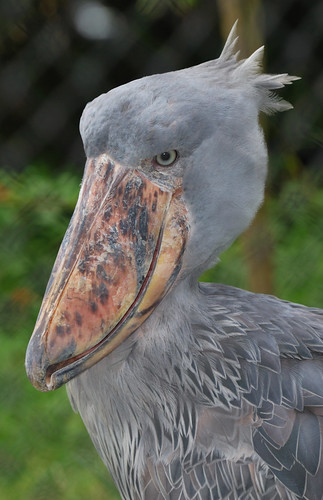

As a poet, Moore’s sympathies extend to the scorned, awkward, resourceful, and unexpected among animals. At heart, she’s a benign moralist who looked to the natural world for models of wisdom and folly. As a translator she rendered La Fontaine’s Fables, including “The Wolf and the Stork.” She also wrote the best poem about ostriches, “He `Digesteth Harde Yron,’” which concludes like this:
“The power of the visible
is the invisible; as even where
no tree of freedom grows,
so-called brute courage knows.
Heroism is exhausting, yet
it contradicts a greed that did not wisely spare
the harmless solitaire
“or great auk in its grandeur;
unsolicitude having swallowed up
all giant birds but an alert gargantuan
little-winged, magnificently speedy running-bird.
This one remaining rebel
is the sparrow-camel.”
At the zoo we met one of my wife’s former newspaper colleagues and her four-month-old daughter, Auden. The baby was named for the poet though our friend said, “I can’t find a good Auden poem for her. Some of them seem to be about prostitutes and depression.” I assured her that wasn’t exclusively the case, and that I would send her some infant-friendly late Auden. In 1967, he wrote in “A Mosaic for Marianne Moore”:
“…we see you sitting,
In a wide-brimmed hat beneath a monkey-puzzle,
At your feet the beasts you animated for us
By thinking of them.”
Wednesday, April 06, 2011
`As If They Need Only to Fly Away'
A woman with severe osteoporosis leaned across a rail fence in the arboretum, peering through binoculars at a brown bit of fuss on the leaf-covered ground, five yards from our feet. I stood behind her, trying to be quiet and motionless, squinting into the forest shadows. She lowered her field glasses and said, “I’m gone two weeks and everything changes. Who is this little fellow?” We agreed he was probably a sparrow, feeding on insects among the dead oak leaves and pine needles, but the shadows and his mottled coloration made naming the species difficult for a couple of ornithological dilettantes.
Further up the path we came to a wooden dock built into a marshy pond. The water was dense with lily pads and duckweed, and two turtles sunned on a half-submerged log. The water was the color of strong tea. At the end of the dock, a middle-aged couple stood with the theatrical stiffness that says: “Don’t move. You might scare it away.” In the weeds below the dock, gray as a Pacific Northwest sky, was a yellow-crowned night heron, the great blue heron’s homelier but still striking cousin. For fifteen minutes I watched the bird methodically make his way through the weeds, probably looking for fish or crawfish. I moved on when the family grew conspicuously impatient. I had never stood so close (six feet) for so long to so large a wading bird.
In another pond I counted fourteen turtles on one log. When we stood at the end of the dock, dozens of them swam toward us, apparently trained to expect lunch. I turned over stones and rotting logs in the woods, hoping to find worms or beetles, but Houston has been dry. I laid flat on the dock, leaned over the end and scratched a foot-long turtle on his head and the back of his shell before he dove. Edward Hoagland begins his best essay, “The Courage of Turtles,” like this:
“Turtles are a kind of bird with the governor turned low. With the same attitude of removal, they cock a glance at what is going on, as if they need only to fly away.”
Birds I enjoy; turtles I admire.
Further up the path we came to a wooden dock built into a marshy pond. The water was dense with lily pads and duckweed, and two turtles sunned on a half-submerged log. The water was the color of strong tea. At the end of the dock, a middle-aged couple stood with the theatrical stiffness that says: “Don’t move. You might scare it away.” In the weeds below the dock, gray as a Pacific Northwest sky, was a yellow-crowned night heron, the great blue heron’s homelier but still striking cousin. For fifteen minutes I watched the bird methodically make his way through the weeds, probably looking for fish or crawfish. I moved on when the family grew conspicuously impatient. I had never stood so close (six feet) for so long to so large a wading bird.

In another pond I counted fourteen turtles on one log. When we stood at the end of the dock, dozens of them swam toward us, apparently trained to expect lunch. I turned over stones and rotting logs in the woods, hoping to find worms or beetles, but Houston has been dry. I laid flat on the dock, leaned over the end and scratched a foot-long turtle on his head and the back of his shell before he dove. Edward Hoagland begins his best essay, “The Courage of Turtles,” like this:
“Turtles are a kind of bird with the governor turned low. With the same attitude of removal, they cock a glance at what is going on, as if they need only to fly away.”
Birds I enjoy; turtles I admire.
Tuesday, April 05, 2011
`Of Growth That Thickens, Not Expands'
On the wall of the new coffee shop at Rice University hang four black-and white photographs of oak leaves, each of a different species found on campus. The pictures hang vertically against a white wall and are six feet tall. The detail is remarkable. Looked at closely, each is a lunar map of craters, plains and veins. A rare instance of public art that is beautiful and appropriate to the setting – the Rice campus is densely shaded with oaks, especially live oaks. When I dream of Rice I see oak-canopied streets and buildings of red brick, and now I think of lines from Yvor Winters’ “The California Oaks”:
“Spreading and low, unwatered, concentrate
Of years of growth that thickens, not expands,
With leaves like mica and with roots that grate
Upon the deep foundations of these lands…”
The academic quadrangle on campus is lined with a non-native species, Italian cypresses that grow tall and needle-like, and slowly tilt and rot and die. Then a grounds crew pulls the dead tree from the earth, like a light bulb unscrewed from its socket, and replaces it with a sapling. The indigenous oaks endure.
The theme of our brief return to Houston is the nature of home and memory, and of what endures. I hardly suspected how happy I was to live here before we moved three years ago. I’ve been reading The Everlasting Man (1925), which G.K. Chesterton starts like this:
“There are two ways of getting home; and one of them is to stay there. The other is to walk around the whole world till we come back to the same place…”
“Spreading and low, unwatered, concentrate
Of years of growth that thickens, not expands,
With leaves like mica and with roots that grate
Upon the deep foundations of these lands…”
The academic quadrangle on campus is lined with a non-native species, Italian cypresses that grow tall and needle-like, and slowly tilt and rot and die. Then a grounds crew pulls the dead tree from the earth, like a light bulb unscrewed from its socket, and replaces it with a sapling. The indigenous oaks endure.
The theme of our brief return to Houston is the nature of home and memory, and of what endures. I hardly suspected how happy I was to live here before we moved three years ago. I’ve been reading The Everlasting Man (1925), which G.K. Chesterton starts like this:
“There are two ways of getting home; and one of them is to stay there. The other is to walk around the whole world till we come back to the same place…”
Monday, April 04, 2011
`How an Instant Can Dilate'
The middle-aged woman who processed our rental car was named Lolita and wished us a spirited: “Welcome to Houston, y’all.” The first music out of the radio was a mariachi band, followed by a few bars of Willie Nelson, and then Johnny Cash singing “Ring of Fire.” For the first time in three years we saw palmettos and sega palms, and heard a mourning dove’s call from a post oak at twilight. The mentally retarded sister of a friend hugged me and shouted a spirited: “Welcome to Houston, y’all.”After dark we drove past the house we lived in for three and a half years, and didn’t recognize the poodle in the front window.
On the plane I sat beside a Marine and read Yaacov Lozowick’s Right to Exist: A Moral Defense of Israel’s Wars and Anterooms by Richard Wilbur, who writes in the title poem:
“Still, it strains belief
How an instant can dilate,
Or long years be brief.”
On the plane I sat beside a Marine and read Yaacov Lozowick’s Right to Exist: A Moral Defense of Israel’s Wars and Anterooms by Richard Wilbur, who writes in the title poem:
“Still, it strains belief
How an instant can dilate,
Or long years be brief.”
Sunday, April 03, 2011
`At Home No Where'
Today we fly to Houston to visit friends, our first return since moving to Washington three years ago. My youngest son, now eight, spent half his life in Houston. My happiest professional memories are associated with my job as the science writer for the engineering school at Rice University. Anecdotal Evidence started in Houston more than five years ago, and our cat adopted us there two months earlier. Houston is one of many former homes, all of them tentative and bolstering my sense of myself as a perpetual guest.
Adam Zagajewski has taught part of each year since 1988 in the writing program at the University of Houston. In an interview he expresses some of my thoughts about Houston and the possibility of belonging anywhere:
“I’m afraid I’m not a Texan yet. I’m trying. All my stays in Houston must have impregnated me with something, but I don’t think it’s the landscape. The cityscape of Houston is not inspiring for me. The human world is sometimes inspiring….I’m a recluse who loves the dialectic of being at the same time within and against a community.”
I look forward to revisiting favorite memories of the city – live oaks, ball moss, the guinea fowl in our old neighborhood, the defunct Pig Stand, Romano’s for pizza, a fire ant megalopolis, a dozen taquerias, the Fondren Library at Rice. Boswell transcribes a 1759 letter Johnson wrote to the son of an old friend in Lichfield, Johnson’s birthplace:
“A man unconnected is at home everywhere; unless he may be said to be at home no where.”
Adam Zagajewski has taught part of each year since 1988 in the writing program at the University of Houston. In an interview he expresses some of my thoughts about Houston and the possibility of belonging anywhere:
“I’m afraid I’m not a Texan yet. I’m trying. All my stays in Houston must have impregnated me with something, but I don’t think it’s the landscape. The cityscape of Houston is not inspiring for me. The human world is sometimes inspiring….I’m a recluse who loves the dialectic of being at the same time within and against a community.”
I look forward to revisiting favorite memories of the city – live oaks, ball moss, the guinea fowl in our old neighborhood, the defunct Pig Stand, Romano’s for pizza, a fire ant megalopolis, a dozen taquerias, the Fondren Library at Rice. Boswell transcribes a 1759 letter Johnson wrote to the son of an old friend in Lichfield, Johnson’s birthplace:
“A man unconnected is at home everywhere; unless he may be said to be at home no where.”
Saturday, April 02, 2011
`The Breakfast of a Little Worm'
Three first-grade girls harvested earthworms on the playground in the rain. Their contempt for squeamishness pleased me. They giggled at the squirming and slime, and one informed me: “They poop in the ground and help the Earth.” Girls who like worms and have something good to say about poop – where were they when I was six? Every species has a reputation among humans – for toothsomeness, beauty or cuteness, or their opposites, among other reasons. On the positive side, and despite Darwin’s pioneering study, worms have always been judged little more than fish bait. Could we be witnessing the rehabilitation of earthworms? From disgust to environmental heroism in a generation?
In Act IV, Scene 3 of Hamlet, King Claudius asks the prince where Polonius is and Hamlet answers, “At supper.” The king replies, “At supper! Where?” and clever, scheming, insufferable Hamlet says:
“Not where he eats, but where he is eaten: a certain convocation of politic worms are e'en at him. Your worm is your only emperor for diet: we fat all creatures else to fat us, and we fat ourselves for maggots: your fat king and your lean beggar is but variable service, two dishes, but to one table: that's the end.”
Besides reminding me of the Diet of Worms, the passage brings back my senior A.P. English class in high school. A friend (where are you, Jan Harlan?) crafted an analysis of Hamlet based on the assumption that the prince’s problem was portliness. He was obese: “We fat ourselves,” “O, that this too too solid flesh would melt,” etc. True or not, worms and maggots join Hamlet’s catalog of disgust (“In the rank sweat of an enseamed bed”).
Scholars have speculated that Shakespeare drew the worm/emperor image from a line in Montaigne’s “Apology for Raymond Sebond” (translated by Donald Frame):
“Little lice are sufficient to make Sylla give up his dictatorship. The heart and the life of a mighty and triumphant emperor form but the breakfast of a little worm.”
On the playground, the girls know nothing of such things. They just like worms. One of them said, “We don’t want them to drown.”
In Act IV, Scene 3 of Hamlet, King Claudius asks the prince where Polonius is and Hamlet answers, “At supper.” The king replies, “At supper! Where?” and clever, scheming, insufferable Hamlet says:
“Not where he eats, but where he is eaten: a certain convocation of politic worms are e'en at him. Your worm is your only emperor for diet: we fat all creatures else to fat us, and we fat ourselves for maggots: your fat king and your lean beggar is but variable service, two dishes, but to one table: that's the end.”
Besides reminding me of the Diet of Worms, the passage brings back my senior A.P. English class in high school. A friend (where are you, Jan Harlan?) crafted an analysis of Hamlet based on the assumption that the prince’s problem was portliness. He was obese: “We fat ourselves,” “O, that this too too solid flesh would melt,” etc. True or not, worms and maggots join Hamlet’s catalog of disgust (“In the rank sweat of an enseamed bed”).
Scholars have speculated that Shakespeare drew the worm/emperor image from a line in Montaigne’s “Apology for Raymond Sebond” (translated by Donald Frame):
“Little lice are sufficient to make Sylla give up his dictatorship. The heart and the life of a mighty and triumphant emperor form but the breakfast of a little worm.”
On the playground, the girls know nothing of such things. They just like worms. One of them said, “We don’t want them to drown.”
Friday, April 01, 2011
R.I.P.: Brian, Brian, Flann, Myles
A reader in Dallas reminds us:
"April 1, 2011 is the 45th anniversary of the death, all in Dublin, of Brian O'Nolan, Brian Ó Nualláin, Flann O'Brien and Myles na gCopaleen."
`An Evident Superiority Over the Other'
The human need to establish and enforce a pecking order, a sometimes invisible and unacknowledged caste system, is, after sex and food, our species’ most powerful urge. All of us do it, sometimes unconsciously, for true democrats of the spirit have never been abundant. They are sports of nature and their defining quality is a quiet, unproclaimed acceptance of others, without the bogus egalitarianism rigidly enforced today. Along with “environmentalism,” our dominant secular religion is militant niceness, a self-serving creed. Dr. Johnson, not unexpectedly, understood our pretensions to equality. Boswell reports him saying:
“So far is it from being true that men are naturally equal, that no two people can be half an hour together, but one shall acquire an evident superiority over the other.”
There’s nothing offensive or intimidating about this state of affairs. I accept with simple equanimity I will never write as well as Jonathan Swift (or as badly as Norman Mailer, etc.) or play piano like Art Tatum – realties that trigger sputtering in some.
In my school, teachers are Brahmins, though most would demur and insist, with much ersatz humility, that students are the crown of creation. The principal is a figurehead, benign but hamstrung by the teachers and their union. Then, inconveniently, come the students. At the base of this irregular polygon is the ancillary staff – office workers, para-educators, the cook and custodians. I recount none of this resentfully. I knew what I was getting into and have shed most of my naiveté about human nature. When I learned a fifth-grade teacher had referred to me as “the help,” a fellow untouchable and I had a good laugh.
In the New English Review, Theodore Dalrymple visits a used bookstore, purchases a volume devoted to the lost art of letter writing, and launches a meditation on the charade of presumed human equality, and other matters:
“An early piece of advice in the book concerns how one should write to one’s social superiors and one’s social inferiors. The very fact that people can be written about in such a way gives one a jolt. But I wonder whether, in fact, this way of speaking, writing and thinking is more honest (and in some ways civilised and psychologically balanced) than our pretence that there are no such creatures as our superiors and inferiors? For it has been my observation that, in practice, the most fervent egalitarians are often egalitarian mainly about the people above them in the social scale; no one is above them, but their conduct often leads one to suppose that they have no difficulty in conceiving of and treating people as their inferiors. With the destruction of the notion of noblesse oblige, behaviour towards inferiors becomes more raw and unpleasant. The pretence that one believes in equality in any other sense than the religious or the abstraction of equality before the law leads directly to cognitive dissonance.”
“So far is it from being true that men are naturally equal, that no two people can be half an hour together, but one shall acquire an evident superiority over the other.”
There’s nothing offensive or intimidating about this state of affairs. I accept with simple equanimity I will never write as well as Jonathan Swift (or as badly as Norman Mailer, etc.) or play piano like Art Tatum – realties that trigger sputtering in some.
In my school, teachers are Brahmins, though most would demur and insist, with much ersatz humility, that students are the crown of creation. The principal is a figurehead, benign but hamstrung by the teachers and their union. Then, inconveniently, come the students. At the base of this irregular polygon is the ancillary staff – office workers, para-educators, the cook and custodians. I recount none of this resentfully. I knew what I was getting into and have shed most of my naiveté about human nature. When I learned a fifth-grade teacher had referred to me as “the help,” a fellow untouchable and I had a good laugh.
In the New English Review, Theodore Dalrymple visits a used bookstore, purchases a volume devoted to the lost art of letter writing, and launches a meditation on the charade of presumed human equality, and other matters:
“An early piece of advice in the book concerns how one should write to one’s social superiors and one’s social inferiors. The very fact that people can be written about in such a way gives one a jolt. But I wonder whether, in fact, this way of speaking, writing and thinking is more honest (and in some ways civilised and psychologically balanced) than our pretence that there are no such creatures as our superiors and inferiors? For it has been my observation that, in practice, the most fervent egalitarians are often egalitarian mainly about the people above them in the social scale; no one is above them, but their conduct often leads one to suppose that they have no difficulty in conceiving of and treating people as their inferiors. With the destruction of the notion of noblesse oblige, behaviour towards inferiors becomes more raw and unpleasant. The pretence that one believes in equality in any other sense than the religious or the abstraction of equality before the law leads directly to cognitive dissonance.”
Subscribe to:
Posts (Atom)