Thursday, May 31, 2012

`In a Small Dirty Hotel'

“if art for its subject
will have a broken jar
a small broken soul
with a great self-pity

“what will remain after us
 will it be lovers' weeping
 in a small dirty hotel
 when wall-paper dawns”

[final lines from Zbigniew Herbert’s “Why the Classics,” Selected Poems, 1977, translated by Peter Dale Scott and Czeslaw Milosz]  

Wednesday, May 30, 2012

`I Have Strew'd It in the Common Ear'

“My holy sir, none better knows than you
How I have ever loved the life removed
And held in idle price to haunt assemblies
Where youth, and cost, and witless bravery keeps.
I have deliver'd to Lord Angelo,
A man of stricture and firm abstinence,
My absolute power and place here in Vienna,
And he supposes me travell'd to Poland;
For so I have strew'd it in the common ear,
And so it is received. Now, pious sir,
You will demand of me why I do this?”

[Vincentio, Act I, Scene 3, Measure for Measure]

Tuesday, May 29, 2012

`Today, Not Tomorrow'

Posted on the white board beside the elevator in the hotel lobby on my final night in Poland:

“`Przyszłość zaczyna się dziś, nie jutro.’ Jan Pawel II”

“`The future starts today, not tomorrow.’ John Paul II.”

His image is everywhere in Kraków.

`Occluded by Flashier Imports'

“The cultural and educational scene which had been dominated by acknowledged masters and role models gave way to free-for-all, with new private schools and universities showing up venerable institutions such as the Jagiellon University, and minor television personalities garnering greater interest than established writers and artists. The Nobel laureate Wisława Szymborska and the Oscar-winning film director Andrzej Wajda still commanded notice as well as respect, but high culture was largely occluded by flashier imports.”

[from Adam Zamoyski’s Poland: A History, 2009]

Monday, May 28, 2012

`The Naive Unity of the Beautiful and the Useful'

“I limited myself to onions, garlic, bread, and especially lump sugar. It’s a wonderful thing, lump sugar. I still have a weakness for it. Even in cafes I’ll catch myself, completely unconsciously, slipping some lump sugar into my pocket. I’m not a cheap person; it’s just that since Lubyanka I’ve loved lump sugar. Those lumps of sugar are beautiful. You have to admit they have a certain beauty. And you can see by their very form that they contain sweetness. They’re well constructed; there’s nothing superfluous about them. Those lumps of sugar were a delicacy for me, and here of course the beautiful and the useful were united – not as they are in constructivism, which I detest, but as they are in human life. A primeval unity. The naïve unity of the beautiful and the useful, the enormously useful. I was sparing with those lumps of sugar; I built up a reserve in case things became worse.”

[from Aleksander Wat’s My Century, 1988, translated by Richard Lourie]

Sunday, May 27, 2012

Listening to Levon

I’m a day late but Saturday would have been the seventy-second birthday of Levon Helm who died April 19. In my hotel room here in Mszana Dolna, Poland, I’m watching the rain and listening to thisthis and this.

`In a Valley or Among Green Hills'

A carriage drawn by two horses carried the bride and groom to the church. The band – two violins, accordion, string bass, two female singers – rode in another horse-drawn carriage behind them. Family and guests followed on foot. The church is in the town, Polnice, where the bride was born and where her parents still live. Neighbors stood in their yards and waved, blew kisses and threw flowers. Someone stuck sprigs of lilac under the horses’ bridles. The sky was deep blue and cloudless. Cows grazed on the shining green hills. 

The church, built of stone and mortar, stands on a hill. The pews and kneelers are old, wooden and creaky. Above the altar is the image of the Black Madonna of Częstochowa. One of the transepts is filled with sunlight, and at its center stands a tall candle and a lectern holding an open bible. On the wall hang three framed pictures, left to right: John Paul II, Jesus, and the Black Madonna. Mass was in Polish except for the gospel -- 1 Corinthians13:4-7 – which was read in English. That evening I asked the Polish woman who did the reading why she chose English and she said, “We want to welcome people.” 

After the service, as the bride and groom stood in front of the church having their picture taken again and again, I saw the priest preparing to close the tall front doors of the church. I walked up the steps, shook his hand and said, “Thank you, Father.” He smiled and said in perfect American, “No problem.” 

On the ride from the church to the hotel where the reception was held, we passed townspeople who cheered and sang and waved Polish flags. Using their hoses, the fire department shot arches of water over the procession. I hear the reception was still going strong after 3 a.m. I left at 10 p.m. Two bands performed, including the folk musicians in costume who had accompanied the wedding party. The other group played generic rock/pop/disco sung in Polish. I recognized two songs, a medley of “By the Rivers of Babylon” and Bobby Hebb’s “Sunny.” We were given photocopies of the music and lyrics to Sto lat,” an all-purpose toast and salutation, and virtually the informal national anthem of Poland. Every Pole in the room knew the words. In English: 

“A hundred years, a hundred years,
May he (she) live, live with us.
A hundred years, a hundred years,
May he live, live with us.
Once again, once again, may he live, live with us,
May he live with us!” 

With the Germans, Canadians, English and Peruvians at my table, I helped mangle the Polish lyrics with gusto. Much beer, wine and vodka, and a meal of endless courses. Adam Zagajewski writes in Epithalamium” (Eternal Enemies, translated by Clare Cavanagh, 2008): 

Only in marriage do love and time,
eternal enemies, join forces.
Only love and time, when reconciled,
permit us to see other beings
in their enigmatic, complex essence,
unfolding slowly and certainly, like a new settlement
in a valley or among green hills.”

`Written As That of a Failed State'

“In the early modern period, the Poles failed spectacularly to build an efficient centralised state structure and they paid the price, being swallowed up by their more successful neighbours. The history of Poland has therefore, up until now, been written as that of a failed state. Like some distorting lens or filter, that failure coloured and deformed the historian’s view of the whole of Polish history.”

[from Adam Zamoyski’s preface to Poland: A History, 2009]

Saturday, May 26, 2012

`Friends Find Each Other Interesting'

On a visit to Poland, to read A Garden Carried in a Pocket: Letters 1964-1968, the correspondence of Guy Davenport and Jonathan Williams, is to be doubly exiled from one’s customary world. Casual exchanges of conversation call for patience and imagination. The Poles I’ve met have been intelligent, polite, amiable and without exception more fluent in English than I am in Polish. They invariably express pleasure when I throw in a shaky kawa, Jak się masz? or Dziękuję. Making oneself understood without ambiguity or insult challenges self-centered laziness. Speaking with Poles, I feel not anxious but revitalized, despite lingering jet lag.
Reading A Garden (edited by Thomas Meyer, Green Shade, 2004) is like overhearing funny, erudite, bitingly satirical conversation between new and still uncertain friends. Williams is aggressively outgoing. His humor is campy and irreverent. Davenport is guarded, a stance he never entirely relaxes, though his humor blossoms with the friendship. Each helped the other professionally with editing, reviews, introductions, free books and publishing connections. Both love gossip. Williams is the life of the party. Davenport remains staunchly private, ever the Southern gentleman. His responses, however Rabelaisian, are carefully measured. As Williams unloads the complications of his love life, Davenport sympathetically hears him out, offers tactfully phrased fatherly advice, and keeps his business to himself. The sexual subtext makes for fascinating reading, an Appalachian translation of Les Liaisons dangereuses.
Davenport died in January 2005, shortly after the publication of A Garden. His brief introductory note must be among the last things he wrote. In it he says:
“The self, as some fancy psychologists have said, is always several selves, a congeries of identities. We like people who make us like ourselves (Jonathan is one of these). We tend to have a different self for all our acquaintances, accomplished hypocrites that we are. Consequently, we never really know another person. What’s going on in a friendship is that friends find each other interesting, appreciate each other’s jokes (this complicates things for the readers of other people’s mail), and enjoy each other’s company.”
Williams died in March 2008. His introduction is characteristically jokier than Davenport’s, but he too addresses the multiplicity of the self:
“My letters to Guy Davenport would be very different from those to R.B. Kitaj, or Kenneth Rexroth, or Ian Hamilton Finlay, or Jesse Helms. The range of his information, his precision and style and `manners’ forced me to try to get the facts `right,’ to try to get the words `right.’”
Davenport would not have placed quotation marks around manners and right. While Williams obsessively socializes, Davenport laments his lack of privacy: “Hermitude, like bliss, is pleasant to imagine since, surely, neither exists for more than fifteen minutes. Which, just as surely, makes them both so attractive.”
While Davenport is reviewing books for Bill Buckley at National Review, Williams serves as poet-in-residence at the trendy Aspen Institute for Humanistic Studies. In 1967, after Williams mails him a brochure outlining the programs at the Institute, Davenport lets go with his funniest rant:
“Aha, so you have been put upon by the Liberals? I began years ago turning them out of my doors. Had to, to have some peace…Sensitivity is simply the enfranchisement to mooch…Bishop Pike! Norman Cousins! The two silliest one-worlders ever to kiss the hammer-and-sickle. Pike gets about a million dollars per annum of American tax money to pray nightly to Chairman Mao…You are, my friend, enrolled in a Communist Sunday School—ironically of the Liberal Variety, which will be the first to be put in the gas chambers when the Revolution comes.
“Fortunately, there is no known record of a real artist being taken in by the tears and panty-waist Socialism of the Left.”
Now I must catch a bus to take me to a Polish wedding.

`Its Provinciality and Splendor'

“I now walked the streets of Cracow ascertaining how much smaller it had become. But after a while, quite unexpectedly, I rediscovered my former admiration for the royal city. And so it happened that I roamed Cracow  feeling simultaneously  its smallness and greatness, its provinciality and splendor, its poverty and riches, its ordinariness and extraordinariness. I was certain of just one thing: the trees of Planty had grown. My admiration was undercut by doubt, but the trees had become even more majestic, even more real.”

[from Adam Zagajewski’s “Cracow,” Two Cities: Exile, History, and the Imagination, 1995, translated by Lillian Vallee]

Friday, May 25, 2012

`The Marvelous Journey'

My closest companion in Poland has been a former Greek diplomat, age seventy-six, who was born in Alexandria and lived in Iraq, the United States, Syria, Canada, Australia and now, in retirement, Greece. Walking to dinner in Kraków the other evening, I asked him about Alexandria, ancient and modern, and he spoke of the Library as though it had burned down last week. I mentioned Cavafy, E.M. Forster’s 1922 book about the city and Lawrence Durrell’s tetralogy. He couldn’t finish the Durrell, read Forster years ago and recited Cavafy from memory in Greek. Here is how Edmund Keeley and Philip Sherrard rendered the lines from “Ithaka” in English:

Ithaka gave you the marvelous journey.
Without her you would not have set out.
She has nothing left to give you now.”


From the same translators I returned the favor with the final lines of “Waiting for the Barbarians”:

“And now, what’s going to happen to us without barbarians?
They were, those people, a kind of solution.”


The retired diplomat recited the lines in Greek and said, “The end of that poem always makes me laugh.”

`Ugliness Creates Individuality'

“Cities that are too beautiful lose their individuality. Some of the southern towns cleaned up for tourists remind one more of glossy photo ads than of organic human settlements. Ugliness creates individuality. Cracow cannot complain of a dearth of infelicitous, heavy, melancholy places.”

[from Adam Zagajewski’s “Cracow,” Two Cities: Exile, History, and the Imagination, 1995, translated by Lillian Vallee]

Thursday, May 24, 2012

`A Barrier to German Plans'

“In the ancient Polish city of Cracow, the entire professoriate of the renowned university was sent to concentration camps. The statue of Adam Mickiewicz, the great romantic poet, was pulled down from its pedestal on the Market Square, which was renamed Adolf-Hitler-Platz. Such actions were symbolic as well as practical. The university at Cracow was older than any university in Germany. Mickiewicz had been respected by the Europeans of his day as much as Goethe. The existence of such an institution and such a history, like the presence of the Polish educated classes as such, was a barrier to German plans, but also a problem for Nazi ideology.”

[from Timothy Snyder’s Bloodlands: Europe Between Hitler and Stalin, 2010]

Wednesday, May 23, 2012

`Pray That the Road is Long'

Today I fly to Kraków to attend a wedding. One of my wife’s cousins, a German, is marrying a Polish girl. I’m uncertain of internet availability at my hotel, and I’m even more uncertain of my mental state after sixteen hours of travel, with a stop in Paris, so in advance I’m posting daily excerpts from the Polish commonplace book I’ve been keeping. I will add to the entries as circumstances permit. Here is the first stanza of Zbigniew Herbert’s “Journey”:

“If you set out on a journey pray that the road is long
a wandering without apparent aim a blind groping
so you come to know earth’s harshness not just by sight but by touch
so that you measure yourself against the world with your whole skin”

[The Collected Poems 1956-1998, translated by Alissa Valles]

Tuesday, May 22, 2012

`Johnson's Impressed Me by Being Human'

I’ve been reading a good deal lately in a book called `Prayers and Meditations’ by Dr Johnson. I like it very much.”

So writes Ludwig Wittgenstein in a July 19, 1940, letter to his friend Raymond Townsend (Wittgenstein in Cambridge 1911-1951, ed. Brian McGuinness, 2008). His fondness for Johnson is hardly a surprise. With gusto he also read, in their original languages, St. Augustine, Pascal, Kierkegaard, Dostoevsky, Tolstoy and William James’ Varieties of Religious Experience. Georg Henrik Von Wright, who succeeded Wittgenstein as professor at Cambridge, says Wittgenstein experienced “deeper impressions” from writers “in the borderlands between philosophy, religion, and poetry” than from the formal Western philosophical tradition, which certainly fits Johnson. In his biography of Wittgenstein, Ray Monk suggests he never read Aristotle. Samuel Beckett, too, was a great Johnson admirer, though also deeply read in formal philosophy.

In a letter to his student and friend Norman Malcolm, dated Sept. 8, 1945, Wittgenstein writes:

“The other day I read Johnson’s `Life of Pope’ and liked it very much. As soon as I get to Cambridge I’m going to send you a little book `Prayers and Meditations’ by Johnson. You may not like it at all,--on the other hand you may. I do.”

Johnson’s biography of Pope is one of the masterpieces in his Lives of the Most Eminent English Poets. In it Johnson writes of the poet:

“…but he read only to store his mind with facts and images, seizing all that his authors presented with undistinguishing voracity, and with an appetite for knowledge too eager to be nice. In a mind like his, however, all the faculties were at once involuntarily improving. Judgement is forced upon us by experience. He that reads many books must compare one opinion or one style with another; and when he compares, must necessarily distinguish, reject, and prefer.”

On Oct. 6, 1945, Wittgenstein mails a copy of Johnson’s Prayers and Meditations (third edition, H.R. Allenson, 1928) to Malcolm, and writes in the accompanying letter:

“This is the little book I promised to send you. It seems to be out of print so I’m sending you my own copy. I wish to say that normally I can’t read any printed prayers but that Johnson’s impressed me by being human. Perhaps you’ll see what I mean if you read them. As likely as not you won’t like them at all. Because you will probably not look at them from the angle from which I see them. (But you might.) If you don’t like the book throw it away.”

I admire people who give away books they love but attach no strings. Wittgenstein tells Malcolm he can read the Johnson or not. If he does read it, he’s free to like it or not. If he doesn’t like it, he can throw it away. Few things are more irksome than gifts wrapped in expectations. Go here to read selections from Johnson’s Prayers and Meditations. For example:  

“April 20, 1764, GOOD FRYDAY.

“I have made no reformation, I have lived totally useless, more sensual in thought and more addicted to wine and meat, grant me, O God, to amend my life for the sake of Jesus Christ. Amen.

“I hope

“To put my rooms in order*.

“I fasted all day.

“* Disorder I have found one great cause of idleness.”

Wittgenstein knew similar torments and made similar resolutions.

Monday, May 21, 2012

`Exemplar of the Small'

While weeding and sweating Sunday afternoon in the backyard, I saw and held the most beautiful creature in the world. No, not one of the butterflies working the flowerbeds, nor the doves calling from the oaks, nor the gray squirrels complaining about my presence, nor the brazen blue jays, nor the millipedes and earthworms exposed with each bite of the trowel.

No, this fellow was Anolis carolinensis, the green anole lizard, and I almost didn’t see him. A sprawling palm-like plant with vivid green leaves or fronds grows near the back of the garage. (How I hate not knowing the names of things.) The stem is woody, a veritable trunk, but frilly white flowers grow at the end of its long stalks. The anole was clinging vertically, head down, to one of the long leaves and seemed to be studying me. The color of his skin was identical to the leaf. I caught him and he fastened to the palm of my hand with his jaws but without breaking the skin or causing pain. His color was, I suppose, chartreuse, a shade I’ve heard called harlequin. We stared at each other. When I opened my hand, he leaped back to the palm, climbed a few inches and resumed his previous study.

About five years ago, the green anole became the first reptile to have its entire genome sequenced. There’s even a website, Anole Annals, devoted to them. So large the human attention focused on this impossibly beautiful “exemplar of the small.”

Sunday, May 20, 2012

`The Grand Pacification is Coming'

One hundred-fifty years ago this week, on May 25, 1862, Herman Melville’s youngest brother, thirty-two-year-old Thomas, was making his final commercial voyage, bound for Hong Kong as captain of the Bengal. Herman was landlocked at Arrowhead, the house in Pittsfield, Mass., where he and his family lived from 1850 to 1863, and where he finished writing Moby-Dick in 1851. Melville addressed his letter to Tom “My Dear Boy: (or, if that appear disrespectful) My Dear Captain.” Its tone throughout is affectionate, kidding and, near the conclusion, rousingly patriotic. He begins by chiding his brother for the “long and entertaining letter” (now lost) Tom had written their mother. In it, Tom had complained of a “jackass” who “improves his opportunities in the way of sleeping, eating & other commendable customs.” Melville writes:

“For my part I love sleepy fellows, and the more ignorant the better. Damn your wide-awake and knowing chaps. As for sleepiness, it is one of the noblest qualities of humanity. There is something sociable about it, too. Think of those sensible & sociable millions of good fellows all taking a good long friendly snooze together, under the sod—no quarrels, no imaginary grievances, no envies, heart-burnings, & thinking how much better that other chap is off—none of this: but all equally free-&-easy, they sleep away & reel off their nine knots an hour, in perfect amity.”

It’s typical of Melville, creator of the innkeeper Peter Coffin, to turn joshing into a light-hearted meditation on death. However, he tells his youngest brother: “Tom, my boy, I admire you. I say again, you are a hero.” There’s more kidding, and then a shift:

“Do you want to hear about the war?--The war goes bravely on. McClellan is now within fifteen miles of the rebel capital, Richmond. New Orleans is taken &c &c &c. You will see all no doubt in the papers at your Agents. But when the end—the wind-up—the grand pacification is coming who knows. We beat the rascals in almost every feild [sic], and take all their ports &c, but they don’t cry `Enough!’—and it looks like a long lane, with the turning quite out of sight.”

The Shakespearean allusion is likewise typical of Melville. Earlier in the letter he had alluded to As You Like It. Now, in a darker key, it’s Macbeth’s “Enough!” The Confederates were three years away from conceding “Enough!” In June, Robert E. Lee would force McClellan’s army to retreat and thus end the threat to Richmond in the Seven Days’ campaign. Ahead in 1862 lay the Second Battle of Manassas, another Southern victory; Antietam, a slaughter on both sides; and, in December, a crushing Union defeat at Fredericksburg. Of that battle, Melville would write in “Inscription for Marye's Heights, Fredericksburg” (Battle-Pieces and Aspects of the War, 1866):

“To them who crossed the flood
And climbed the hill, with eyes
Upon the heavenly flag intent,
And through the deathful tumult went
Even unto death: to them this Stone--
Erect, where they were overthrown--
Of more than victory the monument.”

[The passages from Melville’s letter are taken from Correspondence, The Writings of Herman Melville, Vol. 14, edited by Lynn Horth, Northwestern University Press and The Newberry Library, 1993.]

Saturday, May 19, 2012

`Face Gleaming Like Lamps'

Over at The Dabbler, Elberry concludes his review of Wittgenstein in Cambridge, Letters and Documents 1911-1951 like this:

“One could say, this book takes a close look at Wittgenstein’s face; and whether or not this will interest anyone, he was nonetheless a human being and so it may have value.”

Wittgenstein appeals to some of us precisely because our philosophical training is small or nonexistent. Much of his attraction is literary. The writing is flinty and gnomic, often more like koans than logical propositions, and seems fashioned not out of the philosophical tradition but his own fractured life. Mistakenly, we sense that all we need to understand him is to have lived, as Thoreau put it, deliberately. Elberry’s observation follows a passage he quotes from a letter Wittgenstein wrote in 1938 to a student studying to become a psychiatrist: 

“Look at your patients more closely as human beings in trouble and enjoy more the opportunity you have to say ‘good night’ to so many people. This alone is a gift from heaven which many people would envy you. And this sort of thing ought to heal your frayed soul, I believe. It won’t rest it; but when you are heathily tired you can just take a rest. I think in some sense you don’t look at people’s faces closely enough.”

Surely this is good advice for a future doctor and for the rest of us. From birth we learn to open and close our faces and to read the faces of others. Lately I’ve been looking at many books of photographs, and have observed the way I look at them. First, are humans present?  If so, I look at the faces and plumb the being behind the mask. Most of my attention is paid to the faces. Part of being human is assuming we have something in common with other humans. Sociopaths look for something else, evidence of their own superiority. In a crowd of strangers I look to the faces. Next week, when I land in Kraków, in a country I have never visited, where people speak a language alien to mine, it’s their faces I’ll read, hoping they’re composed in a dialect of Esperanto I understand. Adam Zagajewski, a poet who has spent much of his life in Kraków, writes in “Faces” (Unseen Hand, 2011):

“Evening on the market square I saw shining faces
of people I didn’t know. I looked greedily
at people’s faces: each was different,
each said something, persuaded,
laughed, endured.

“I thought that the city is built not of houses,
squares, boulevards, parks, wide streets,
but of faces gleaming like lamps,
like the torches of welders, who mend
steel in clouds of sparks at night.”

Friday, May 18, 2012

`And Piles of Solid Moan'

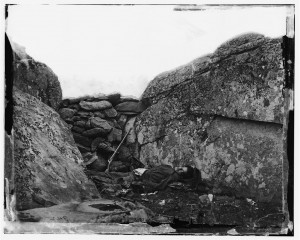
Almost half a century ago when our family visited the Gettysburg National Military Park for the first time, my brother and I searched unsuccessfully for a scene captured in this photograph by one of Mathew Brady’s associates, Alexander Gardner. It shows a dead Confederate soldier and a rifle leaning against a pile of lichen-covered stones in Devil’s Den, a boulder-strewn hill between Little Round Top and Big Round Top on the battlefield. I think we saw the picture in National Geographic and half-expected to see the same pile of stones and the rifle, if not the dead Rebel, but we never found them. Our naïveté says something about the indelible image of the war left by Brady, Gardner and other Civil War photographers.

Brady may have been born one hundred-ninety years ago today, on May 18, 1822, in Warren County, N.Y., near Lake George. The evidence is inconclusive. He also may have been born the following year, on another date. Brady learned his trade in Saratoga Springs, opened his photography studio in New York City in 1844, and eventually photographed 18 of the 19 American presidents from John Quincy Adams to William McKinley. He gave us our lasting image of the Civil War and of mid-nineteenth-century America. He photographed Lincoln many times; Grant, McClellan, Burnside and most senior Union officers; Jefferson Davis, Robert E. Lee and Stonewall Jackson; Clara Barton, Stephen A. Douglas, the great engineer Joseph Henry, the actor Edwin Booth, the midget Gen. Tom Thumb, William Cullen Bryant, Jenny Lind, Thomas Cole, Thaddeus Stevens, John C. Calhoun, Daniel Webster, Henry Clay and Walt Whitman, among thousands of others.   

In 1861, his eyesight failing, Brady dispatched Gardner and twenty-two other photographers, each with a travelling darkroom, to document the war. Late in 1862, Gardner left Brady’s studio to work independently. He arrived at Gettysburg with two other former Brady photographers, Timothy H. O’Sullivan and James F. Gibson, on July 5, 1863, two days after the conclusion of the battle when the fields were still covered with corpses, mostly Confederate. The men took about 60 negatives, many of them notably grisly. By the time Brady arrived a week later, most of the bodies had been removed.

One of the most vivid eyewitness chroniclers of the Battle of Gettysburg was Lt. Frank Aretas Haskell, the aide-de-camp to Union Brig. Gen. John Gibbon. In a letter to his brother, eventually published as The Battle of Gettysburg by the Wisconsin History Commission in 1908, Haskell describes scenes comparable to those photographed by Gardner and the others:

“Oh, sorrowful was the sight to see so many wounded! The whole neighborhood in rear of the field became one vast hospital of miles in extent. Some could walk to the hospitals ; such as could not were taken upon stretchers from the places where they fell to selected points and thence the ambulance bore them, a miserable load, to their destination…Every conceivable wound that iron and lead can make, blunt or sharp, bullet, ball and shell, piercing, bruising, tearing, was there. Some have undergone the surgeon's work; some, like men at a ticket office, await impatiently their turn to have an arm or a leg cut off. Some walk about with an arm in a sling; some sit idly upon the ground; some lie at full length upon a little straw, or a blanket, with their brawny, now blood-stained, limbs bare, and you may see where the Minié bullet has struck or the shell has torn.”

Haskell was killed at the Battle of Cold Harbor in Virginia on June 3, 1864. Emily Dickinson never wrote a poem with a direct topical reference to the war but sometime in 1863 after the Battle of Gettysburg she wrote one beginning “My Portion is Defeat—today—,” including this stanza:

“`Tis populous with Bone and stain—
And Men too straight to stoop again—,
And Piles of solid Moan—
And Chips of Blank—in Boyish Eyes—
And scraps of Prayer—
And Death's surprise,
Stamped visible—in Stone— ”

[Go here and here to see more photographs by Brady, Gardner and their associates.]

Thursday, May 17, 2012

`Alone, As He Is Too, and Also Not Alone'

In her comment on Tuesday’s post, Helen Pinkerton reminds us of the poem by Diane S. Bonds about Edward Hopper’s painting Hotel Room (1931). Bonds relates it to another painting of a woman reading, Jan Vermeer’s A Girl Reading a Letter by an Open Window (c. 1657). Helen writes:

“I thought Bonds’s interpretation interesting, but I questioned the truth that reading words `doubles the self.’ Isn't reading rather an opening of the self to the experience of other selves--an addition of difference not a doubling of the self?”

I share Helen’s understanding. Deep reading, especially of fiction, induces self-forgetting and I become Natasha Rostov or even Henny Pollit. Like most people, I’m already too full of self. “Doubling” would be more than redundant. What counts is losing one’s self, not finding it, and a reliable means of doing so is concentrated reading and imaginative projection. Our reading of the real world deepens as we sympathetically read the fictional. I like Helen’s phrase: “an addition of difference.”

Of course, neither woman in the paintings is reading a work we would judge literary. In her biography of Hopper, Gail Levin reports the artist’s wife, Jo Hopper, modeled for the painting while holding a train timetable. Already, bags still unpacked, she’s planning her departure. In the Vermeer, x-rays have revealed a Cupid on the wall to the right of the girl, eliminated by the artist in the final composition. This lends credence to the common understanding that the girl, though impassive and poker-faced, is reading a love letter.  

Helen, too, has written a poem inspired by a Vermeer painting -- “On Vermeer's Young Woman with a Water Jug (1658), in the Metropolitan Museum,” collected in the “Bright Fictions” section of Taken in Faith: Poems (2002):

“Not Martha nor Diana--only a woman
Working alone, light falling through the casement
On forearms, yellow jacket, blue-white coif,
On a clear brow and eyes that look within.
She pauses in meditative quiet, conscious
That in her being, before her work resumes,
She sees and she is seen, knows and is known--
Thinking, `It is as if this precious light,
Uniting me and him who looks at me,

“`Imaged the unsourced being, first and real,
That gives our being momently, our seeing
And what we see, knowing and what we know.
It is as if my task, privately done,
Its time and place not in the world's arena,
Showed truth beyond geography's fine maps
Or charts of the astronomer--truth needed
By him who paints me here in his bright fiction,
Alone, as he is too, and also not alone.'”

Light appears in almost every Pinkerton poem. Vermeer’s painting glows with sunlight from the opened window. The young woman is buoyant in the light, illuminated with grace. Helen’s “precious light” is divine in origin, a mystery, another “bright fiction.”

In Still Life with a Bridle (1991), Zbigniew Herbert includes “Letter,” an essay in the form of an imaginary letter written by Vermeer to his friend Antonie van Leeuwenhoek, the Delft lens grinder, inventor of the microscope and pioneering microbiologist. Herbert has Vermeer question van Leeuwenhoek’s reductive approach to science, verging on pure materialism. Note Vermeer’s pride in his depiction of light:

“Most likely you will reproach me that our art does not solve any of the enigmas of nature. Our task is not to solve enigmas, but to be aware of them, to bow our heads before them and also to prepare the eyes for never-ending delight and wonder. If you absolutely require discoveries, however, I will tell you that I am proud to have succeeded in combining a certain particularly intensive cobalt with a luminous, lemon-like yellow, as well as recording the reflection of southern light which strikes through thick glass onto a gray wall.”

Wednesday, May 16, 2012

`One of the Wittiest American Writers of His Day'

I have just reread The Earl of Louisiana (1961) for, I think, the twenty-third time and it’s not even my favorite A.J. Liebling, which might be Normandy Revisited (1958), or Between Meals: An Appetite for Paris (1962) or The Sweet Science (1956). I’ve known reporters and editors who knew Liebling strictly as a press critic and at least one restaurant critic who thought he was a “foodie” (hideous baby talk), but Liebling was a man of many pleasures who followed them. As a writer he ranks not among the kvetchers but the celebrators, and he left us some of the best prose ever written by an American.

The Earl of Louisiana is the ringer among Liebling’s books because it has some academic following despite being so well written. I’ve read treatments of it as a solemn study of early Civil Rights Era politics in the South, when in fact Earl Long is Colonel Stingo, Whitey Bimstein or Izzy Yereshevsky (other Liebling heroes) transported south of the Mason-Dixon Line. In his introduction to the updated edition put out by Louisiana State University Press in 2008, Jonathan Yardley tells us The Earl, unlike Liebling’s other titles, has remained in print since first published more than half a century ago. Yardley rightly notes it is “indeed a classic, not merely in one category but three: the literature of American politics, the literature of Louisiana, and the oeuvre of A.J. Liebling.” He describes the prose as "lively, insouciant, luxuriant." Here is a sample chosen almost at random, from Liebling’s portrait of a bit player in the book, Curley, once a boxer, now a bookmaker in Jefferson Parish:

“Curley is a barrel of a man, an old lightweight who never got anywhere and is now unregenerately fat. Men like him are more sentimental about the game than ex-champions, who are often bitter about managers who stole their money. The never-was is less neurotic than the has-been.” 

Funny? Of course, and now we can add “Curley” to our list of synonyms for the terminally forgettable and, we hope, forgotten (Billy Collins, anyone? Ann Beattie? ) Yardley performs another service for Liebling’s admirers, one I’ve never before seen in print. In 1980, Raymond Sokolov published Wayward Reporter, the first and thus far only biography of Liebling. I bought it when it came out and have reread it a number of times, knowing it’s a tiresome book – an extraordinary accomplishment, if you think about it: a dull volume about a supernally exciting writer. Some of the facts are there, and the late Joseph Mitchell, Liebling’s closest friend, agreed to speak with Sokolov, but the resulting book is a desultory sketch of a life, not a life. Yardley writes:

“It is unfortunate that what is likely to remain the only full biography of Liebling…is dutiful and earnest but humorless; Liebling was one of the wittiest American writers of his day, but little of this comes across in Sokolov’s account. Still, it is useful for the bare facts.”

In other words, go first to the holy writ and only later consult the exegesist. In various editions and with some overlap among them, twenty-seven volumes by Liebling sit on my shelves. His only heavyweight contenders in my library are Chekhov and Guy Davenport.

Tuesday, May 15, 2012

`And Lives Go On'

According to my fallible memory, Donald Justice never wrote about Edward Hopper but his poems are suffused with Hopper’s mood of quiet melancholy and solitude even in company. With Walker Evans and Sherwood Anderson, they form a quartet of twentieth-century American artists who gave form to an indelibly American loneliness that shares little with the stylized alienation of the existentialists or the bittersweet comedy of Chekhov. Justice published “Bus Stop” in Night Light (1967), a title Hopper might have used:

“Lights are burning
In quiet rooms
Where lives go on
Resembling ours.

“The quiet lives
That follow us—
These lives we lead
But do not own—

“Stand in the rain
So quietly
When we are gone,
So quietly . . .

“And the last bus
Comes letting dark
Umbrellas out—
Black flowers, black flowers.

“And lives go on.
And lives go on
Like sudden lights
At street corners

“Or like the lights
In quiet rooms
Left on for hours,
Burning, burning.”

Now look at Hotel Room (1931) and Room in New York (1932). Hopper often paints people reading, the most benignly solitary of occupations. Both paintings glow with yellows and reds, and neither is funereal though the latter is framed in black. Neither scene is heightened for gothic effect. The sense of sadness and solitude is not melodramatic but familiar and almost comforting, something all of us know. As Justice writes: “And lives go on.”

In a 1983 essay about the poem, “`Bus Stop’: Or Fear and Loneliness on Potrero Hill” (Platonic Scripts, 1984), Justice recalls the time in 1964 when he and his wife rented a house in San Francisco. Among the poems he wrote around the same time and which, he says, “share the same moods,” is “Poem to Be Read at 3 a.m.” Much of the essay recounts the technical challenge Justice set for himself in the poem – “the possibility of keeping the number of accents and the number of syllables the same from line to line, but without letting them fall together into the regular foot-patterns, iambs and the like, too often and too familiarly.” It’s revealing of Justice’s manner that he treats the poem as a formal challenge, a sort of puzzle to be solved, in a poem that evokes such strong emotions. Hopper was similarly formal-minded. On the view of Oakland from the back porch, Justice writes:

“It was an exemplary view, but in a dark mood it could leave you feeling remote and isolated. We seemed to be perched insecurely on the top of an unfamiliar new world, teetering on the continent’s very edge.”

Edward Hopper, born in 1882, died on this date forty-five years ago.

[Later, in a 1980 interview included in Platonic Scripts, I found a revealing mention of Hopper by Justice. The interviewers ask about the influence of William Carlos Williams’ Pictures from Brueghel and Other Poems (1962) on his Walker Evans poem, and Justice replies: “I once tried writing a series of poems on Hopper paintings and they sounded like Williams’ Brueghel poems, but defective somehow.”]

Monday, May 14, 2012

`Fair Names My Garden Has'

Mother’s Day morning I spent in the company of arthropods, snails and earthworms. To observe such a holiday, we agreed, it ought to be with living, growing flowers, not the cut variety, so we drove early to the garden center and filled the car with flats and pots. The front yard is semi-wild. Even the strip of lawn at the curb is St. Augustine grass, tough vines of earth-covering green. The four water oaks and the wall of azalea are surrounded by the landscaping we inherited from the previous owner, some twenty species of flowers and shrubs, not one of which I can name. Clover and ferns fill in most of the gaps.

At the garden center we selected celosia, portulaca, four colors of impatiens and my favorite, a compact yellow daisy-like flower without a name which I call amarillo. In all, I planted sixty-four flowers, plus sweet basil in a terra cotta pot. As an afterthought, I picked out a packet of “Blue Flower Mixture Summer Garden,” which carried this promise: “Enough seed to plant about 100 square feet.” I sowed them all in a plot slightly larger than my computer screen. The ingredients list on the back of the packet explained:

“18% Love-in-a-Mist, 14% Chinese Forget-Me-Not, 14% Baby Blue Eyes, 11% Perennial Lupine, 7% Blue Cornflower, 7% Chinese Houses, 7% Blue Flax, 7% California Bluebell, 3% Prairie Aster, 3% Blue Sage, 3% Globe Gilia, 2% Lemon Mint, 2% Alyssum `Royal Carpet,’ 2% Forget-Me-Not, 1% Tussock Bellflower.”

There’s something amusing about quantifying so much botanical poetry. Read out of context, the ingredients suggest an herbal dietary supplement or exotic tea, and the names of the flowers hint at a clandestine love story. Poor Tussock Bellflower, a mere one-eighteenth of Love-in-a-Mist. Our great garden poet, Janet Lewis, would have appreciated the floral allegory. In “Garden Note: Los Altos, November” (The Selected Poems of Janet Lewis, 2000) she writes:

“Fair names my garden has, and fairer fruit;
Persimmon, loquat, and the pomegranate,
Loved presences, fair memories, and fair fame.”

Sunday, May 13, 2012

`Fresh, Decisive Imaginativeness'

My middle son soon turns twelve and has been playing trombone for almost two years. I’m surprised. I thought the horn would go the way of coin collecting and origami. Instead, he’s turned into an incipient jazz snob – Count Basie and Dave Brubeck. Actually, less Brubeck than the other members of his best-known quartet – alto saxophonist Paul Desmond (composer of “Take Five”), bass player Eugene Wright and drummer Joe Morello – especially Morello.

Michael contemplates a shift from trombone to drums. My boss’ husband, a gifted guitarist, let him flail away for a few hours on his vintage set of Pearl drums and gave him a set of sticks. Until we get him his own drum kit for his birthday this summer he practices paradiddles on the coffee table and almost any other surface that makes a noise when struck. He’s transferred my Brubeck CDs to his mp3 player and listens for hours.

Whitney Balliett, longtime jazz writer for The New Yorker, was a hobbyist drummer who idolized Big Sid Catlett. Not long after Morello left Marian McPartland’s group and joined Brubeck in 1956, Balliett wrote (Collected Works: A Journal of Jazz 1954-2000):

“On Thursday evening, Joe Morello, the drummer of the Dave Brubeck Quartet, displayed—in a long series of four-bar exchanges with his cohorts—a fresh, decisive imaginativeness, a sense of rhythm, and quick, shifting emphases that recalled some of the snap, pop, crackle of Sidney Catlett.”

The “fresh, decisive imaginativeness” Balliett lauds in Morello is rare among drummers, especially those raised on rock, who confuse their sticks with riveting guns. In Take Five: The Public and Private Lives of Paul Desmond (2005), Doug Ramsey quotes Brubeck:

“Joe could do things I’d never heard anybody else do. I wanted to feature him. Paul objected. He wanted a guy who played time and was unobtrusive. I discovered that Joe’s time concept was like mine, and I wanted to move in that direction.”

Desmond, a master of the alto, objected to what he called Morello’s “adventures” and deft fondness for fast tempos. Relations in the band were tense but Morello proved himself even, eventually, to Desmond. Ramsey writes:

“Morello’s advent laid the groundwork for the adventuring that allowed the Brubeck group’s success with unorthodox time experimentation.”

Of all instrumentalists, drummers with a sense of nuance and subtle drive most resemble poets. Morello, who lost his eyesight in the nineteen-seventies, died last year at age eighty-two.

Saturday, May 12, 2012

`A Strain of Music from a Straw'

Pope Benedict XVI has inscribed Hildegard of Bingen (1089-1179) in “the catalogue of saints.” St. Hildegard was an enormously accomplished woman, a German Benedictine mystic and abbess who wrote books of theology, botany and medicine, as well as letters, poems and liturgical songs, and invented her own alphabet and language, Lingua Ignota . She wrote at least seventy musical compositions, including the earliest surviving morality play, Ordo Virtutum. In Great Christian Thinkers: From the Early Church through the Middle Ages (Fortress Press, 2011), the Pope writes:

“For her, the entire creation is a symphony of the Holy Spirit, who is in himself joy and jubilation.”

Hildegard judged herself merely a channel for divine music rather than its composer. In one of her letters translated in The Personal Correspondence of Hildegard of Bingen (Oxford University Press, 2006), she cautions “those who desire to perform the works of God should abandon celestial matters to Him Who is celestial…only sounding the mysteries of God like a great trumpet.” Music is not self-expression but God-expression. Could any conception of art be more alien to modern understanding – artist as obedient conduit? She continues:

“Whence, in metaphor, the prophetic spirit commands us to praise God with clashing cymbals and cymbals of jubilation [Psalms 150:5], as well as other musical instruments which men of wisdom and zeal have invented, because all arts pertaining to things useful and necessary for mankind have been created by the breath that God sent into man’s body. For this reason it is proper that God be praised in all things.”

In his journal entry for Oct. 26, 1851, Thoreau records a reverie he experiences after waking from a dream in which he rode horses, sailed in a Viking ship, saw the dog he doesn’t own and buttons from the coats of drowned men, and in a field met Bronson Alcott with whom he exchanges “pleasing couplets.” On waking, Thoreau fancies himself a sort of human Aeolian harp:

“And then again the instant that I awoke, methought I was a musical instrument from which I heard a strain die out, a bugle, or a clarionet, or a flute. My body was the organ and channel of melody, as a flute is of the music that is breathed through it. My flesh sounded and vibrated still to the strain, and my nerves were the chords of the lyre. I awoke, therefore, to an infinite regret,—to find myself, not the thoroughfare of glorious and world-stirring inspirations --but a scuttle full of dirt--such a thoroughfare only as the street & the kennel--where perchance the wind may sometimes draw forth a strain of music from a straw.”

Friday, May 11, 2012

`Into the Very Grain of Existence'

The Work of Joe Webb: Appalachian Master of Rustic Architecture (The Jargon Society, 2009) reminds us that artists make things, whether sonnets, sonatas or in the case of Joe Webb, log cabins and frame houses, and that the quality of their work depends on its sturdiness, elegance and craft. The reminder is welcome because much that passes for art is gimcrack. The book is a collection of photographs taken by Reuben Cox of the structures built by Webb in the nineteen-twenties and -thirties near the resort town of Highlands, N.C. The volume, from the press founded by the late poet/photographer/publisher Jonathan Williams, is assembled with the same sturdy elegance as Webb’s cabins.

For a book about an artist, the title is carefully chosen. In his foreword Cox quotes a passage he attributes to Guy Davenport from a text he doesn’t name and that I haven’t been able to identify:

“For style is everything. It is not, as [Comte de] Buffon said, the man; it is the work. It is also the work’s genetic heritage. The artist is a technician whose teachers go back to Lascaux.”

Artistic style is nothing so ephemeral as fashion, though styles have fashions. Webb was born in 1881. He was self-taught and no record of his school attendance survives. He worked construction jobs as a young man but also farmed and cut wood. He built his first house in 1922 for a man from Anderson, S.C., Davenport’s birthplace. Cox says Webb’s next house, built two years later, “has a different feel entirely—like a natural musician becoming abruptly acquainted with his talents.”

Cox deems Webb, without question, an artist, and repeatedly juxtaposes him with other artists, high and low, the formally trained and autodidacts, without snobbery:

“Webb’s ability to view the familiar and transparent design of the mountain cabin and reimagine it for a new clientele of rusticators is no less than remarkable, as basic and compelling a shift as packaging pre-mixed oil paint in tin tubes and freeing the impressionists from the confines of their studios.”

Webb used no power tools and Cox supplies a photo of the cabin-builder's crosscut saw hanging on a barn wall with lanterns. Cox’s text is brief and tightly written, and includes interesting digressions on such topics as woodworking tools and the blight that ravaged the American chestnut tree. Cox writes:

“Equilibrium is met between builder and his tools and materials, and then an aesthetic sensibility is generated. To offer a musical parallel, Louis Armstrong, asked by a fan why he played the trumpet in his particular style—always reaching for a high C note—responded, `Because that’s the way a trumpet is best played.’ Hiring Joe Webb to build a cabin was more like a commission than contracting—like having your portrait painted.”

Webb continued building cabins until about 1940, when demand decreased and alcohol started getting the better of him. He died of kidney failure in 1950, age sixty-eight. Cox writes of his legacy:

“He is the last, and has no descendants in the tradition of cabin building brought to America in the seventeenth century by the Swedes, though, of course, log cabins continue to be built in quantity today—just as daguerreotypes are still produced, painter’s pigments are still ground by hand, and madrigals sung.”

In his essay “Jonathan Williams” (The Geography of the Imagination, 1981) Davenport writes: “The poet works his melodies into the very grain of existence.”

[Go here for an interview with Jonathan Williams and a photo of the late poet by Reuben Cox.]

Thursday, May 10, 2012

`Go Back to Beginnings'

The saddest end I can imagine for a once-great writer:

“He even abandoned his chaotic notetaking and writing. Television became both his pastime and his obsession: his last writing efforts were madcap and pathetic attempts to parody TV commercials.”

This is Edward Dahlberg (1900-1977) in 1974, just a decade after publishing Because I Was Flesh, one of the great American memoirs. The reporter is Charles DeFanti in The Wages of Expectation: A Biography of Edward Dahlberg (1978), a chronicle of unrepentant crankiness relieved only by occasional bouts of brilliant prose. Dahlberg had no talent for fellowship or contented living. He alienated seven wives and, sooner or later, every friend and admirer. This same savagely unhappy man, at the conclusion of Because I Was Flesh, can write of his mother Lizzie, proprietor of a Kansas City barbershop:

“When the image of her comes up on a sudden—just as my bad demons do—and I see again her henna hair, the eyes dwarfed by the electric lights in the Star Lady Barbershop, and the dear, broken wing of her mouth, and when I regard her wild tatters, I know that that not even Solomon in his lilied raiment was so glorious as my mother in her rags. Selah.”

Forty years ago, when a friend first told me about Dahlberg, the source of the attraction was his formidable bookishness, his dedication to literary tradition (in the Battle of the Books, he stands with the ancients), the bracing quality of his best prose and his strict policy of non-alignment, a refusal to run with any fashionable literary pack. All of those reasons stand, untouched by DeFanti’s documentation of Dahlberg’s monumental unpleasantness as a human being. Here’s how Dahlberg chose to encourage the poet Isabella Gardner:

“What I want to say to you is very simple: shun modern books. Go back to Beginnings: ritual will heal a line, a stanza, your whole head; you need symbols, Isis, Hathor, Typhon, the Kabala for your image and vision. Go to school with some Master, Ovid, Plutarch, Livy, Tacitus, and you will then find the river back to your own identity.”

Eccentric? Probably, but also excellent advice rooted in Dahlberg’s own experience. No one starts writing ex nihilo. All of us have mentors, models and precursors, living and dead. Dahlberg is one of mine. For this reason and others, reading DeFanti’s book has been not disillusioning or disheartening but merely sad. I couldn’t have imagined Dahlberg, the author of Can These Bones Live and one-time friend of Sherwood Anderson and Allen Tate, even watching television, let alone writing parodies of commercials.

Wednesday, May 09, 2012

`It Ought to Be Part of a Man'

Some books devoted to individual authors interest us more than their ostensible subjects. G.K. Chesterton, a journalist who transcended the customary limits of his trade, specialized in turning out such volumes. Think of his monographs on Dickens (1906), Blake (1910), Cobbett (1925), Stevenson (1927) and, best of all, Browning (1903), a poet who consistently thwarts my efforts to read him sympathetically. For Nige, reading Browning at his best is “a bracing, cheering and enriching experience.” The failure, of course, is mine.

As Nige notes, Monday was the bicentenary of Browning’s birth, and I pulled out an anthology and read again such war horses as “My Last Duchess,” “Rabbi Ben Ezra” and “Two in the Campagna.” I don’t deem this time wasted. Rather, it serves as a useful reminder that some writers, perhaps even some of the best, are beyond us and we will always remain immune to their charms. Then I reread Chesterton’s Robert Browning in one late-night sitting and wished it were, at 217 pages, a little longer. The book was commissioned by MacMillan for its “English Men of Letters” series, a line whose contributors already included Henry James (Nathaniel Hawthorne) and Anthony Trollope (Thackeray). It would be Chesterton’s first original volume, not a collection of previously published essays or verse. Near the end of his life, in his wonderful Autobiography, Chesterton claims the book was not about Browning at all. Rather it was

“…a book on love, liberty, poetry, my own views on God and religion (highly undeveloped), and various theories of my own about optimism and pessimism and the hope of the world; a book in which the name of Browning was introduced from time to time, I might almost say with considerable art, or at any rate with some decent appearance of regularity.”

Chesterton’s retrospective review of a book he wrote while still in his twenties is fancifully self-deprecating but accurate. In the hands of most writers, such a strategy would result in self-indulgent incoherence, but through sheer imaginative exuberance and identification with his subject, Chesterton creates a small discursive masterpiece. In Chapter IV, “Browning in Italy,” he describes the poet’s devotion to painting, his dedication to “the obstetrics of art,” which enabled him to write poems about painters and their work:

“He was, in other words, what is called an amateur. The word amateur has come by the thousand oddities of language to convey an idea of tepidity; whereas the word itself has the meaning of passion. Nor is this peculiarity confined to the mere form of the word; the actual characteristic of these nameless dilettanti is a genuine fire and reality. A man must love a thing very much if he not only practises it without any hope of fame or money, but even practises it without any hope of doing it well. Such a man must love the toils of the work more than any other man can love the rewards of it. Browning was in this strict sense a strenuous amateur. He tried and practised in the course of his life half a hundred things at which he can never have even for a moment expected to succeed.”

I’m not qualified to judge whether this is a valid evaluation of Browning, but it certainly sounds true to Chesterton's experience and mine. In his recent biography of Chesterton, Ian Ker notes that the Browning volume was an immediate success with the public and remained in print throughout Chesterton’s life. When reviewers chastised him for misquoting some of Browning’s lines, Ker reports, Chesterton replied:

“I quote from memory both by temper and on principle. That is what literature is for; it ought to be part of a man.”