Friday, September 30, 2022

'I Rouse Your Spine to Ask What Might Be Done'

The cavalier, half-bored manner in which some parents treat their children can be astonishing. Not overt abuse, beatings or neglect, precisely. More like distraction or indifference, the way we might not notice another passenger on the bus. I knew a boy, a fellow fifth-grader, whose parents forgot him when they left to spend the weekend in Detroit – almost thirty years before Home Alone. He was an only child, an awkward kid, not popular, but this time some of us envied him. He became a modest legend among us. To their credit, his parents returned home a little earlier than planned. Here is the poet Robert Mezey on E.A. Robinson (1869-1935): 

“Edwin Arlington seems a stately enough name, but Robinson hated it. That no doubt had something to do with the way he got it. Having already had two sons, his parents, especially his mother, had their hearts set on a girl; a third son was such a disappointment that they neglected to name him for many months.”


Finally, in the summer of 1870, Robinson’s family was vacationing at the coastal resort of Harpswell, Maine. Other guests urged that the child be given a name. Suggestions were scrawled on scraps of paper and “Edwin” was pulled from a hat. The woman who had suggested it was a native of Arlington, Mass. Thus: “Edwin Arlington.” Mezey writes, parenthetically:


“(I have sometimes wondered if that nonchalant and offhand christening was not the source of Robinson’s penchant for assigning so many of his characters arbitrary, peculiar, often outlandish name—Tasker Norcross, for example, or Bewick Finzer, Roman Bartholow, Umfraville, Miniver Cheevy, Sainte-Nitouche, to list but a few.)”


Scott Donaldson confirms the story in his biography Edwin Arlington Robinson: A Poet's Life (2007), and describes the infant’s name as “rather highfalutin.” Adam Tavel includes the story in his sonnet “Elegy for E.A. Robinson,” published in the Spring 2021 issue of Appalachian Review:


“Six months and still your parents couldn’t name

the boy they wished a girl. They let a crowd

of tipsy cooers at their resort pluck

Edwin from a hat. Of course you earned your Bs

at Harvard, left with no degree, and failed

to woo your brother’s fiancée--most lives

can spot themselves in butcher apron stains.

Half of what you penned sad Robinson

just plods, and half of that runs too long. And yet

on nights when gloom, no maudlin thing, knifes through

these rooms like news a fevered child has died

I rouse your spine to ask what might be done.

Down rows of tombs in Tilbury Town you hum

at empty plots, a spade in either palm.”


Robinson’s best poems, like good stories and novels, become tools for living in the hands of receptive readers, which is why Tavel says he “rouse[s] your spine.” We can read Hardy that way, and Frost and Housman. When it comes to “outlandish” names, consider Robinson’s sonnet “Reuben Bright”:


“Because he was a butcher and thereby

Did earn an honest living (and did right),

I would not have you think that Reuben Bright

Was any more a brute than you or I;

For when they told him that his wife must die,

He stared at them, and shook with grief and fright,

And cried like a great baby half that night,

And made the women cry to see him cry.


“And after she was dead, and he had paid

The singers and the sexton and the rest,

He packed a lot of things that she had made

Most mournfully away in an old chest

Of hers, and put some chopped-up cedar boughs

In with them, and tore down the slaughter-house.”


This might account for Tavel’s “most lives / can spot themselves in butcher apron stains.” You’ll find little condemnation of behavior or cheap moralizing in Robinson’s poems. Often what he feels strongest about is precisely what he never mentions or only glancingly. You can call this “New England repression” if you wish. I prefer to think Robinson’s understanding of human behavior was so nuanced, so appreciative of contradiction, that disapproval would be presumptuous and irrelevant. In a remarkable letter Robinson wrote in 1900 to a friend who was conducting an affair with his brother’s wife (a situation Robinson knew first-hand, except for the sexual part), the poet writes:


“What I am most afraid of in your case is that you are in danger of forgetting that even the most hellish of human complexities are not to be considered too bitterly in the beginning. We cannot measure anything until we have seen it through.”


[Robert Mezey’s essay is the introduction to his edition of The Poetry of E.A. Robinson (Modern Library, 1999).]

Thursday, September 29, 2022

'My Laden Shelves'

When conversation turns to books, especially with people who are not themselves staunch readers, precise definitions are essential: 

“I am not a bibliophile in the true sense, that is to say someone who finds excitement in a misprint on page 278 which proves that the book, which he might or might not ever read, is a true first edition. Nor am I a bibliomaniac in the true sense, the kind of person who will eventually be found lying dead under a pile of books that he has incontinently or indiscriminately collected because of some psychological compulsion to accumulate.”


Fetishism of any sort has never appealed to me. The books of a bibliophile as defined above by Anthony Daniels (aka Theodore Dalrymple) constitute less a library than a museum. Several of the most enthusiastic book accumulators I’ve known have not been readers. When my friend Bill Healy named his bookstore Bibliomania in 1981, that was marketing not linguistic exactitude. Most of the dedicated non-academic readers I’ve known have been pleasant, interesting, emotionally inoffensive folk, not lust-driven obsessives.


I’ve occasionally posted on Anecdotal Evidence photographs of my bookshelves. They were intended to illustrate my devotion to the subject of a given post – say, Chekhov or Joseph Epstein. I wasn’t gloating over my vast holdings. I’m not a freak about first editions, a condition I find amusing, especially when the owner has no intention of reading the books. The last time I bought a volume for “investment” purposes – that is, not to read but to quickly resell at a profit -- was almost thirty years ago, and at the time I could barely pay the rent.


A blogger previously unknown to me has asked if I would take photographs of all my books so he could add them to a “visual essay” he plans to devote to “private libraries.” That last phrase is pretentious and a little embarrassing. Having a lot of books handy is not the same as running a library. I’m happy to loan or give books to appropriately appreciative readers, but any similarity ends there. I see little difference between showing off my books and another guy who flaunts his collection of Armani jackets. Daniels’ attitude sounds happy and healthy:


“For the moment, however, I derive a certain comfort from looking over, and being surrounded by, my laden shelves. They are my refuge from a world that I have found difficult to negotiate; if it had not been for the necessity of earning my living in a more practical way, I could easily, and perhaps happily, have turned into a complete bookworm, or one of those creatures like the silverfish and the small, fragile, scaly moths that spend their entire lives among obscure and seldom disturbed volumes. I would have not read to live, but lived to read.”

Wednesday, September 28, 2022

'A Precipitation of Water to the Eyes'

A reader tells me he has discovered Bryan Appleyard’s 2007 essay “Poetry and the English Imagination” and my response, “A Nation of Poets.” Bryan articulates a notion I had been carrying around since I was a teenager: “The English do poetry.” For some of us English poetry, Shakespeare in particular, permeates our lives. Ask my wife about my spontaneous footnotes while we’re watching a movie. Last night a character said, “Perchance to dream.” 

To emphasize what ought to be obvious, Bryan’s conclusion has nothing to do with xenophobia or ultra-nationalism. He writes:


“It is unfashionable to speak of national characteristics. Queasy types think it is akin to racism. But the truth is that nations are definably different. Most importantly, they differ in what they do best. No nation has produced better essayists than France, none has produced better composers that the Germans, better painters than the Italians, nor better novelists than the Russians. America invented jazz and still masters the form and, though some may dissent, her record in film is unsurpassed.”


Who else, when it comes to poetry, might have a claim to the poetry title? Foremost, the Italians, followed by the Russians and French. But my American heart belongs to the English. Lately I’ve been wallowing in Auden while reading poets Bryan doesn’t mention – Swift, Housman, MacNeice. In his 1933 Leslie Stephen Lecture,“The Name and Nature of Poetry,” Housman famously says that a good line of poetry can make his beard bristle as he shaves. He adds that it might send a shiver down his spine, or trigger “a constriction of the throat” or “a precipitation of water to the eyes.” See if you experience any of these symptoms when you read this quatrain by Housman published posthumously in Additional Poems (1939):


“When the bells justle in the tower

     The hollow night amid,

Then on my tongue the taste is sour

     Of all I ever did.”

Tuesday, September 27, 2022

'Thou Whoreson, Obscene, Grease Tallow-Catch'

The assignment in our senior A.P. English class was to write an extended essay on some aspect of Hamlet. The teacher had remarkable faith in our abilities. Earlier she had given an exam requiring us to write an explication de texte of “The Wild Swans at Coole.” How many high-school teachers today respect their students enough to give them such assignments?

I no longer remember what I wrote about Hamlet but have kept an amusing memory of another student’s paper. Jan Harlan was a brilliant, droll fellow who argued that the prince’s problem was obesity: “We fat ourselves,” “O, that this too too solid flesh would melt,” and so on. He gave it a deadpan reading to the class, and we were howling.

I thought of Jan’s thesis while rewatching Chimes at Midnight, Orson Welles’ celebration of Sir John Falstaff. Beyond fat, Welles as Falstaff is built like a Patton tank, bigger even than Welles as Hank Quinlan in Touch of Evil. I thought of the exchange between the prince and Falstaff in the Boar’s Head Tavern. Hal seldom fails to mention Falstaff’s girth: “Why, thou globe of sinful continents!” and “this huge hill of flesh.” Here is Hal’s finest insult, describing not Falstaff’s bulk but the nature of fat itself:

“Why, thou

clay-brained guts, thou knotty-pated fool, thou

whoreson, obscene, grease tallow-catch,—”


That final phrase refers to the pan under roasting meat that catches the dripping fat. Here is the OED’s entry for tallow: “a substance consisting of a somewhat hard animal fat (esp. that obtained from the parts about the kidneys of ruminating animals, now chiefly the sheep and ox), separated by melting and clarifying from the membranes, etc., naturally mixed with it; used for making candles and soap, dressing leather, and other purposes.” Which explains why Hal’s insult is so disturbing. As Dromio of Syracuse says in A Comedy of Errors:


“Marry, sir, she’s the kitchen wench and all grease; and I know not what use to put her to but to make a lamp of her and run from her by her own light. I warrant, her rags and the tallow in them will burn a Poland winter: if she lives till doomsday, she’ll burn a week longer than the whole world.”

Monday, September 26, 2022

'A Calm and Very Clear Eye'

“[T]oday one rarely sees flowers on the graves in traditional Jewish cemeteries. Instead there are stones, small and large, piled without pattern on the grave, as though a community were being haphazardly built.” 

I wondered about this custom of placing stones on the graves of Jews but never looked into it. Stones suggest solidity and permanence. Flowers are virtually a symbol of transient beauty. The sight of withered flowers on graves I’ve always found sad, more than unadorned graves. That’s how I have felt when visiting Proust’s burial site in Père Lachaise. His mother was Jewish. I’ve always seen stones and dead flowers left on the flat slab of black marble that covers his grave.


The observation above is from Rabbi David Wolpe’s essay “Why Stones Instead of Flowers?” He reviews various explanations for the tradition, “from the superstitious to the poignant.” The Talmud suggests the souls of the dead remain at their grave, Wolpe tells us: “Stones are more than a marker of one’s visit; they are the means by which the living help the dead to ‘stay put.’” The stones prevent the hauntings we know from Yiddish theater and the stories of Isaac Bashevis Singer. The rabbi writes:


“All the explanations have one thing in common—the sense of solidity that stones give. . . . But the memory is supposed to be lasting. While flowers may be a good metaphor for the brevity of life, stones seem better suited to the permanence of memory. Stones do not die.”


As I write on Sunday, Rosh Hashanah, the Jewish New Year, is about to start. Eight years ago on this date, September 26, my friend D.G. Myers died at age sixty-two after living for eight years with cancer. David was a literary critic, teacher, husband, father and Orthodox Jew. I’ve thought of him every day since he entered what Longfellow called “the long, mysterious Exodus of Death.” David died in Columbus, Ohio, and is buried in that city’s New Beth Jacob Cemetery. I’m unlikely to visit Columbus again but this annual post on his yahrzeit is a polished stone placed virtually on his grave.


The Polish poet Zbigniew Herbert, raised a Roman Catholic, claimed Jewish ancestry. The final stanza of his poem “Pebble” (A Study of the Object, 1961) might have been written for David:


“Pebbles cannot be tamed

to the end they will look at us

with a calm and very clear eye”


[Rabbi Wolpe’s essay is collected in Wrestling with the Angel: Jewish Insights on Death and Mourning (ed. Jack Riemer, Schocken Books, 1995).]

Sunday, September 25, 2022

'As Alike As a Row of Bayonets'

A rare satisfaction: learning that a favorite writer speaks well of another writer one admires, especially if one or both are little-noted or unfashionable. It feels like confirmation of our judgment and prompts us to look for commonality between them. We like it when our friends get along. In a May 13, 1968 letter to Hugh Kenner, Guy Davenport asks: 

“I wonder if dear Ivy Compton-Burnett [1884-1969] is the last author to submit her MSS on cream-laid paper and written with a fountain pen?”


In his note to this sentence, Edward M. Burns quotes Davenport’s obituary for Compton-Burnett, published in October 7, 1969 issue of National Review: “She wrote her novels in longhand on Victorian cream laid paper, uncompromised by any invention later than the steel-nib pen, and publishers had to accept them in that unrelenting condition.”


On July 15, 1968, Davenport writes to Kenner: “Grand news, the recognition by the Right Hon. Lord Butler of Dame Ivy Compton-Burnett. She will arrive at  Hyde Park Gardens in an electric Daimler, proceeding at 15 MPH, dressed as if time had not moved since the Diamond Jubilee [of Queen Victoria, on June 22, 1897]. So much exposure to the world beyond her grounds may even fluster her stern composure and cause her to ask if Princess Marie Louise [of Schleswig-Holstein, 1872-1956, Queen Victoria’s last surviving granddaughter] be present for the occasion, or Kaiser Wilhelm.”


Burns in his note tells us Compton-Burnett was elevated to Dame Commander, with Lord Butler conferring “the Dignity of Companion of Literature” not only on the novelist but on Rebecca West, Compton MacKenzie and John Betjeman. In 1971, Davenport reviewed Compton-Burnett’s posthumously published final novel, The Last and the First, in The New York Times Book Review. Burns quotes these lines from the review:


“It is almost certain that her powerful novels will gain in significance and be thought of, in time, as some of the finest writing of our century. In the classical correctness of her plots and in her classical propensity for psychological rather than local realism, there is hidden her real distinction— that of doggedly refusing to under-write the standard transcendentalism of practically all our arts.”


I look for enthusiasm in a book review, whether it celebrates or savages the work at hand. A few more samples of Davenport’s wit and energy:


“The novel nags and preaches; poems exhort; most teachers have forgotten that a work of art need not be a sermon. A few writers (Joyce most notably) have declined to make their readers better people, and have concentrated on the first duty of fiction, which is to depict humanity for what it is.”


“[A]ll her novels . . . are as alike as a row of bayonets.”


Some can read these novels; some can’t. One must first have an ear for the crisp insults, the merciless innuendos, the precise, frank words that mean ten times what they say. And one must be patient. Style is all with Miss ComptonBurnett, and style is balance, a regular pace, a perfect evenness of tone.”


[All letters and annotations quoted can be found in Questioning Minds: The Letters of Guy Davenport and Hugh Kenner (ed. Edward M. Burns, Counterpoint, 2018).]  

Saturday, September 24, 2022

'Of All the Pleasures of Life'

A wistful but gratifying task: giving away some of the books we read to our sons or they read on their own while still boys. We have three bookcases and several cardboard boxes full, from wordless board books to “classics” like Dickens and Kipling. Some we’ll keep for reasons sentimental and literary. The Roald Dahl books are beat-up paperbacks but I remember reading them repeatedly to my middle son, now a second lieutenant in the Marine Corps. I’ll keep Tuesday (1991) by David Wiesner which I “read” – it contains six words – to all three of my sons. 

Nine kids under twelve, mostly boys, live on our cul-de-sac. The oldest is also the most enthusiastic reader, and we’ve given him first dibs. Some of the books feel like mine because of the pleasant memories associated with them. We’ll keep Eurotunnel (Gloucester Press, 1990) by Lionel Bender, part of the Engineers at Work series for young readers. When the Marine was about three years old, he repeatedly borrowed the book from the library in Saratoga Springs, N.Y. When he had to return it, I would take him to the library the following day and he would run to the children’s room in the basement, to the place where Eurotunnel had been reshelved, and he clutched it to his chest, almost weeping with relief. We eventually bought him a copy. Michael’s major at the Naval Academy was computer not civil engineering.


In the chapter titled “Reading and Learning” in her memoir Images and Shadows: Part of a Life (John Murray, 1970), Iris Origo describes her tastes in reading as a girl:


“In early childhood, my choice of books was directed by two contrasting, but simultaneous, preferences, one for the remote, the fantastic, the heroic; the other for a world exactly like the one I knew, only a little safer, more harmonious, more rounded. The latter satisfied my need for the reassurance of a set moral frame; the first, for an ‘expanding universe’.”


As a boy I bent more toward the latter, and I definitely favored nonfiction. I was partial to history books. I dove into the Civil War during the 1961-65 centennial. I loved biographies of great men and women – Davy Crockett, Marie Curie, Charlemagne. That’s where “the heroic” came in for this young reader. I think these early interests helped make me ever aware of historical context. Only a little later and very briefly did I start reading science fiction and Edgar Rice Burroughs. Origo says of reading:


“Of all the pleasures of life, this is the only one that, at every age, has never failed me.”

Friday, September 23, 2022

'And What I Have to Say Is This'

I’m certain the least interesting thing I can know about you is your opinion of anything. And yet, people turn themselves into spring-loaded, opinion-manufacturing Jack-in-the-boxes. Just turn the crank. Dedicated opinion-makers – opinionists? – assume readers or listeners share their sweaty enthusiasm for off-the-cuff punditry. The mania for spouting off has grown pandemical since the coming of social media.

I could never take seriously the Indian-born novelist Salman Rushdie. He seemed just another mid-list careerist who dabbled in postmodernism and cashed in on the vogue for magical realism. I read the early books and they were always a slog. In February 1989, the Iranian literary critic Ruhollah Khomeini issued his fatwa against Rushdie for having published The Satanic Verses. Like the rest of the literate world I bought the novel and read it -- the death sentence was a shrewd career move -- and remember nothing about it save tedium. The impulse to demonstrate solidarity with a man likely to be murdered, and thus to reaffirm the wisdom of the First Amendment, was not enough to make me opine that Rushdie’s book was any good. As an American, I’m still embarrassed by the New York Times op-ed written by former President Carter, who called Rushdie’s novel an “insult” to Muslims everywhere. See what I mean about opinions?   


The fatwa proved to be time-released. Some evil soul last month assaulted the novelist with a knife, and the usual sources, pro and con, issued their pre-fab opinions. At least this time there was no blather about gun control. “Knife control” doesn’t have the same zing. I remembered something I read a long time ago by Joe Queenan. He hadn’t promptly weighed in on the fatwa. Three months later, in The American Spectator, Queenan published a dry-as-dust parody of the Rushdie-besotted handwringers:    


“The time has come for me to lay bare my soul and speak my piece, knowing full well the immense personal danger I risk in doing so. Here, now, I will say what I have to say -- and if this be folly, then let the devil take the hindermost!”


The behaviors Queenan mocks have come to be known as “virtue-signaling,” a close cousin of opinion-spewing. After spending most of the column assembling excuses for his delay, Queenan writes:  


“And what I have to say is this: There has to be a better way. Things simply can’t go on like this. We must love one another or die. Oi vey. Let he who is without sin cast the first stone. It takes one to know one. El condor pasa. If you’re not part of the solution, you’re part of the problem. Eli, eli, lamasabatanna.


“Next month, I will share my thoughts on Joe Stalin.”


Auden's silliest line in this context is delicious.

Thursday, September 22, 2022

'We Shall Be Comfortable By-and-By'

Eric G. Wilson sets the scene as though he were writing a B-movie screenplay: 

“Chairs, crockery, peas, beef, and bread on the floor; mother, bloody from chest to waist, lifeless; father, forehead gashed, bellowing; Aunt Sarah flinching in the corner. Mary towers over the riot, her eyes animal-wild. She has a knife.”


The date, September 22, 1796. The place, 7 Little Queen Street, Holborn, central London. The most famous literary matricide since Orestes was a pup has just taken place. Mary Lamb has fatally stabbed her mother and wounded her father. Her brother Charles wrote five days later to Coleridge, his childhood friend:


“I will only give you the outlines. My poor dearest sister in a fit of insanity has been the death of her own mother. I was at hand only time enough to snatch the knife out of her grasp. She is at present in a mad house, from whence I fear she must be moved to an hospital. God has preserved to me my senses,—I eat and drink and sleep, and have my judgment I believe very sound.”


In Dream-Child: A Life of Charles Lamb (Yale University Press, 2022), Wilson tells us Charles that morning had gone to consult Dr. David Pitcairn about Mary’s “erratic behavior,” but the doctor was out. Mary, Wilson says, had assumed “crushing responsibilities.” She worked as a seamstress at home. Her mother was almost fully paralyzed and required constant care, as did her father, “who had no more sense than a small child.” Aunt Sarah lived with the Lamb family, was in her eighties “and moody to boot.” Charles had started the year with a six-week stay in the madhouse. A taint of insanity ran through the family. Here is Wilson’s cautious diagnosis of Mary’s condition:


“The consensus is that Mary suffered from bipolar disorder, though one dissenter argues for limbic lobe seizures. Applying twenty-first-century diagnoses to people living over two centuries ago is suspect. Our knowledge of their symptoms is incomplete.”


Charles voluntarily served as Mary’s legal caretaker for the rest of his life (she outlived him by thirteen years). He never married, had no children and always lived with his sister. Wilson picks up the action after the stabbing: “To get from snatching the knife to installing his sister in a madhouse was complicated and courageous. First Lamb had to calm Mary. He was the only one who could; she trusted him, loved him most, and he was not agitated.” Mary’s illness was episodic. The scene of Charles walking Mary to the madhouse recurs periodically throughout his letters. Wilson describes the pitiful state of treatment for mental illness in the eighteenth century as “bloodletting, berating.”


Who can blame Lamb for his  drinking and occasional foolishness? That we judge him among the finest of comic writers in his letters and essays is testimony to human resilience. In 1807, the siblings wrote and published Tales from Shakespeare, a volume that has never gone out of print. Charles wrote to Coleridge in 1809:


“What sad large pieces it cuts out of life!--out of her life, who is getting rather old; and we may not have many years to live together. I am weaker, and bear it worse than I ever did. But I hope we shall be comfortable by-and-by.”


Lamb was still eleven years away from writing the first of his Essays of Elia, his masterpiece.

Wednesday, September 21, 2022

'Poets Survive in Fame'

“The history of a literary group that advocates no political program, and that has developed almost entirely outside New York or the Continent, has significance beyond the merits of the individual writers. It suggests interesting possibilities from such native groups, held together by a common interest in their craft, and committed neither to the furtherance of class struggle nor to an aggressive regionalism.” 

The author of this declaration was twenty-one years old and writing at the nadir of the Great Depression. Like a million other Americans, he rode the rails and picked up work where he could find it. He witnessed two suicides in the days following the 1929 stock-market crash. Born in Maryland, he grew up in Montana and Colorado, and always thought of himself as a Westerner. J.V. Cunningham (1911-85) was already a wayward soul. What he is describing above, in embryonic form, later became known as the “Stanford School” of poets.


Cunningham published “The ‘Gyroscope’ Group” in the November 1932 issue of The Bookman. “Gyroscope” was the name of the mimeographed literary magazine edited by Yvor Winters (1900-68) in Palo Alto. He published four issues in 1929-30. At the time, Winters was moving away from Imagistic free verse and beginning to work in traditional meter and rhyme. Cunningham, who had been summoned in 1931 to Stanford by Winters and would earn his B.A. there in 1934, concentrates on Winters, his wife Janet Lewis (1899-1998) and Howard Baker (1905-90). Cunningham refers to the trio as “a craft group, committed to no political program, and thus without community of subject-matter.”


Lewis had just published the first of her five novels, The Invasion: A Narrative of Events Concerning the Johnston Family of St. Mary’s (1932). Set in Sault Ste. Marie, Mich., it tells the story of the Johnston family beginning in the eighteenth century. Born in Ireland, John Johnston is a fur trader who marries an Ojibway woman who becomes the novel’s central character. I find the story too often bogged down in undigested history. It reads for pages at a stretch like a documentary. Cunningham says it is “perhaps the best example we have of the regional chronicle.” He must not have read Willa Cather. Lewis’ finest novel is The Wife of Martin Guerre (1941) but all are worth reading: Against a Darkening Sky (1943), The Trial of Soren Qvist (1947) and The Ghost of Monsieur Scarron (1959). 


Cunningham considers Howard Baker’s first novel, Orange Valley (1931), which I haven’t read. He writes: “The theme is the most serious available to any writer—the effort to continue a moral attitude in a world that no longer credits it.” Baker’s reputation has faded. I’ve read a scattering of his poems, including the sonnet “Dr. Johnson” in Ode to the Sea and Other Poems (Alan Swallow, 1966):


“With what imperious ‘Sir!’ he devastated

Coherences relieved of miracles,

I do not know; nor how he demonstrated

That cornered doubters wore the stripe of trulls.

But that after all the hue and cry is done,

Though his the victory who defends the name

Of the Immortal Soul, what has he won?

Death not more lightly shakes the mortal frame.


“Like him we stand, watching a smoky sky.

The eye loosens, blurring with darkness, haunted

By memory of faces; syllables die

Along the draft, and the heaving blood is daunted

In a blue chill on flesh. No other terms,

We are all Boswells harkening the worms.”


Cunningham and Winters were an uneasy pair. In his 1961 monograph devoted to his one-time colleague (Cunningham would have hated “protégé”), Winters described him, rightly, as “the most consistently distinguished poet writing in English today, and one of the finest in the language.” Cunningham, in turn, came to resent what he saw as Winters’ attempts to dominate and patronize him. Though both worked in the “plain style,” no one would mistake one’s work for the other’s. Describing Winters’ anti-romantic sensibility, Cunningham writes self-revealingly:


“More clearly than the others, he displays in his five books of verse their common tendency away from romantic excess and its preoccupation with the fringes of consciousness, not by ignoring romanticism, which is practically impossible for a poet without a settled background, but by subjecting its materials to classical form. If a writer begins with experience, which is essentially formless, strict form will prove to be a straitjacket. True classicism begins with a form and then selects from the only available material, one's private experience, whatever is pertinent to the realization of the abstract form in concrete poetic terms.”


Wiseblood Books recently republished J.V. Cunningham’s The Exclusions of a Rhyme: Poems and Epigrams (1960) and next year will return to print one of my favorite books, The Collected Essays of J.V. Cunningham (1976). Guy Davenport wrote that Cunningham’s poems “are as well made as wristwatches.” Here is an early one, “Lector Aere Perennior,” written at Stanford in 1933:


“Poets survive in fame.

But how can substance trade

The body for a name

Wherewith no soul’s arrayed?


“No form inspires the clay

Now breathless of what was

Save the imputed sway

Of some Pythagoras,


“So man so deftly mad

His metamorphosed shade,

Leaving the flesh it had,

Breathes on the words they made.”


Timothy Steele in the edition he edited, The Poems of J.V. Cunningham (Swallow Press/Ohio University Press, 1997), tells us the title, borrowed from Horace and revised, means “The Reader More Enduring Than Bronze.”

Tuesday, September 20, 2022

'Wildness, Imagination Escaping Out of Bounds'

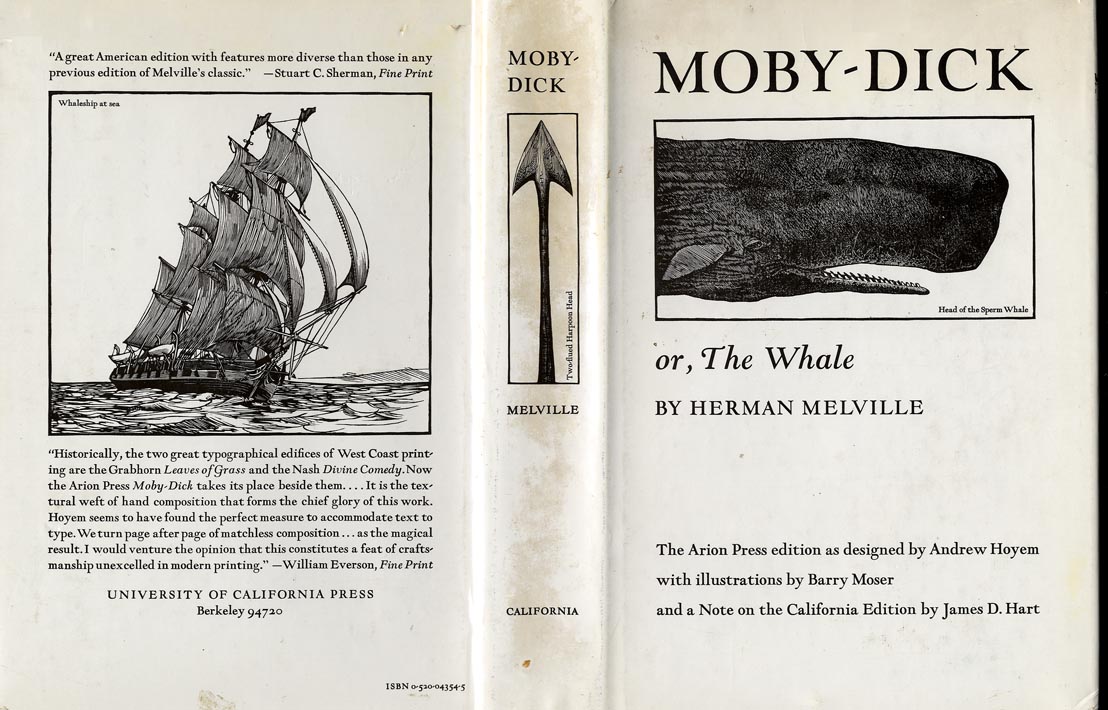
I’ve mailed a copy of Moby-Dick to a reader who wants to read Melville’s book but is short of funds. That’s a situation I understand. In thin times over the years I’ve relied exclusively on public libraries for reading matter, which partially explains why I still patronize them – free books, convenience, the thrill of serendipity. I shipped her the University of California’s paperback reprint of the Arion Press edition illustrated by Barry Moser. The first page is rubber-stamped:


Melville and his family lived at Arrowhead in the Berkshires from 1850 to 1863, and there he wrote most of Moby-Dick and all of Pierre, The Confidence-Man, Israel Potter and The Piazza Tales. In my twenty years living in upstate New York, I visited Arrowhead dozens of times. On the second floor you can look north out the window in the room where Melville worked and see Mount Greylock, which in winter reminded him of a great white sperm whale. He dedicated Pierre to “Greylock’s Most Excellent Majesty.”


Moby-Dick was published in England in October 1851 and a month later in the U.S. It is a famously misunderstood, forgotten and rediscovered book. It went out of print in 1887, four years before Melville’s death. His lifetime earnings from the book totaled $1,260. It was rediscovered by critics and readers near the end of World War I. Among the champions of Moby-Dick was the English writer Viola Meynell (1885-1956). Thanks to her, in 1920 it became the first American novel published in the Oxford World’s Classics series. In the introduction, “A Great Story Teller: Herman Melville,” she writes:


“Herman Melville has that rarest quality, rare even in genius, of wildness, imagination escaping out of bounds. But the whale is the cause — this natural object, and its order, and the truth that we know of it, and its laws, are the occasion of his wildness.”


I’m reminded of this line from Yvor Winters' poem “To a Portrait of Melville in My Library” (1937):Wisdom and wilderness are here at poise.” In defiance of conventional critical wisdom, Winters writes in “Herman Melville and the Problems of Moral Navigation” (In Defense of Reason, 1947) that Moby-Dick is:


“. . . beyond a cavil one of the most carefully and successfully constructed of all major works of literature; to find it careless, redundant, or in any sense romantic, as even its professed admirers are prone to do, is merely to misread the book and to be ignorant of the history leading up to it.”

Monday, September 19, 2022

'A Great Excellence in Style'

“[H]is own style being exceedingly dry and hard, he disapproved of the richness of Johnson's language, and of his frequent use of metaphorical expressions.” 

If Johnson’s prose is criticized, it’s usually for its Latinate solemnity and dignified gravitas – hardly a tone adapted to today’s readers. The dry style in question is the oddly named Lord Monboddo’s (1714-99), the Scottish judge and Darwin precursor who once speculated that orangutans were human. He was a Deist, which probably helped indict him in Dr. Johnson’s judgment. Boswell is writing on this date, September 19, in 1777. Lord Monboddo had written a letter to Boswell in which he criticized Johnson’s A Journey to the Western Islands of Scotland (1775). Johnson replies:


“’Why, Sir, this criticism would be just, if, in my style, superfluous words, or words too big for the thoughts, could be pointed out; but this I do not believe can be done.”


Johnson distills the message I give younger, less experienced writers I work with at the university. Eliminate superfluous words. Be ruthless. Read what you’ve just written and remove the dross. I stress that any prose can be improved, most often by deleting unnecessary words. The way we speak is not identical to the way we write. Writing is editing. Likewise with “words too big for the thoughts.” Customarily, this means jargon, clichés and pretentious language. Popular at the moment is “leverage” as a verb, meaning to use or exploit. And all research is “novel,” of course. Deep-six “leverage” and “novel.” And “stakeholders.” Remember that word entered the language by way of gambling. Boswell continues quoting Johnson:


“For instance: in the passage which Lord Monboddo admires, ‘We were now treading that illustrious region,’ the word illustrious, contributes nothing to the mere narration; for the fact might be told without it: but it is not, therefore, superfluous; for it wakes the mind to peculiar attention, where something of more than usual importance is to be presented. ‘Illustrious!’—for what? and then the sentence proceeds to expand the circumstances connected with Iona. And, Sir, as to metaphorical expression, that is a great excellence in style, when it is used with propriety, for it gives you two ideas for one;—conveys the meaning more luminously, and generally with a perception of delight.”


When I think of “metaphorical” prose, two writers come to mind: Sir Thomas Browne and Herman Melville. Of the former in his “Life of Browne,” Johnson writes what sounds suspiciously like a self-judgment: “It is vigorous, but rugged; it is learned, but pedantick; it is deep, but obscure; it strikes, but does not please; it commands, but does not allure: his tropes are harsh, and his combinations uncouth.” And this is a positive assessment.

Sunday, September 18, 2022

'A High Place Among Minor Poets'

If I were asked to introduce a newcomer to Dr. Johnson, the first book I would suggest he read is his final major work, Lives of the Most Eminent English Poets (1779-81). Johnson reviews the lives and works of fifty-two poets. Even novice readers will know the big names Johnson takes on – Milton, Dryden, Pope, Swift. But part of the enduring charm of the book is Johnson’s reclamation of minor, half-forgotten figures. Take Johnson’s assessment of the euphoniously named Thomas Tickell: 

“[T]he versification is smooth and elegant, but the fiction unskilfully compounded of Grecian Deities and Gothick Fairies. Neither species of those exploded Beings could have done much; and when they are brought together, they only make each other contemptible. To Tickell, however, cannot be refused a high place among the minor poets; nor should it be forgotten that he was one of the contributors to the Spectator. With respect to his personal character, he is said to have been a man of gay conversation, at least a temperate lover of wine and company, and in his domestick relations without censure.”


Johnson works hard to be fair: “a high place among minor poets.” Think of how many poets we revere who can be stuffed under that umbrella. There’s no shame in such a judgment, though to contemporary tastes Tickell's verse would be a tough sell.


One mark of a major literary critic is that even when he is wrong in his judgments, he is usefully, interestingly wrong. In Boswell’s account Johnson is wrong about Sterne, for instance: “Nothing odd will do long. Tristram Shandy did not last.” Johnson thus reminds us to beware of novelty for its own sake. There has to be more to the work than mere eccentricity. Here is Johnson on Dryden:


“Perhaps no nation ever produced a writer that enriched his language with such variety of models. To him we owe the improvement, perhaps the completion of our metre, the refinement of our language, and much of the correctness of our sentiments. By him we were taught ‘sapere et fari,’ to think naturally and express forcibly.”


In his biography of Johnson, John Wain writes: “The Lives of the Poets is a work of memory, judgement, and love, not a work of research.” The lessons Johnson learned when writing his periodical essays he applies to his great poetical forebears.


Johnson was born on this date, September 18, in 1709.

Saturday, September 17, 2022

'In the Way of Politicians, Urbanists, Pedagogues'

“I’m rather sensitive to the presence of history,” says the late Adam Zagajewski, and in an essay titled “The Presence of History,” his fellow Pole, Zbigniew Herbert, writes: 

“No one denies that the past exists, although we try to push it under the surface of consciousness. It exists, because it stands in the way of politicians, urbanists, pedagogues. It’s big, mute, heavy, awkward. Even if it’s dead—as some claim—it can’t be hidden or destroyed without a trace.”


Unlike Americans, Poles can’t afford to forget the past, deny its existence or edit it for our convenience. The air in Poland is heavier, dense with history. In May 2012, I was the sole American attending the wedding of my wife’s cousin. He is German, the bride Polish. I stayed at the inn where the reception was held, in Mszana Doln, near Kraków. In early September 1939, the 10th Armored Cavalry Brigade of General Stanisław Maczek fought here against the advancing Wehrmacht. During the war, Mszana Doln lost one-third of its population, including its Jews, of whom 881 were murdered by the Germans on August 19, 1942. One drizzly afternoon I took a walk and happened on a stark monument of gray granite, away from the main street and obscured by woods. The inscriptions were in Polish but I understood it was dedicated to the Polish dead of World War II.


September 17 for Poles might be likened to September 11 for Americans. On that day, two weeks after the Germans invaded from the west, the Red Army invaded from the east. In his poem “September 17,” Herbert writes:


“My defenseless country will admit you invader

and give you a plot of earth under a willow—and peace

so those who come after us will learn again

the most difficult art—the forgiveness of sins”


Have the Poles forgiven Hitler – and Stalin? I’m in no position to say. Herbert writes in “The Presence of History”:


“It’s pleasant to engage with history when one has a sense of one’s own innocence, righteousness, and serenity. Then it’s easy to pass judgment on the past, defend the oppressed, and brand the tyrants. . . . History turns into a balance sheet of conscience—it condemns, reminds, robs us of peace.”


[Herbert’s 1975 essay is found in The Collected Prose: 1948-1998 (trans. Alissa Valles, Ecco, 2010).]

Friday, September 16, 2022

'God and Mother and Betrayal'

The poet Turner Cassity in the April 2000 issue of Modernism/modernity reviewed Workin’ Man Blues: Country Music in California by Gerald W. Haslam, and he takes it seriously, without condescension. Readers shouldn’t be surprised. We already know that anything might show up in Cassity's poems. They have identifiable subjects. They are always about something other than the poet and his precious feelings. Cassity revels in knowing things. In this he reminds me of Guy Davenport, who wrote: “I am not writing for scholars or fellow critics, but for people who like to read, to look at pictures, and to know things.” Cassity shares what he and Haslam know:

“Haslam’s own credentials are flawless. He went to elementary school in Oildale, outside Bakersfield, with Merle Haggard, and he makes the point right away that Nashville’s claim to have been, if not the mother city, then at least the Bayreuth of country is not secure. Atlanta in the 1920s, Chicago in the 1930s, and Hollywood in the 1940s could challenge its primacy. Nashville is a manipulation of the recording companies, whose fickleness the book details.”


Cassity was born in Mississippi in 1929 and for almost forty years he worked as a librarian at Emory University in Atlanta, Ga. He was a Southerner. At least by the late 60s, country music had gone mainstream. In 1969 I bought the double album Same Train, A Different Time: Merle Haggard Sings the Great Songs of Jimmie Rodgers, and albums by Lefty Frizzell, George Jones, and Hank Williams, who died just months after I was born. And, of course, Gram Parsons. I love the scene in The Last Waltz when Arkansas-born Levon Helm casually refers to Muddy Waters as “the king of country music.” Cassity writes:


“Not surprisingly, the subject matter of the lyrics is pretty much as it has been parodied. Only in tango is there a higher percentage of God and Mother and betrayal. However, Haslam supplies enough background and supporting material to soften the edges of the stereotype, making it clear that there were Okies who had to put up with things that would have frightened John Steinbeck to death.”


At his death in 2009, Cassity left two unpublished books of poems: Hitler’s Weather and Poems for Isobel. Cassity’s literary executor, R.L. Barth, sent me copies of the manuscripts. In his review of Haslam's book, Cassity refers to “Hank Williams the Elder.” Williams makes a brief appearance in “Oppie in the Heartland” in Hitler’s Weather. “Oppie” is J. Robert Oppenheimer:


“End of the World, for Pentecostal outreach groups

In 1930s farm states, so preoccupies

Revivals that not much is heard of cards, strong drink,

And missionaries. Not that, ordinarily,

The End is spelled out in detail. The Last Trump sounds;

Imagination does the rest, and memories

Of illustrations from the Dore Bible. Meant

As an apotheosis, Come-To-Jesus seems

Almost a comedown. But with 1945

And the atomic bomb, and possibility

The world in fact may end, the tent revivalists

Fall strangely quiet. Some, the more sophisticated,

Take on godless communism; most fall back

To battling Darwin. Missionaries may have lost

Cachet, along with China, and as a destroyer

Of worlds J. Robert Oppenheimer, stringy build

And hair out of control, have less the look of Shiva

Than of, say, Hank Williams, Sr.--and be fit

Reminder that the worlds of gambling and of drink

Go on--yet change and incongruity cannot

Prevent re-labeling as ‘Rapture’ what was once

The Day of Judgment, or to anti-Darwin minds

Point out that Fundamentalism too evolves.”