Monday, September 30, 2013

`Ordinary Everyday Readers of English Literature'

On my father-in-law’s shelves are thirteen books he was awarded as academic prizes while a student at Saint Andrew’s College in Aurora, Ontario, in the early nineteen-fifties.  Among the volumes, all published by Oxford, are three by Shakespeare, two by Dickens and one each by Byron and Tennyson. There was a time when educated people read and valued such things, and judged them worthy of bestowing on accomplished students. Our thirteen-year-old son is now a student at St. Andrew’s, and I wonder if the  school still gives books as prizes, or is it gift cards and “smartphones.” Not one of the Oxford volumes, all printed on fine India paper and some bound in leather, has turned brown. The bindings remain sturdy, spines unbroken, despite residence in three countries across sixty years. 

The largest of the books, at 932 two-column pages, is the third edition of The Oxford Companion to English Literature (1932), edited by Sir Paul Harvey and reprinted in 1953. As a sign of the times, consider the opening sentence of Harvey’s preface: “This volume will serve its purpose if it proves a useful companion to ordinary everyday readers of English literature.” One could write a substantial volume devoted exclusively to glossing nearly every word in that sentence, including “a.” The emphasis on the uncommon common reader is almost poignant, and Harvey’s tome can read as an artifact from an almost-vanished civilization. He devotes slightly more space to Dr. Johnson than to Shakespeare, and makes this curious observation of the lexicographer: 

“Johnson’s literary output bears no proportion to his reputation. The latter is due in great measure to the fortunate accident by which an ideal biographer was found in Boswell to record for us the humour, wit, and sturdy common sense of his conversation, and a kindness of heart sometime concealed under a gruff exterior.” 

Most entries are brief and factual, a collection of names, titles and dates, but occasionally Harvey digresses into often entertaining opinion. Of Ben Jonson he writes: “As a man Jonson was arrogant and quarrelsome, but fearless, warm-hearted, and intellectually honest.” Why “but?”  Of Thomas Gray, unexpectedly: “His letters are among the best in the language; they reveal his character and humorous spirit.” Harvey includes entries for T.S. Eliot but not Pound or Stevens. From Fors Clavigera, he quotes several sentences (not typical of most entries) and says Ruskin “sets out to show the causes of the evil and the means of remedying it.” And who do you suppose he’s writing about here: “He is considered typical of a certain side of modern American writing. That is to say he is sophisticated, conscientiously unsentimental, and largely concerned with members of the various American colonies in Europe, especially in Paris.” That would be Hemingway. 

As a bonus, I’ll reproduce a passage from another of my father-in-law’s prizes, The Musical Companion: A Compendium for All Lovers of Music (1934), edited by A.L. Bacharach. This is the “eighteenth impression,” published in May 1952, from a section titled “A Word About Rhythm and `Rubato’”:                                       

“Jazz, popularly supposed to be much the most rhythmic music, is not rhythmic at all, but rigidly metrical. True rhythm has the fundamental regularity, but also the quick, responsive variability, of the human pulse, not the mechanically precise beat of the metronome. It feels time and goes in time, but not dead in time. Yet the jazz fever—if anything so cold-blooded and machine-pulsed may be called fever—has been allowed to invade the concert room. One has heard performances of Mozart concertos, particularly by one of the younger French pianists, sound as though their composer were indeed the `Austrian Gershwin.’”

Sunday, September 29, 2013

`It Makes Me Think of Home'

My in-laws’ neighborhood in Fredericksburg, Va., near the battlefield, is heavily wooded with oaks, beeches, tulip trees, holly and various maples, and I was hoping to see evidence of autumn, a season cooler than high summer but otherwise rather undistinguished in Houston. Virginia is still mostly green. The leaves on the tulips are turning a muddy yellow but most colorful are the dogwoods, richly scarlet, filling in the lower reaches of the woods among the taller trees. In a letter he wrote here in Fredericksburg five months after the battle, on May 14, 1863, Richard Henry Brooks tells his wife Telitha: “The Spring is open hear now the Peach trees is all in full bloom an the dog woods are in bloom an all the bushes are buding out nice it makes me think of home.” 

Home for Brooks was Blakely, Ga. He enlisted in May 1862 and served in Longstreet’s Corps for the duration of the war. His letters home are collected in Keep All My Letters: The Civil War Letters of Richard Henry Brooks, 51st Georgia Infantry (ed. K.S. Holland, Mercer University Press, 2003). Many were written here in Fredericksburg, before and after the battle, and I enjoy the knowledge that Brooks, a curious, observant man with a well-exercised sense of humor, who was much devoted to his family, walked this same ground a century and a half ago. Here is a passage from a letter written Aug. 15, 1863, from Fredericksburg: 

“My Dear I was very sorry to hear of you’re an the children’s sickness but I hope when you get this you will all be better, if you are not try my old remedy take 60 grains of Quinine an forty grains of Rhubarb and put it in one quart of whiskey an take a big spoonful three times a day, an give the children a teaspoon full three times a day. an I think that will cure you all of the chills an fever.”

Saturday, September 28, 2013

`A Glory Lights an Earnest End'

“Old, much alone, and seemingly self-sufficient, Melville could still be thawed, though when a topic set him off he might fall into harangue rather than genial conversation.” 

Herman Melville’s final years have been thoroughly mythologized by fellow writers seeking to heighten their sense of romanticized neglect. So goes the familiar lament: Artists are misunderstood and unappreciated. When will the boorish public recognize our brilliance? In June 1851, as he labors to finish Moby-Dick, Melville writes to Hawthorne with his customary tone of mingled braggadocio and self-pity: 

“Dollars damn me; and the malicious Devil is forever grinning in upon me, holding the door ajar. My dear Sir, a presentiment is on me, -- I shall at last be worn out and perish, like an old nutmeg-grater, grated to pieces by the constant attrition of the wood, that is, the nutmeg. What I feel most moved to write, that is banned, -- it will not pay. Yet, altogether, write the other way I cannot. So the product is a final hash, and all my books are botches.” 

No, just most of them, but the others are glories of American literature and the world’s. That Melville was a difficult character, perhaps a depressive, is obvious. So too that he wrote great books and bad ones. No sane man writes with the expectation of fame,  wealth and universal love. Art is not a democracy and its values are not egalitarian. Critical justice is rare and good intentions count for nothing. Bad writers thrive, good ones wither.  More rarely, good ones thrive and bad ones wither. It has nothing to do with fairness. The late Frederick Busch’s novel The Night Inspector (1999) includes Melville as a character in his role as customs inspector for the City of New York. That’s the job he secured in 1866, the year he published his poetry collection Battle Pieces and Aspects of the War, which surely ranks among his masterpieces. Busch also writes about the author of Moby-Dick in “Melville’s Mail” (A Dangerous Profession: A Book About the Writing Life, 1998). In another essay in that collection, “The Floating Christmas Tree,” he might be writing with Melville in mind: 

“Writing, then, is a test of character; the ones who pass are merely doing what their trade requires, while the ones who fail are doing what comes, alas, quite naturally.” 

I’m traveling today to Fredericksburg, Va., to spend a week caring for ailing in-laws. Most days I should get to tramp around the battlefield, keeping in mind Melville’s “Inscription for the Slain [Dead] at Fredericksburgh”: 

“A glory lights an earnest end;
 In jubilee the patriot ghosts ascend.
 Transfigured at the rapturous height
 Of their passionate feat of arms,
 Death to the brave’s a starry night, —
 Strown their vale of death with palms.” 

Cynthia Wachtell reminds us that Melville waffled on the wording of this poem, eliding “dreadful” as the modifier for “glory,” among other changes. Either version of the first line seems a prescient comment on Melville’s subsequent quarter-century of life as a writer. The passage quoted at the top comes from near the end of Hershel Parker’s Herman Melville: A Biography Vol. 2, 1851-1891 (2002). As the epigraph to his final chapter, “In and Out of the House of the Tragic Poet,” Parker quotes the Oct. 10, 1891, issue of Harper’s Weekly: 

“The name of Herman Melville will not suggest any note of interest to many readers, but it none the less recalls the career of a man of brilliant genius, who practically retired from the pursuit of letters a quarter of a century since, in the prime of his powers.” 

Melville died on this date, Sept. 28, in 1891, age seventy-two.

Friday, September 27, 2013

`We Could Not Pull It Away or Cut It'

“The wood, very hard and yellowish in color, will not rot much faster than steel.  Traditionally it has been used for archery bows. Such bows, still being made by woodcrafters, are breathtakingly beautiful and in demand if you’ve got the money. Any woodenware made with Osage orange is ultra-striking— jewel wood, I call it.” 

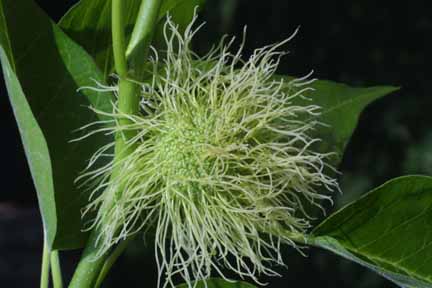
This is The Contrary Farmer, Gene Logsdon, recently writing about the Osage orange, Maclura pomifera, since childhood one of my favorite trees. We called its fruit “monkey balls,” though anatomically they resemble green cerebrums the size and shape of softballs. The trees formed a dense, thorny hedge between my elementary school and the neighbor to the north. An alternate folk name is “hedge apple.” Squirrels savor them. Little boys throw them. Their taste is bitter and the white sap they leak is sticky as a milkweed’s and contains 2,3,4,5—tetrahydroxystilbene, a natural insect repellant. Small, black, wiry hairs grow from the dimples on the surface of the fruit (“monkey balls?”).  

The first half of the name derives from the early inhabitants of the Osage River Valley in Missouri. The Europeans didn’t what to make of what they called themselves, and mangled the word accordingly. The Oxford English Dictionary reports: “In the 19th cent. a large number of forms reflect attempts to reproduce the original Osage form. These include Huashasha, Huzaa, Huzzaw, Osawsee, Wahasha, Wasagè, Wasasa, Washasha, Wassashasha, Wassashsha, Wausashe, Wawsashe, Wazhazhe, and Wossoshe.” In the OED, I also found a wonderful citation from the April 15, 1910, issue of Science: “Osage orange endures hail better than any other of the broadleaved trees.” The “orange” is said to refer of the citric scent from the fruit, but I don’t remember smelling that. 

Donald Culross Peattie, our poet laureate of flora, says in The Natural History of North American Trees that the Osage orange “is not a gracious tree; it sends out, unless carefully tended, long sprawling shoots that render it shapeless and unsightly. The foliage is very tardy, not appearing until mid-May in the latitude of Chicago, and the unattractive flowers [a little harsh: see female and male flowers], which bloom in June and July, are wind-pollinated and cause some hay fever.” 

Among the 177 new species of plants identified by Meriwether Lewis during his journey west was the Osage orange. On March 26, 1804, near St. Louis, in a letter accompanying some cuttings from the tree, Lewis writes to Thomas Jefferson: “So much do the savages esteem the wood of this tree for the purpose of making their bows, that they travel many hundreds of miles in quest of it.” Earlier French explorers had already discovered the tree and named it bois-d’arc, “wood of the bow.” Later English speakers corrupted the name to “bodark.” 

Several grim stories about the Osage orange date from the Civil War. On June 7, 1863, Confederate Maj. Gen. J.G. Walker attacked a Union force at Milliken’s Bend in Louisiana, hoping to relieve some of the pressure on Vicksburg. His attack was thwarted, in part, by a dense hedge of Osage orange around the village. In a report he wrote three days later, Walker said the Union soldiers were “posted behind the hedges, so as to fire through the openings. Upon reaching the hedges it was found utterly impracticable to pass them except through the few openings left for convenience by the planter. In doing this, the order of battle was necessarily broken, and the frequency with which this became necessary before reaching the first levee, behind which the enemy in superior force was found posted, exposed the brigade to a galling fire.” 

Osage orange is credited with contributing to another Confederate defeat, this one on the outskirts of Franklin, Tenn., on Nov. 30, 1864. Part of a Union force under the command of Gen. John M. Schofield deployed in trenches dug behind a dense thicket of Osage orange. The southerners advanced across open farm fields. Many of the Union soldiers were armed not with muskets but newly issued repeating rifles. Joseph Nicholas Thompson of the 35th Alabama wrote in a letter: 

“…a wall of fire rose that swept our ranks like hail. Many fell then, but on we went up to them, and when we got to their works we found that we could not get to them on account of a Osage orange hedge in front of their works, so thick that we could not pull it away or cut it. Poor Capt Steward the last I saw of him he was trying to cut a path through the Osage orange hedge with his sword. He fell with four bullets in him. I soon saw that nearly all of my company was killed or wounded.”

Thursday, September 26, 2013

`Intelligence and the Grace of Blessed Temperament'

A reader writes: 

“One shouldn’t make imperious statements, speak with unbridled certitude, but as I get older I think the biggest difference between men…is intelligence. My theory, which I pretty much keep to myself, is that what saved Johnson, Lamb, and Dickinson, even enabled them to succeed almost without parallel, was their superior intelligence. Had Johnson or Dickinson had an IQ score ten points lower (it’s just convenient to word it this way), both, I am convinced would have ended up mad, locked away, Johnson in Bedlam, Dickinson a mad woman locked away in the attic. Lamb, without his intelligence and the grace of blessed temperament, might have ended up a mere drunk.” 

I’ve come to suspect that intelligence, sheer intellectual capacity, unless tempered with the proper qualities, is overrated. That Johnson (especially Johnson), Lamb and Dickinson were phenomenally gifted is inarguable, especially because intelligence among writers, as among pipefitters and psychiatrists, is always chronically scarce. How smart was Shakespeare? That he was a genius is incontestable, but his retroactively calculated IQ is up for grabs, and probably irrelevant. To his credit, my reader adds: “When all is said and done, however, what remains of these three geniuses is their work. Their lives would not interest us so much was their work mediocre.” 

Precisely. I replied, in part, to my reader: “To your mention of intelligence I would add just the right mingling of pride and humility. Pure self-centeredness is crippling and, obviously, obnoxious. Too much humility turns men into noodles. Johnson is exhibit A when it comes to the optimal balance.” In The Rambler #103, Johnson identifies a critical ingredient in intelligence: “Curiosity is one of the permanent and certain characteristics of a vigorous intellect.” Mental inertness, regardless of IQ, is a sure symptom of what we might call functional dumbness (see: functional illiteracy). Joseph Epstein writes of IQ: 

“IQ was derived by dividing mental age by actual age and then multiplying by 100. What IQ chiefly showed was a propensity, or want thereof, for solving abstract problems. (The Scholastic Aptitude Test similarly predicts nothing more than one’s chances of doing well in college.) Chess players, mathematics wizards, memory freaks tended to score highest on IQ tests.” 

Perhaps intelligence is many things, and never complete unto itself. Lamb says, “Books think for me,” and no one would suspect him of mental dimness. And Dickinson, that subtle comedian, knew when and how to use a microscope.

Wednesday, September 25, 2013

`Innocent Vanities, and Jests, and Irony Itself'

One of the lasting pleasures of reading Charles Lamb is the dreamy logic of his essays and letters tempered by the precision of their digressive prose. Lamb’s Muse is Whimsy – for most writers, a death sentence. From phrase to phrase he abruptly shifts voice, tone and persona. He revels in put-ons, confidence games and aliases. Despite his cherished archaisms, Lamb seems more our contemporary than his fellow English Romantics. A gin-addled Fernando Pessoa with a sense of humor, a less savage Flann O’Brien, Lamb christens his alter ego Elia -- “a lie” anagrammized. Helen Rittelmeyer gives a close and sympathetic reading to Lamb, his drinking and work, specifically “Confessions of a Drunkard,” dating from 1813, a decade before the great Elia essays, though retrofitted by Lamb into his masterpiece. Rittelmeyer writes: 

“The `Elia’ essays, on which Lamb’s reputation as a writer rests, are light-hearted musings on very ordinary topics like how dull one’s friends become when they marry. It is almost enough to point out that the title of the most well-known Elia essay is (what could be more benign) `A Dissertation Upon Roast Pig.’” 

Well, yes and no. “Light-hearted musings on very ordinary topics” is about half-right, mostly because Rittelmeyer’s words are more suggestive than precise. Critics and readers long ago pigeonholed Lamb as a folksy purveyor of gentle good humor. In this mode he often skirts insufferability, and a prudent writer would no more try to imitate Lamb than he would Laurence Sterne. Such voices are too invitingly inimitable. “Musings” suggests cracker-barrel inanities. I hear a residue of condescension in Rittelmeyer’s reference to “very ordinary topics.” Lamb had a horror of pretension, of the big ideas of the day, which is why he found his friends Coleridge and Wordsworth, and most of all Hazlitt, so inexhaustibly silly, while admiring them extravagantly (in Lamb, everything is balance). In a letter to Southey, Lamb writes: “I was at Hazlitt’s marriage, and had like to have been turned out several times during the ceremony. Anything awful makes me laugh. I misbehaved once at a funeral.” Lamb could never have written an op-ed piece. He could never muster sufficient portentousness. 

That Lamb sometimes drank to excess, that he was a tippler, a toper, a tosspot, seems inarguable. That he was an “alcoholic” is less certain. As a noun, the word entered the language after Lamb’s death. Its veneer of medical respectability accrued slowly across the next century. The disease concept of alcoholism is useful and widely accepted but remains contentious and unproven. Like cancer, alcoholism seems multivalent. There are as many “alcoholisms” as there are drunks. The matter is made even more complicated by Lamb being the sort of writer he is. “Confessions of a Drunkard” has been read as straight autobiography, but I’m not certain anything Lamb ever wrote can be so described. The language of the essay is inflated to mock-pomposity, as in the opening sentence: “Dehortations from the use of strong liquors have been the favourite topic of sober declaimers in all ages, and have been received with applause by water-drinking critics.” This sounds familiar to any longtime reader of Lamb. To label it a “recovery memoir” – a marketing phrase – is laughable. Lamb is creating a character, telling a story and giving his narrator a voice that resembles his own in the same sense that a parody resembles the original text – exaggerated but close enough to fool us. 

In A Portrait of Charles Lamb (1984), Lord David Cecil writes of the essayist’s drinking: “It may not have, in consequence, been very good for his health but it did not impair his efficiency. Neither did it change his personality for the worse: no description of him in his cups presents him as disgusting or quarrelsome or embarrassingly sentimental. Rather, he was an exaggeration of his sober self in high spirits—drunk with an airy elfin drunkenness that grew ever more freakish and fantastic, more prone to extravagant unexpected talk and actions, punctuated by sudden fits of falling asleep.” Again, every alcoholic is idiosyncratic. Of “Confessions of a Drunkard,” Cecil says, “though we can recognise some of it as drawn from his experience, in the main it is fiction.” I think this is close to the case, though Rittelmeyer counters, in part: 

“It has little in common with the two standard addiction narratives of its era, the maudlin cautionary tale popular in temperance tracts or the Romantic panegyric on the spiritual benefits of intoxication. It is clear-eyed, unsparing, and full of insight—and after setting down such a perceptive first-person account, Lamb tried a dozen different evasions to avoid being credited with it.” 

True enough, but we can’t read “Confessions” as unambiguous case study. In A Double Life: A Biography of Charles and Mary Lamb (2003), Sarah Burton describes “Confessions of a Drunkard” as Lamb’s “most controversial piece of writing as far as his autobiographical work [already stacking the deck] is concerned,” and writes: “Widely believed to be a gross exaggeration of the facts—if not outright fiction—it nevertheless represents a major inconvenience to those who have argued that Charles’s drinking was not a problem.” 

His gift as a writer will always eclipse his drinking, but Lamb is a special case. As with Dr. Johnson, readers, including this one, have difficulty segregating writer and man. Lamb was a good man and a great writer. His devotion to his sister Mary suggests saintliness. In “New Year’s  Eve” he writes: 

“A new state of being staggers me. Sun, and sky, and breeze, and solitary walks, and summer holidays, and the greenness of fields, and the delicious juices of meats and fishes, and society, and the cheerful glass, and candle-light, and fire-side conversations, and innocent vanities, and jests, and irony itself—do these things go out with life?”

Tuesday, September 24, 2013

`Any Man with a Large Enough Mind'

My taste in authors, I find, runs to those who write little and those who seem unable to stop writing. In the first group we find Edgar Bowers and J.V. Cunningham, poets of the Stanford School variously associated and disassociated with Yvor Winters, who also wrote a small body of poetry but much criticism, both excellent. Bowers and Cunningham were painstaking craftsmen, neither ever published a mediocre poem and both wrote several poems that are perfect. Other writers in the same unprolific-but-highly-accomplished corner are J.F. Powers and John Williams (Stoner). The connection between low productivity and artistic excellence is intriguing but remains unproven. 

Among the high-volume writers I favor are Johnson, Chekhov, Henry James, P.G. Wodehouse – and Shakespeare. Inclusion of the last may surprise, but he had a hand in at least thirty-eight plays, 154 sonnets and two long narrative poems, and died at age fifty-two. He was a working writer, a professional who produced on demand, never a dilettante. In the same league of high-fecundity we find a writer who proudly described himself as a journalist – G.K. Chesterton. There are stories of him writing two articles or reviews simultaneously. A bibliography of his work will probably always remain incomplete, though we know he produced 1,535 essays for the Illustrated London News between 1905 and 1936. In “What is Right With the World” he writes: 

“Any man with a large mind ought to be able to write about anything. Any really free man ought to be able to write to order. Some of the greatest books in the world -- Pickwick, for instance -- were written to fulfil a scheme partly sketched out by a publisher.”

Inspiration without industriousness is self-indulgent and sterile. The connection between high productivity and artistic excellence is intriguing but remains unproven.

Monday, September 23, 2013

`The Happy Eachness of All Things'

Sometimes a line or two will shine from the dimness of an otherwise undistinguished poem. Much of Auden’s later verse was occasional, prompted by a births, deaths, weddings or commencements. In his final decade, he wrote poems about the assassination of President Kennedy and man’s first walk on the moon. By definition, this is public poetry, prompted by a public occasion but also implying a pronouncement not hermetic but cheerfully accessible, open to a large intelligent audience, not merely academics or fellow poets. Auden is a fluent master of this mode. “Prologue at Sixty” was published on the occasion of his sixtieth birthday in 1967, in the New York Review of Books, and collected in City Without Walls (1969). In book form, the poem is dedicated to Friedrich Heer (1916-1983), the Austrian historian. It’s conversational, digressive, the talk of a charming, thoughtful witty man on the cusp of old age. These lines illuminate the rest for me:

“a Mind of Honor must acknowledge
the happy eachness of all things,
distinguish even from odd numbers,
and bear witness to what-is-the-case.”
 

“Happy eachness” is a memorable fine, typical of Auden’s late sense of gratitude for creation, despite human foolishness and cruelty. One of his best interpreters, Arthur Kirsch, writes of the poet’s late manner in Auden and Christianity (2005): “He becomes more interested in forgiveness, thankfulness, and prayer.” Born on Feb. 21, 1907, Auden died forty years ago this week, on Sept. 29, 1973. An old friend, now a professor of English in Pennsylvania, came downstairs to tell me of Auden’s death, and I remember there were tears in his eyes.

Sunday, September 22, 2013

`Be Sure of Finding Something Interesting'

Aldous Huxley was first inflicted on me in the eighth grade when we were assigned Brave New World. My transition from children’s books (science fiction, Tolkien) to literature (Kafka, Thoreau) was well underway, and Huxley’s novel (like 1984) struck me as the former disguised as the latter. It was thesis-driven and grindingly dull, written in indifferent prose, and that pretty much fixed my understanding of Huxley as a big-idea writer of shallow means – a species much favored by teachers. Mike Gilleland has been reading Huxley’s essay “Books for the Journey,” collected in Along the Road: Notes and Essays of a Tourist (1925), and quotes excerpts from it here, here and here. The theme interests me – which books to pack for sustenance – so I borrowed Huxley’s Complete Essays, Vol. 1: 1920-1925, read the entire essay and found a few things of interest not quoted by Mike. Some of it gibes with my experience. For instance, he lists the essential qualities of a “good traveling-book”: 

“It should be a work of such a kind that one can open it anywhere and be sure of finding something interesting, complete in itself and susceptible of being read in a short time. A book requiring continuous attention and prolonged mental effort is useless on a voyage; for leisure, when one travels, is brief and tinged with physical fatigue, the mind distracted and unapt to make protracted exertions.” 

This is true to my reading, especially on long jet flights. Huxley goes on to recommend poetry anthologies, and that’s a prudent choice, but I would also suggest books of brief prose passages – journals, diaries, letters. Mike and I are both reading Leopardi’s recently translated Zibaldone, which would be excellent for cross-continental travel while having the advantage of being pleasingly zaftig (2,592 pages). Huxley’s choice of La Rochefoucauld is ideal. An aphorism, he rightly says, “does not depend on verbal wit. Its effect is not momentary, and the more we think of it, the more substance we find in it” – making it at once compact and dense, and thus ideally portable. Most commendable is Huxley’s endorsement of Boswell’s Life of Johnson as a volume that “combines expansive aphorisms with anecdotes.” 

He praises a technological development in printing – the use by Oxford Press of India paper, which permits publication of small octavo volumes, long before the paperback revolution and ebooks. Huxley gives Henry Frowde, a fascinating character, most of the credit: “Thanks to Henry Frowde one can get a million words of reading matter into a rucksack and hardly feel the difference in its weight.” He goes on to celebrate “what in my opinion is the best traveler’s book of all – a volume (any one of the thirty-two will do) of the twelfth, half-size edition of the Encyclopedia.” Here I part company with Huxley and laud Frowde’s contribution. My most frequent traveling companions have been my two-volume Lives of the English Poets by Samuel Johnson and a one-volume Gulliver’s Travels – both pocket-sized, hard-covered and published by Oxford.

Saturday, September 21, 2013

`To Pay Homage to the Late Sublime'

Consolation, like enlightenment, is fickle or at least unreliable. To depend on its prompt arrival is childish, though even children know better than to believe the world will soothe the wounds it inflicts. To pass the time waiting for the ophthalmologist, one day after cataract surgery, I packed a library copy of Moon in a Dewdrop: Writings of Zen Master Dōgen (North Point Press, 1985) – not my customary reading, but I was looking for something I remembered finding in it a long time ago. Instead, what I found was a folded sheet of ruled paper tucked into the glossary/index. On it, in a childish hand, were two words printed in pencil: “You’re stupid.” A note passed behind the rōshi’s back? A koan? Regardless, I closed the book and picked up the clinic’s copy of The New Yorker for June 3, 2013. There I found Clive James’ Leçons des ténèbres, which begins:

“But are they lessons, all these things I learn
Through being so far gone in my decline?
The wages of experience I earn
Would service well a younger life than mine.
I should have been more kind. It is my fate
To find this out, but find it out too late.”


The moral life has a certain symmetry, but only when perceived retrospectively. Too little, too late; youth wasted on the young – all that Shavian cleverness that never quite convinces. Some of us, even the brightest, never stop being stupid. James calls his recent poems “funeral songs.” For several years he has been sick with lymphocytic leukemia, but remains productive, a dedicated word man to the end, or almost the end. Leçons des ténèbres concludes:

“Not only to enumerate my wrongs
But to pay homage to the late sublime
That comes with seeing how the years have brought
A fitting end, if not the one I sought.”


The ophthalmologist tells me the vision in my right eye, without corrective lenses, is now 20/20.

Friday, September 20, 2013

`Vex Not the Poet's Mind'

Stevie Smith’s favored reading included theology, the Teutonic nightmares of the Brothers Grimm and her preferred poets, Tennyson and Browning, whom she read assiduously from childhood. She read as a poet reads, not as a scholar or critic – for pleasure, kinship and confirmation of purpose. Wayward and immune to fashion, she owed no poetic debts to her English-language contemporaries. Take this scene from the third of her three novels, The Holiday (1949): 

“After supper we had the very great relief of listening to Maud being read on the radio by Robert Harris; he read for three-quarters of an hour; his voice was controlled, strong, clear and sensitive, never strained, never affected. I thought: So there goes our hero to the Crimean War for his seelische Entlassung [“emotional release”], and no thought for him whether it was a good war, or the right war, or the right front, et cetera. So off he goes, as happy as the day is long, to fetch a bullet in a simple death.” 

The collection Maud, and Other Poems (1855) was Tennyson’s first after becoming poet laureate, and includes his patriotic warhorse “The Charge of the Light Brigade.” “Maud” is an uneasy mix of monodrama, melodrama and pastoral, featuring suicide, a fatal duel, death from a broken heart, madness and war. None of this bothers Smith’s narrator: 

“And I thought: Here indeed is the great Tennyson a-roar, God bless the great Tennyson. And God blessed him and he wrote: `A still small voice said unto me, Thou art so full of misery, Were it not better not to be? Then to the still small voice I said, I cannot cast into the grave, what is so wonderfully made.’ Hurrah.” 

The quoted lines are a purposeful mangling of the first two stanzas of Tennyson’s “The Two Voices” (1842). Smith replaces the fifth line, “Let me not cast in endless shade,” with “I cannot cast into the grave.” The line “Were it not better not to be?” expresses Smith’s frequent longing for oblivion (not the same as romancing suicide), one she shares with Samuel Beckett. Elsewhere, Smith writes: “There are some human beings who do not wish for eternal life.” Smith next refers obliquely to the initial outrage voiced by English readers over Maud: 

“And what did Tennyson say when the reader bit at him, when the sheep-like shallow-pate of a reading public ventured a word of protest, `A word in your ear, if I may make so bold’—if they dared demur? What the great Tennyson, the supposedly meek and mild Old Blether of a Queen’s pet baa-lamb, said was this: 

“`Vex not the poet’s mind
With thy shallow wit
Vex not thou the poet’s mind
For thou canst not fathom it.'” 

Here, Smith seems to be voicing her own poetic credo by appropriating a stanza from Tennyson’s “The Poet’s Mind” (1830). Smith was born on this date, Sept. 20, in 1902, and died on March 7, 1971, at age sixty-eight.

Thursday, September 19, 2013

`Lift Them, Keep Them Away'

Twenty-five years ago I wrote a story for my newspaper about a revival in the use of leeches in medical procedures. For centuries, bleeding was a much-favored cure-all among doctors otherwise helpless in the face of disease, but who wished to appear decisive to their patients. The Theory of Humors encouraged the practice. As a sort of automated blood-letting device, leeches were dramatic, and anything stirring primal revulsion had to be efficacious. In one of the recent additions to its “Animal” series, Reaktion Books has published Leech by Robert G.W. Kirk and Neil Pemberton, who write: 

“Once in position leeches were generally allowed to work until they chose to detach themselves, which could take anything from 30 minute to an hour. Physical removal was thought equally damaging to leech and human and so was discouraged. However, if a patient began to feel faint, physicians could intervene by sprinkling salt, pepper or ashes onto the leech, causing the animal to detach.” 

The story I wrote involved the use of leeches in microsurgery to correct “venous insufficiency,” helping to permit blood flow to such damaged tissue as a reattached finger. The saliva of leeches contains an enzyme that prevents clotting. Patients can bleed for hours, permitting oxygen-rich blood to reach the wound until the veins resume healthy circulation. Kirk and Pemberton call the leech “a horror and a healer.” When I think of leeches, my first thought is of the creek that flowed behind our house when we were kids. Before pollution turned it uninhabitable, the shallow, rock-filled stream was home to leeches and crayfish – suckers and pinchers. My next thought is of the most pitiable scene in all of literature of a writer suffering. This is from Vladimir Nabokov’s Nikolai Gogol (New Directions, 1944): 

“With as fine a misjudgment of symptoms, as a clear anticipation of the methods of Charcot, Dr. Auvers (or Hovert) had his patient plunged into a warm bath where his head was soused with cold water after which he was put to bed with half-a-dozen plump leeches affixed to his nose. He had groaned and cried and weakly struggled while his wretched body (you could feel the spine through the stomach) was carried to the deep wooden bath; he shivered as he lay naked in bed and kept pleading to have the leeches removed: they were dangling from his nose and getting into his mouth (Lift them, keep them away—he pleaded) and he tried to sweep them off so that his hands had to be held by stout Auvert’s (or Hauvers’s) hefty assistant.” 

Nabokov plays the scene for grotesque comedy (the mock-pedantry of settling the doctor’s name), an impression increased when we remember the treatment is medically worthless and that Gogol’s greatest story is “The Nose.” In his biography of Gogol, Divided Soul (1973), Henri Troyat describes the same scene more prosaically: 

“As though following the author’s stage directions, Dr. Over [!], after consulting his colleagues, prescribed bloodletting and warm baths alternating with dousing of cold water on the head….Then he was put naked into his bed, and Dr. Klimentov applied a half dozen leeches to his nose; and thus that nose, the subject of so much of Gogol’s writing, now became the pretext for yet another nightmare. Fat creatures were hanging from his nostrils, gorging on his blood. They squirmed and writhed, they touched his lips. He yelped, `You mustn’t! Take the leeches away! Get the leeches out of my mouth!’ But nobody listened. His hands were pinned down so he could not tear the cluster of worms with the voracious suckers from his nose.” 

In a bizarre coda, Troyat adds: “To ease the dying man, he administered a dose of calomel and placed loaves of hot bread around his body. Gogol began to moan again.” At eight o’clock the following morning, Feb. 21, 1852, the author of Dead Souls died. He was forty-two years old.

Wednesday, September 18, 2013

`Pierce Each Scene with Philosophic Eye'

“A suffusion of the eye, when little clouds, motes, and flies, seem to float about in the air; when confirmed, the pupil of the eye is either wholly, or in part, covered, and shut up with a little thin skin, so that the light has no admittance.” 

That’s from Dr. Johnson’s entry on “cataract” in his Dictionary of the English Language. Ophthalmologically speaking, his definition is imprecise but usefully suggestive, constrained only by the limits of eighteenth-century medical understanding. Compare it with the description given by the website for the hospital where I’ll have cataract surgery performed on Thursday: 

“A cataract is a clouding or opaque area over the lens of the eye--an area that is normally transparent. As this thickening occurs, it prevents light rays from passing through the lens and focusing on the retina--the light-sensitive tissue lining located in the back of the eye. This clouding is caused when some of the protein which makes up the lens begins to clump together and interferes with vision.” 

Accurate, obviously, but lacking Johnson’s pithiness, reflected also in his definition of “eye”: “The organ of vision; the medium of the sense of sight.” I discovered my cataracts when complaining to the optometrist of my difficulty making out street signs until it was too late to turn. The formal diagnosis: “Cataract, nuclear sclerotic, both eyes.” My cataracts and astigmatism leave me with nearsightedness (myopia). Blessedly, I have no trouble reading or writing, though I’ve worn glasses for half a century and bifocals for more than twenty years. Distance vision is the problem, the reverse of Johnson’s diagnosis.  In a fascinating article about Johnson’s eyesight, an exercise in retrospective diagnosis, Graham A. Wilson and Dr. James G. Ravin write in the Journal of the American Medical Association – Ophthalmology: 

“Johnson read with the material held very close to his face [see the portrait by Sir Joshua Reynolds]. His friend Thrale noted that Johnson's wigs were scorched from reading too close to a candle and was seriously afraid that Johnson might burn himself up while reading in bed. According to the sister of the artist Sir Joshua Reynolds, Johnson's sight was so poor that he could not distinguish faces half a yard away. Hester Thrale believed his crude eating habits owed something to his poor eyesight. Johnson confirmed as much to Boswell, saying `I am short-sighted, and afraid of bones, for which reason I am not fond of eating many kinds of fish, because I must use my fingers.’’ 

Johnson was short-sighted in his right eye, with limited peripheral vision in his left – probably the result of the scrofula he suffered as an infant. His vision was poor from childhood, but his handwriting (unlike mine) remained legible and he never wore eyeglasses, though they were readily available in his day. In Samuel Johnson in the Medical World: The Doctor and the Patient (Cambridge University Press, 1991), John Wiltshire suggests that Johnson’s “visual difficulties have been popularly exaggerated,” adding that “references to blindness are part of the mythology surrounding this disabled giant.” To remind us of Johnson’s fallible humanity, Wiltshire writes, alluding to Pride and Prejudice: “Johnson himself spoke frequently of his eye troubles, and one sometimes feels that with this as with some of his other disabilities, he was not beyond what Mr Darcy was to call the `indirect boast.’” Putting Johnson’s vision into realistic perspective, Wiltshire writes: 

“No one could have done the amount of reading Johnson did for the Dictionary, as well as supervise the collection, collation, and – presumably – the proof-reading of the quotations without an eyesight which in practice was highly efficient.” 

Regardless of mere visual acuity, Johnson was surely gifted with vision that could “pierce each Scene with Philosophic Eye.” He was born on this date, Sept. 18, in 1709, and died on Dec. 13, 1784, at age seventy-five.

Tuesday, September 17, 2013

`Things That Sweetness Cannot Be Without'

Iago’s metaphorical and duplicitous tour-de-force of gardening and passion in Othello (Act I, Scene 3): 

“Virtue! a fig! 'tis in ourselves that we are thus
or thus. Our bodies are our gardens, to the which
our wills are gardeners: so that if we will plant
nettles, or sow lettuce, set hyssop and weed up
thyme, supply it with one gender of herbs, or
distract it with many, either to have it sterile
with idleness, or manured with industry, why, the
power and corrigible authority of this lies in our
wills. If the balance of our lives had not one
scale of reason to poise another of sensuality, the
blood and baseness of our natures would conduct us
to most preposterous conclusions: but we have
reason to cool our raging motions, our carnal
stings, our unbitted lusts, whereof I take this that
you call love to be a sect or scion.” 

At times, divorced from story and theme, language in Shakespeare grows vividly autonomous. It takes center stage, as in The Merry Wives of Windsor, where there’s little else to hold our attention. In Othello, metaphor and meaning merge: “Supply it with one gender of herbs.” Iago’s speech came to mind as I was rereading Hapax (2006), A.E. Stallings’ second collection. She devotes poems to two of the plants Iago harvests in his garden of metaphor. Here is “Thyme,” about the most punningly irresistible of herbs: 

“I have some if it still,
We gathered on the hill,
In an empty glass, the bunch of wild thyme, 

“Faded now, and dried,
But in which yet abide
Some purple, a smell of summer in its prime, 

“When we stopped the car
Bought honey in a jar
At a roadside stand. It makes me think about 

“The theft of bloom, the sting,
A swiftness on the wing,
Things that sweetness cannot be without.” 

What starts as little more than a clever conceit turns inspired in the final stanza: no pleasure without pain, no gain without loss. Sweetness, too, is bitter. Thyme on a hill shows up in another poem from Hapax,“Minutes”: “Some are selling packets of paper tissues, / Some sell thyme they found growing wild on hillsides. / Some will offer shreds of accordion music, / Sad and nostalgic.” The other Shakespearean plant nurtured by Stallings is “Nettles." It too comes together in the final stanza: 

“…herb,
like hate or love, barb by barb,
grown from noun to verb.” 

Stallings is playfully adept at rhyme. Whitney Balliett dubbed jazz “the sound of surprise,” a useful way to think of rhyming in the hands of a gifted poet. Stallings concludes her brief prose seminar on rhyme, “Presto Manifesto!,” like this: “See also: chime, climb, clime, crime, dime, grime, I’m, lime, mime, paradigm, pantomime, prime, rime, slime, sublime, thyme, Time.” Read with a little sympathetic imagination, that too is a poem. 

[About the pleasurable primacy of Shakespeare’s language, Nabokov has John Shade say in Pale Fire, with its title borrowed from Timon of Athens: “First of all, dismiss ideas, and social background, and train the freshman to shiver, to get drunk on the poetry of Hamlet or Lear, to read with his spine and not with his skull.” Kinbote asks: “You appreciate particularly the purple passages?" Shade replies: “Yes, my dear Charles, I roll upon them as a grateful mongrel on a spot of turf fouled by a Great Dane.”]

Monday, September 16, 2013

`In the Calm They Guarded Now Abide'

On the day I was telling someone about the post oak that almost crushed our house eight years ago on Easter morning, Helen Pinkerton wrote me about my favorite trees as they grow near her home in Northern California: 

“One characteristic of a Live Oak, growing over our swimming pool, was that it dropped its leaves on the hard surface of the pool surround, which when dry were very sharp, as the Latin name indicates. When small bare feet emerged from the water, they often were distressed by the very sharp dry leaves as they stepped on them. [Yvor] Winters refers to all three types [live, black, valley] in his elegiac nature poem `The California Oaks.” He is, I believe, prematurely anxious about their survival, when he writes: 

“Then the invasion! and the soil was turned,
The hidden waters drained, the valleys dried;
And whether fire or purer sunlight burned,
No matter! one by one the old oaks died.
Died or are dying! The archaic race--
Black oak, live oak, and valley oak--ere long
Must crumble on the place which they made strong
And in the calm they guarded now abide.” 

“The California Oak” seems not to be available online. You can find it in The Selected Poems of Yvor Winters (ed. R.L. Barth, Swallow Press/Ohio University Press, 1999), with a wonderful introduction by Pinkerton; and in Yvor Winters: Selected Poems (ed. Thom Gunn, Library of America, 2003). In the poem, Winters speculates on the possibility that Chinese explorers visited California late in the fifth century A.D. See Barth’s note to the poem. Here are Winters’ first four lines: 

“Spreading and low, unwatered, concentrate
Of years of growth that thickens, not expands,
With leaves like mica and with roots that grate
Upon the deep foundations of these lands…” 

Helen continues: “Thousands of all types growing in the hills around Woodside and in the Stanford hills, and elsewhere on the SF Peninsula are still flourishing as far as I can see. However, Winters might be even more pessimistic about their future had he known about the recent epidemic of the fatal `sudden oak death’ disease, Phytophthora ramorum, which has spread like a plague through the oaks in San Mateo county (where we lived). Nature is never done changing, is it?” 

About that post oak: It was a fat, 75-footer growing on the side of our old house here in Houston, two blocks from where we now live in the Oak Forest neighborhood. That Easter morning, I was assembling a wooden desk for my middle son, not yet five years old, when my wife noticed a ten-inch vertical crack in the wall of our youngest son’s bedroom. The oak had already squashed the gutter and was leaning like a drunk against the house. We called a tree service and half a dozen young Mexican guys spent the rest of the day dismantling the tree. They were still there after dark, climbing with chain saws and ropes like a demented and very careful acrobatic team. That was four months before Hurricane Katrina.

[Last week, the poet Kenneth Fields published an essay in the Los Angeles Review of Books about Winters, his former teacher and co-editor for The Quest for Reality: An Anthology of Short Poems in English (1969).] 

Sunday, September 15, 2013

`The Best of the Letter'

In the nineteen-seventies I had a friend, a would-be poet who lived less than two hours away, with whom I exchanged long, hand-written letters, scratched out sometimes daily and always in a rabid fever about books. His tastes were pleasingly eclectic and overlapped with mine. We shared enthusiasm for an unlikely batch of writers – Sherwood Anderson, Robert Burton, Jules Renard, Konstantin Paustovsky, Cesare Pavese, Edward Dahlberg, Thomas Traherne, Italo Svevo, Henry Green and Sergey Aksakov, among others. We were college dropouts in our twenties and crazy about books, and didn’t live in the same city. But for the occasional telephone call, our only option in that pre-internet age was epistolary.  How long is it since any of us have written or received a dense, meaty, overheated letter, whether bookish, angry or romantic, and posted it via U.S. mail? I can’t remember either. Email has erased the urge and turned communication almost strictly utilitarian – or goofy, or obscene. Never again will scholars be able to collect letters comparable to those written by, say, Keats, George Santayana or Flannery O’Connor. Who keeps texts or tweets? Who would want to? 

Imagine being, like John Childs, a printer living in Bungay (shades of H.G. Wells), the recipient of a letter like the following from Charles Lamb, dated Sept. 15, 1834. According to Sir Thomas Noon Talfourd, one of Lamb’s friends, the essayist had received a letter from Childs, “whose copy of [Essays of] Elia had been sent on an Oriental voyage, and who, in order to replace it, applied to Mr. Lamb.” Lamb replies: 

“The volume which you seem to want is not to be had for love or money. I with difficulty procured a copy for myself. Yours is gone to enlighten the tawny Hindoos. What a supreme felicity to the author (only he is no traveller) on the Ganges or Hydaspes (Indian streams) to meet a smutty Gentoo ready to burst with laughing at the tale of Bo-Bo! for doubtless it hath been translated into all the dialects of the East. I grieve the less, that Europe should want it. I cannot gather from your letter whether you are aware that a second series of the Essays is published by Moxon, in Dover Street, Piccadilly, called The Last Essays of Elia, and, I am told, is not inferior to the former. Shall I order a copy for you? and will you accept it ? Shall I lend you, at the same time, my sole copy of the former volume (Oh! return it) for a month or two? In return, you shall favour me with the loan of one of those Norfolk-bred grunters that you laud so highly; I promise not to keep it above a day. What a funny name Bungay is! I never dreamt of a correspondent thence. I used to think of it as some Utopian town, or borough in Gotham land. I now believe in its existence, as part of Merry England! 

“[Here are some lines scratched out.] 

“The part I have scratched out is the best of the letter. Let me have your commands. 

“CH. LAMB, alias ELIA.” 

At this point, Childs disappears from literary history. We know he died at age seventy in 1853. The reference to the Indian rivers is from Book 3 of Paradise Lost, lines 435-436: “the Springs / Of Ganges or Hysdaspes, Indian streams.” The Hysdaspes is a river in the Punjab. “Gentoo” is an archaic term for “Hindoo” or “Hindu.” “Bo-Bo” is “a great lubberly boy” in Lamb’s “Dissertation Upon Roast Pork.” Childs lives, at least in memory, because Lamb replied to his question with a funny and charming letter. Lamb died three months later, on Dec. 27, 1834, at age fifty-nine.

Saturday, September 14, 2013

`Strength, Stability, and Steadfastness'

This made me happy when I needed it: The Live Oak Society, founded in 1934, has roughly 7,114 members in fourteen states, many of whom are dead and one of whom is human. The society is dedicated to the preservation and appreciation of the Southern live oak, Quercus virginiana, and is administered by the Louisiana Garden Club Federation, Inc. According to its bylaws, the society’s only human member is the honorary chairman, whose sole responsibility is registering and recording members. To be eligible for membership, an applicant must have a trunk circumference of at least eight feet measured at a point 4.5 feet above the ground. The live oak with the most substantial girth is named president. According to the society’s web site, its first president was the Locke Breaux Oak of Taft, La., “who lost its life in 1968 due to air and ground water pollution.” The society rightly says that the live oak "symbolizes strength, stability, and steadfastness." 

I’ve always felt an attachment to oaks. The stout red oak behind my childhood home in suburban Cleveland, Ohio, is still standing. Since first moving to Houston nine years ago, my primary allegiance has shifted to the live oak, a species I previously knew only through Whitman’s poem. The Rice University campus, where I work, doubles as the Lynn R. Lowrey Arboretum, home to 4,200 woody plants representing about one-hundred species. Included are fourteen species of oak, including 2,220 live oaks. In effect, I spend every work day in a green colonnade, a living park. Whitman says the live oak “made me think of myself.” Of course, everything made Whitman think of himself. I’m partial to Richard Wilbur, who sees in oaks and other trees “a great largesse.”