Thursday, July 31, 2014

`My Praise Is for Decency, Craft-Lore'

We best honor a writer by reading him attentively, articulating our understanding, bafflement and pleasure, and sharing our thoughts with others. Two weeks ago a reader requested a “Nabokov reading plan.” Where to begin with the great Russian-American master? I suggested the obvious, Lolita, followed by Pnin, Pale Fire and the memoir, Speak, Memory, and the reader, to my surprise, is following my proposal.  After finishing Lolita he wrote: 

“You may recall that, near the end of the book, H.H. describes for us the absolute beauty he perceives in Lolita’s tennis playing (the `pristine armpit, burnished arm and far back-flung racket’). As I read that scene, I could not help but feel that it described perfectly my experience watching Nabokov exercise his talents: `I watched being drenched with an almost painful convulsion of beauty assimilation.’ Which is a curious thing given that the immediate subject matter is repulsive. There’s much to consider in that.” 

I’ve earned better readers than I deserve. This one is an attorney, husband and father in Arizona. I had warned him of Nabokov’s trickiness and Humbert Humbert’s charm, and recalled but didn’t mention the noxiously persistent rumor that Nabokov was himself a pedophile. Who can name a funnier, sadder novel? On Wednesday my reader wrote: 

“I finished Pnin over the weekend. What a wonderful book. It’s an example of what I think of as the `small novel.’ The subject matter is modest and seemingly without any grand conceit. VN does his work quietly in this book, which is not to say that it lacks any of the beauty I found in the style of Lolita. It’s my favorite kind of novel: a story about a man who would seem to have nothing to recommend him as a novelist’s subject. That is, until an observant storyteller gets ahold of him. (The novel Stoner comes to mind.) I know there must be an established critical term for what I'm describing.” 

There is: a really good novel. I recognize the category he describes, and would add The Wife of Martin Guerre, Seize the Day, The Franchiser, Mr. Bridge, Zeno’s Conscience, Morte D'Urban, Loving and The Man Who Loved Children to the basket, among others. Now my reader is reading my favorite, Pale Fire, and says, referring back to Pnin: 

“By focusing on the relatively insignificant life of this man, VN is able to say something bigger about `the melancholy and tenderness of mortal life’ (to borrow a phrase from the late John Shade). I don't mean to suggest that there's a moral to the story of Pnin. I don’t care about that. I mean to describe my experience as a reader. Having come to know and like Timofey Pnin, and having shared a little in his happiness and heartbreak, I sense that I've gained an important, though inarticulate, understanding about my own mortal life.” 

All of which reminds me of a poem by Dick Davis in which he lauds another poet as both writer and man. Here is the final stanza of “In Praise of Auden” (Touchwood, 1996): 

“My praise is for decency, craft-lore,
The twin ways you laughed
Off what wouldn’t depart, importunate
Self-important Fortune,
The hand dealt you by orgulous Duty;
You could be rude and cute
At the drop of a hat and often
Were, but the sidelong cough
Of Conscience recalled you always to
The one life that pays,
As, minding our manners and metres,
You affirmed the discreet
And distinguished; in cosmic terms a trifle,
But an unwasted life.” 

There’s a further encomium to Auden concealed here, Nabokov-fashion. Consider “orgulous,” meaning “proud, haughty.” A rare word – one of Auden’s delights. The older poet used it in “The Dark Years” (The Double Man, 1941): “That the orgulous spirit may while it can / Conform to its temporal focus with praise.”

Wednesday, July 30, 2014

`Well, I Might As Well Get My Pension'

Poets no longer write much about money.  In the sixteenth century, Barnabe Googe could sing, “Give money me, take friendship whoso list,” and readers nodded their heads. Today, to write a poem about making money would be – what? Tacky? Unpoetic?  Ironic, isn’t it, considering that poetry, after agriculture, is the most heavily subsidized of industries. People get paid to write the stuff, regardless of how many other people read it -- a total subversion of market forces. Dr. Johnson, an occasional poet and never a blogger, famously remarked: “No man but a blockhead ever wrote, except for money.” Not unexpectedly, Philip Larkin shared a few thoughts on the subject in “Money” (High Windows, 1974), which concludes with these lines: 

 “I listen to money singing. It’s like looking down
    From long french windows at a provincial town,
The slums, the canal, the churches ornate and mad
    In the evening sun. It is intensely sad.” 

Money, like food and sex, is among the leading causes of insanity and tedious conversation. The key to the poem comes earlier and is written in a voice we might call mock-disingenuous: “Clearly money has something to do with life / —In fact, they’ve a lot in common.” Those of us who had little money when young – not poverty-stricken but necessarily careful – perhaps have it easier than some, being neither misers nor spendthrifts. Larkin sees in money not cause for self-righteousness but sadness and futility, as he does in most things. In his notes to The Complete Poems (2012), Archie Burnett glosses the final sentence of “Money” with a line by Larkin on Thomas Hardy collected in Required Writing (1983): “his own characteristic intensely sad, intensely penetrating note.” When his Paris Review interviewer asks Larkin, “Do you think economic security an advantage to the writer?” the university librarian replies, in part: 

“On the one hand, you can’t live today by being a `man of letters’ as easily as a hundred or seventy-five years ago, when there were so many magazines and newspapers all having to be filled. Writers’ incomes, as writers, have sunk almost below the subsistence line. On the other hand, you can live by `being a writer,’ or `being a poet,’ if you’re prepared to join the cultural entertainment industry, and take handouts from the Arts Council (not that there are as many of them as there used to be) and be a `poet in residence’ and all that.” 

Chilling thoughts, clearly, to Larkin. Never clubbable, he was too proud and independent to go on the dole for poetry, but a spirit of aggrieved entitlement has produced generations of poets eager to line up at the trough. Larkin continues in the interview: 

“But I was brought up to think you had to have a job, and write in your spare time, like Trollope. Then, when you started earning enough money by writing, you phase the job out. But in fact I was over fifty before I could have `lived by my writing’—and then only because I had edited a big anthology—and by that time you think, Well, I might as well get my pension, since I’ve gone so far.”

Tuesday, July 29, 2014

`No Objection to His Own Company'

The Dictionary of National Biography, launched in 1885, was one of those grandly ambitious productions of the hyper-industrious Victorians, alongside the Oxford English Dictionary, Tennyson’s verse, Darwin’s researches and Fors Clavigera. Though many writers contributed, the Dictionary was the brain-child of a single, self-made man, George Smith, who dropped out of school at age fourteen and within five years was running the family publishing business, Smith, Elder & Co. The DNB’s successor, the Oxford Dictionary of National Biography, was published online and in sixty volumes in 2004.

Literary Lives (2001) is a selection of the DNB’s more recent potted biographies, edited by John Sutherland, though to call them “potted” is misleading. Each is an essay, really, prepared by a fellow writer who was not a stranger to the deceased. Sutherland observes in his introduction: “The writers of these pieces (how often `private knowledge’ and `personal information’ appear) typically knew their subjects, as closely as we know our friends, family, and colleagues.” The method has limitations – most obviously favoritism and special pleading – but many of the entries strike a pleasing balance between reference utility (names, dates) and essayistic interest. Here is John Wain – poet, novelist, biographer of Dr. Johnson -- on his friend Philip Larkin, who died in 1985:

“Larkin, while always courteous and pleasant to meet, was solitary by nature; he never married and had no objection to his own company; it was said that the character in literature he most resembled was Badger in Kenneth Grahame’s The Wind in the Willows. A bachelor, he found his substitute for family life in the devotion of a chosen circle of friends, who appreciated his dry wit and his capacity for deep though undemonstrative affection. His character was stable and his attitude to others considerate, so that having established a friendship he rarely abandoned it.” 

Not a bad way to be remembered, and certainly a corrective to the many caricatures of Larkin published after his death. Wain is good, too, on the work: 

“Both in prose and verse, Larkin’s themes were those of quotidian life: work, relationships, the earth and its seasons, routines, holidays, illnesses. He worked directly from life and felt no need of historical or mythological references, any more than he needed the cryptic verbal compressions that were mandatory in the `modern’ poetry of his youth. Where `modern’ poetry puts its subtleties and complexities on the surface as a kind of protective matting, to keep the reader from getting into the poem too quickly, Larkin always provides a clear surface—one feels confident of knowing what the poem is `about’ at the very first reading—and plants his subtleties deep down, so that the reader becomes gradually aware of them with longer acquaintance.” 

In defending Larkin’s poetic practice, Wain is simultaneously defending, in a very Johnsonian manner, the importance of sanity and common sense in art. He accomplishes that, and includes all the vitals, in less than three pages. Compare this to the two pages Wain devotes in Literary Lives to Christopher Murray Grieve (1892-1978), better known as Hugh MacDiarmid. Never overtly dismissive of the Scottish poet, the entry feels clinical, like a police rap sheet. Without comment, Wain notes than MacDiarmid twice joined the Communist Party of Great Britain. The coolness and objectivity of the entry, while mustering the pertinent facts, is damning in its effect. One senses that Wain is not impressed by a modernist Scottish nationalist who dabbled in the most successfully savage political philosophy of the last century. 

(This prompts one to ask, parenthetically, has a Communist ever been a first-rate writer? Former Communists, yes: think of Whittaker Chambers and Arthur Koestler. But true believers and fellow travelers? Neruda, Brecht, Sartre and the rest? A sorry lot. One wonders here about cause and effect, but politics undeniably tends to corrupt literary practice. A writer interested foremost in politics probably ought to devote his career to that endeavor, not debasing the language and boring the rest of us.) 

Larkin himself contributed the entry devoted to the wonderful novelist Barbara Pym (1913-1980), whose reputation he generously helped resuscitate. Larkin praises her novels for “their alertness of eye and ear and unsleeping sense of the ridiculous, [and] their continual awareness of life’s small poignancies and the need for courage in meeting them, expressed in a style exactly suited to her material and for which she never had to strive.”

Monday, July 28, 2014

`He Took a Cold Bath Each Morning'

“By his early twenties his knowledge of literature and history was so impressive that his Piccolo cousins dubbed him il monstro, the monster. Nearly all his reading, except for Russian novels, was done in the original language. As a child he had learnt to read Italian, French and German, and later on he had acquired English: he had read all of Shakespeare before visiting England in the twenties and must have been one of the first Italians to penetrate Joyce. Giuseppe later compared literature to a forest where it was important to investigate everything, not just the large trees in isolation but the undergrowth and wild flowers as well.” 

The reader in question is Giuseppe Tomasi di Lampedusa (1896-1957), as described by David Gilmour in The Last Leopard: A Life of Giuseppe di Lampedusa (1988). His only novel, Il Gattopardo (The Leopard), was published in 1958, the year after his death, and became both a bestseller and recognized as one of the great historical novels of the twentieth century. Luchino Visconti’s film version came out in 1963. 

Lampedusa’s father was the Prince of Lampedusa and Duke of Palma di Montechiaro. He was an aristocrat and his grand theme was the decline of the Sicilian aristocracy and the rise of the lower orders. Lampedusa wrote other works but The Leopard, based largely on the life of his great-grandfather, Don Giulio Fabrizio Tomasi, also a Prince of Lampedusa, sustains his literary reputation. As the quoted passage above suggests, Lampedusa was devoted to literature and read widely. The Leopard is often compared not to Joyce or Proust – writers he much admired – but to the cool realism of Stendhal and Tolstoy. One way to think about The Leopard is as a pan-European Italian novel. 

Lampedusa was thoroughly familiar with English literature and judged Jane Austen the greatest of all female writers. He admired Dickens, Emily Brontë, Hardy, Thackeray, George Eliot and Disraeli. Gilmour tells us “the quality he liked most about the English was their sense of humour. Once again this was a characteristic of their literature which ran all the way from Chaucer to Evelyn Waugh. He thought nonsense verse very funny and argued that `anyone incapable of laughing at a limerick basically understands nothing about England and its literature.’” Unexpected is Lampedusa’s valorization of Dr. Johnson. Gilmour reports that “one of [Lampedusa’s] favourite pictures” was Sir Joshua Reynolds’ 1756 portrait of Johnson in the National Portrait Gallery in London. The biographer reports: 

“We know that he saw London not as a tourist in Trafalgar Square but as a reader of Dickens and Dr. Johnson. For Giuseppe, Johnson was the quintessential Londoner, `a countryman in exile’ who each Sunday went out to the country, had a picnic on the grass and returned to the City with a bunch of wild flowers.’ [Gilmour is quoting a lecture on England prepared by Lampedusa].” 

Of all the Englishmen Lampedusa admired, the two who “incarnated their country” – interesting pair – were Johnson and Isaak Walton (in particular the latter’s biographies of Donne and Herbert). The Italian thought Johnson’s character “embraced all the country’s national peculiarities.” Lampedusa was praising England when he called it “the country least governed by logic,” a quality offset by an innate capacity for common sense. Keep in mind these words were written by a Sicilian. Gilmour paraphrases Lampedusa when he writes: 

“He was also humorous, scrupulous and unconcerned with appearances; he might have dirty fingernails or forget to polish his shoes, but he took a cold bath each morning and changed his shirt every day. Above all he was phlegmatic and…a master of understatement. Lampedusa once recounted to friends how Johnson, after being robbed and injured by thieves, had described the affair as a lively exchange of opinions. `Any of us Sicilians,’ he commented, `would have screamed, “They have killed me!’”

Sunday, July 27, 2014

`His Step was Plantigrade'

Early One Morning in the Spring trails one of those long, extravagantly explicit subtitles more characteristic of books today and in the eighteenth century than in 1935: Chapters on Children and on Childhood as It Is Revealed in Particular in Early Memories and in Early Writing. The contents of the volume are likewise anachronistic by contemporary standards. One can hardly imagine a publisher in 2014 bringing out a light-hearted but serious six-hundred-page anatomy of childhood combining elements of essay, encyclopedia, anthology and literary criticism. Walter de la Mare’s book is a ramble, not a treatise. The Faber and Faber edition I borrowed from the library is the sixth impression, from 1949, and the book remains in print. Someone has been reading it (though, in my library edition, not since 1956, the year of de la Mare’s death). He takes children seriously, as few adults do. The obvious explanation for his gift is that the poet retained some essential child-like component in his adult nature, a component that passes away in most of us, like baby teeth or a cowlick. He published thirteen volumes of poetry for children and some thirty story collections. In his introduction to Early One Morning, de la Mare writes: 

“Most adults...are at least friendly to childhood and to children. With a benevolent eye they watch their gambols, are amused at their primitive oddities, give what they suppose to be the countersign, and depart. A few take children as they take one another, just as they come, welcome them for what they are, refrain from making advances, and are gladly admitted on these terms into the confraternity. The very few—as few in books as in life—have the equivalent of what the born gardener is blessed with—a green thumb. He can pluck up a plant and without the least danger examine its roots. However delicate his specimen may be, his cloistered wizardry will succeed in bringing it into flower.” 

De la Mare frequently skirts sentimentality, the obvious risk a writer runs when writing about children. But sentimentality is merely the obverse of contempt, a quality almost absent in de la Mare. He likes kids, often understands them, and would seem to enjoy their company. He accepts that some children are nearly as rotten as adults. He devotes a chapter to “Bullies,” a familiar feature of every childhood (and adulthood) from every era, a type as abidingly human as liars and thieves. He begins: “Queer-looking or eccentric children, of looks or ways, that is, not acceptable to their contemporaries—long noses, shock-hair, `carrots,’ prominent ears, tallow skin, the knock-kneed, the bow-legged, the splay-footed—are liable to a preliminary handicap.” In our newly sensitive era, we’re not supposed to notice that some people, including children, are peculiar or unpleasant looking. We’ve outgrown all that. After he notes that Oliver Goldsmith was “jeered at for his ugliness,” de la Mare continues: 

“Charles Lamb was in this respect, at least, an exception. He had a peculiar plantigrade walk, eyes differing in colour, and what has become the most famous stutter in literature. But he was also amiable, sensible and keenly observant, and was indulged on account of his stutter by both boys and masters.” 

De la Mare senses a kinship with Lamb, another benevolent, child-like soul (a sort that shows up frequently in English literary history), though childless and a lifelong bachelor. The letters and Elia essays are laced with children and childhood memories. As a boy he attended Christ’s Hospital in Newgate Street, where he befriended Coleridge. In “Christ’s Hospital Five-and-Thirty Years Ago,” he describes the whipping of a boy by a master, “after the old Roman fashion, long and stately.” Lamb is neither bitter nor nostalgic, and even corporal punishment, justly applied or not, is chronicled with a hint of comedy: 

“These solemn pageantries were not played off so often as to spoil the general mirth of the community. We had plenty of exercise and recreation after school hours; and, for myself, I must confess, that I was never happier, than in them.” 

In his description of Lamb, de la Mare borrows “plantigrade” from zoology and anatomy. The term refers to mammals (bears, badgers, raccoons) that walk on the soles of their feet. In Origin of the Species, Darwin refers in passing to “the plantigrades or bear family.” They are distinguished from mammals (cats, dogs, weasels, mongooses, ballet dancers) that walk on their toes and are known as “digitigrades.” The word evolved a more mundane meaning in the human realm: flat-footed. A school mate of Lamb’s, Valentine La Grice, told the essayist’s friend and biographer Thomas Talfourd (Final Memorials of Charles Lamb, 1849-50): 

“Lamb was an amiable, gentle boy, very sensitive and keenly observing, indulged by his schoolfellows and by his master on account of his infirmity of speech. His countenance was mild, his complexion clear brown, with an expression which might lead you to think that he was of Jewish descent. His eyes were not each of the same colour, one was hazel, the other had specks of grey in the iris, mingled as we see red spots in the bloodstone. His step was plantigrade, which made his walk slow and peculiar, adding to the staid appearance of his figure.”

Saturday, July 26, 2014

`An American Literary Giant'

Brooks Landon has a fine remembrance of Thomas Berger in the Los Angeles Review of Books: 

“From Tom I received an invaluable education, the intellectual joy of my life, an attitude toward the language that constructs the world, and maybe even a smattering of secondhand wisdom. Tom is gone, but his gift to us remains, wrapped between the covers of his 23 novels, waiting patiently in the amazing and frequently serpentine syntax of his exquisite sentences, promising to introduce or reintroduce us to the unique sensibility of an American literary giant.”

`It's No Good Just Writing It Down'

“I like to say that form is not about having control, but giving up control, allowing other forces into the poem.  Absolute liberty is paralyzing for me.” 

The latter sentence, I suppose, has political applications, but A.E. Stallings in her interview with the Tupelo Quarterly is delivering the coup de grâce to vers libre. “Other forces” means meter and rhyme, the happy disciplines that distinguish poetry from prose, though not necessarily good poetry from bad. “Absolute liberty” is a state sought after by adolescents of all ages. Adults understand that no such state exists. Like art, life is a compromise with reality. Formlessness means surrender, the coward’s way out, and anarchy is tiresome. The speaker in one of Stallings’ poems, “Prelude” (Hapax, 2006) tries to account for the powerful emotions art elicits in her. In the final stanza she concludes: 

“No, no. It is something else. It is something raw
That suddenly falls
Upon me at the start, like loss of awe—
The vertigo of possibility—
The pictures I don't see,
The open strings, the perfect intervals.” 

Asked what poets she reads when “in a rut,” Stallings answers: “Housman (not necessarily when in a rut, but when feeling down) and Larkin, to a lesser extent Heaney, Dickinson, Bishop, the Oxford Anthology of English Verse.” No surprises there, all respectable choices. Nice of her to acknowledge her envy when reading poems by an American contemporary, Joshua Mehigan. And best of all: “Larkin’s greater poems strike me as having almost an unapproachable perfection.” Mehigan too has declared his admiration for Larkin, a “formalist” – meaningless term – for whom form is a way to organize emotion and reproduce it in others. Larkin says: 

“I read poems, and I think, Yes, that’s quite a nice idea, but why can’t he make a poem of it? Make it memorable? It’s no good just writing it down! At any level that matters, form and content are indivisible. What I meant by content is the experience the poem preserves, what it passes on. I must have been seeing too many poems that were simply agglomerations of words when I said that.”

Friday, July 25, 2014

`Art Endures, or So the Masters Say'

Like the rest of us, poets are egotists, only more so. Most you would never invite to dinner, loan money or leave alone in the company of your children, so we’re gratified to hear the story of a poet behaving selflessly or generously. This is even truer when the recipient of the kindness is another poet. 

The poems of Agnes Lee (1868-1939), a native Chicagoan, were never widely read even during her lifetime. In 1903 she published a translation of Théophile Gautier’s Enamels and Cameos and Other Poems, and five volumes of her own poems followed. She was associated with Poetry magazine from its earliest days, and Yvor Winters, also born in Chicago, was a friend and admirer. In the September 1939 issue of Poetry, Winters published a remembrance of Lee who had died July 23. As we would expect of Winters, the tribute is generous but whitewashes nothing. Winters was congenitally allergic to bullshit, even when writing a eulogy. The Gautier translation, he says, “is not successful, but the task of translating Gautier must resemble that which a foreigner would encounter in rendering Herrick: it is really hopeless.” Then he singles out one of her poems, “A Statue in a Garden,” for praise, saying it contains “unyielding grandeur,” and goes on: 

“This quality is characteristic of all her best work, and sets her off sharply from all the women poets of our time whether good or bad. It is not that her work was unfeminine, but that it was impersonal and absolute. She was a great lady, and would have been at home in the court of Louis XIV.” 

This is extraordinary but believable praise for a minor poet, and not unique in Winters’ criticism (Tuckerman, Daryush). He raises the stakes by adding that, “among American writers, regardless of medium, her spiritual quality seems to me closest to that of Mrs. Wharton.” As always, Winters’ judgments are careful, shrewd and blunt: 

“She is the author of a handful of separate but beautiful poems, an anthology poet, essentially, but one of the finest. No American poet of her generation except Robinson is comparable to her.” 

Keep Winters’ evaluation in mind as you read Lee's “Convention”: 

“The snow is lying very deep.
My house is sheltered from the blast.
I hear each muffled step outside,
I hear each voice go past. 

“But I'll not venture in the drift
Out of this bright security,
Till enough footsteps come and go
To make a path for me.” 

Clean lines, no muddle or posturing, echoes of Robinson and Frost. The poem honors tradition, our dependence on forebears. None of us writes without first reading. We’re not blazing trails but following paths. The poem is homage, not an admission of weakness. To “A Dedication in Postscript,” Winters, a deeply tradition-minded writer, adds as a subtitle: “Written to Agnes Lee shortly before her death”: 

“Because you labored still for Gautier’s strength
In days when art was lost in breadth and length;
Because your friendship was a valued gift;
I send these poems—now, my only shift.
In the last years of your declining age,
I face again your cold immortal page:
The statue, pure amid the rotting leaves,
And her, forsaken, whom Truth undeceives.
Truth is the subject, and the hand is sure.
The hand once lay in mine: this will endure
Till all the casual errors fall away.
And art endures, or so the masters say.”

Thursday, July 24, 2014

`A Secret Influence on the Understanding'

Had my reader been physically present, his voice, surely, would have trembled. I might have asked him to take a seat and offered an aspirin or glass of water. Clearly, he was making an effort to control his emotions, like a man about to deliver momentous news. He had a book he wanted me to read, one that has changed his life. “I know how important books are to you,” he wrote, and recalled my cardiac scare of several years ago. “I know you probably think you’re a happy and healthy person, but you’re really not. That’s just your mind giving you the wrong message.” To clear things up, he urged me to read You Are the Placebo: Making Your Mind Matter (Hay House, 2014) by Joe Dispenza, a chiropractor. 

Of my reader’s good intentions I have no doubts; of his understanding of my bookish bent, I’m skeptical. My idea of self-help is keeping Charles Lamb handy, though I’m touched and impressed when people find power in a book. Perhaps all dedicated readers harbor the notion that some book, some day, if they persist, will transform them – reading as a form of human alchemy. In The Adventurer #137, Dr. Johnson is remarkably sanguine about the benign sway of books over readers: 

“Books have always a secret influence on the understanding; we cannot at pleasure obliterate ideas: he that reads books of science, though without any fixed desire of improvement, will grow more knowing; he that entertains himself with moral or religious treatises, will imperceptibly advance in goodness; the ideas which are often offered to the mind, will at last find a lucky moment when it is disposed to receive them.”

Wednesday, July 23, 2014

`A Vine that Survives in the Ruins of Skill'

ZMKC is reading Les Murray again, as I often do – he writes for grownups – and I was impressed by the line she singles out for attention in “Driving to the Adelaide Festival 1976 via the Murray Valley Highway”: “Romance is a vine that survives in the ruins of skill.” Murray likes to use familiar words in unfamiliar settings without descending into cheesy surrealism. His language is sometimes private but never hermetic. It sounds right and overlaps generously with ours, though laced with Australian words we already know (“billabongs”) and those we don’t (“footy”: the OED calls it a diminutive of “football” in Australia and New Zealand). This isn’t like writing in dialect, which can be condescending and incoherent. Above all, Murray prizes energy -- linguistic, emotional and intellectual – and he dedicates all of his books “to the glory of God.” 

Fifty year ago I had a pen pal, a girl in New South Wales, Murray’s home turf. I’m ashamed to say I don’t remember her name. I thought of her again last week when my middle son and I watched the film Tomorrow, When the War Began, a Red Dawn remake set in New South Wales. The movie doesn’t improve on John Milius’ original (which was a good boy’s adventure story, out of Kipling and Stevenson) but features achingly beautiful Australian landscapes. Growing up in Cleveland, the romance of Australia mingled with the romance of the American West, another place I had never visited. To this adolescent it signified vast open spaces, self-reliance, freedom and a code of honor: “Romance is a vine that survives in the ruins of skill.” 

Go here to read the other poem mentioned by ZMKC, “The Buladelah-Taree Holiday Song Cycle.” Read him aloud: 

“Now the ibis are flying in, hovering down on the wetlands,
on those swampy paddocks around Darawank, curving down in ragged dozens,
on the riverside flats along the Wang Wauk, on the Boolambayte pasture flats,
and away towards the sea, on the sand moors, at the place of the Jabiru Crane;
leaning out of their wings, they step down; they take out their implement at once,
out of its straw wrapping, and start work; they dab grasshopper and ground-cricket
with non-existence... spiking the ground and puncturing it... they swallow down the outcry of a frog;
they discover titbits kept for them under cowmanure lids, small slow things.”

Tuesday, July 22, 2014

Thomas Berger, R.I.P.

I was wrong on Sunday. Thomas Berger did not live to see his ninetieth birthday. He died July 13, age eighty-nine, though his death was not made public until Monday. There's only one true way to commemorate the passing of a writer: read his books.

`Discontent Seeks for Comfort'

In my own drinking days I enjoyed the novels of Donald Newlove, in particular Leo & Theodore (1973) and The Drunks (1974), the story of alcoholic Siamese twins who are prodigious drinkers and musicians playing traditional jazz. The novels were reprinted in a single paperback volume in 1978 under the title Sweet Adversity. On a visit to New York City in 1981, several years after Newlove and I had sobered up, I found an autographed copy of his newly published Those Drinking Days: Myself and Other Writers. At the same time I bought a first edition of Guy Davenport’s The Geography of the Imagination (later autographed by the author), also just published, and a collection of Colette’s stories (she wasn’t available for an autograph) – perhaps my single most successful visit to a bookstore, though I didn’t know it at the time. A few years earlier I had read W. Jackson Bate’s Samuel Johnson (1977), so I wasn’t surprised when Newlove writes: “One of the most striking recoveries from excessive drinking was made by Dr. Samuel Johnson two centuries ago.” In the familiar roll call of literary drunks – Dylan Thomas, Malcolm Lowry, John Berryman, et. al. – Johnson’s name is seldom included, perhaps because he slowed down and eventually stopped. To his credit, Johnson never preached against the evils of demon rum. He was too subtle a psychologist and too empathetic a man to do so. Boswell reports him saying: 

“Sir, I have no objection to a man’s drinking wine, if he can do it in moderation. I found myself apt to go to excess in it, and therefore, after having been for some time without it, on account of illness, I thought it better not to return to it. Every man is to judge for himself, according to the effects which he experiences.” 

A small anthology of drinking wisdom could be drawn from Johnson’s writing and conversation. In his “Life of Addison,” Johnson writes: “In the bottle discontent seeks for comfort, cowardice for courage, and bashfulness for confidence.” And again, in Boswell: 

“Talking of drinking wine, he said, `I did not leave off wine because I could not bear it; I have drunk three bottles of port without being the worse for it. University College has witnessed this.’ Boswell: `Why then, Sir, did you leave it off?’ Johnson: `Why, Sir, because it is so much better for a man to be sure that he is never intoxicated, never to lose the power over himself.’” 

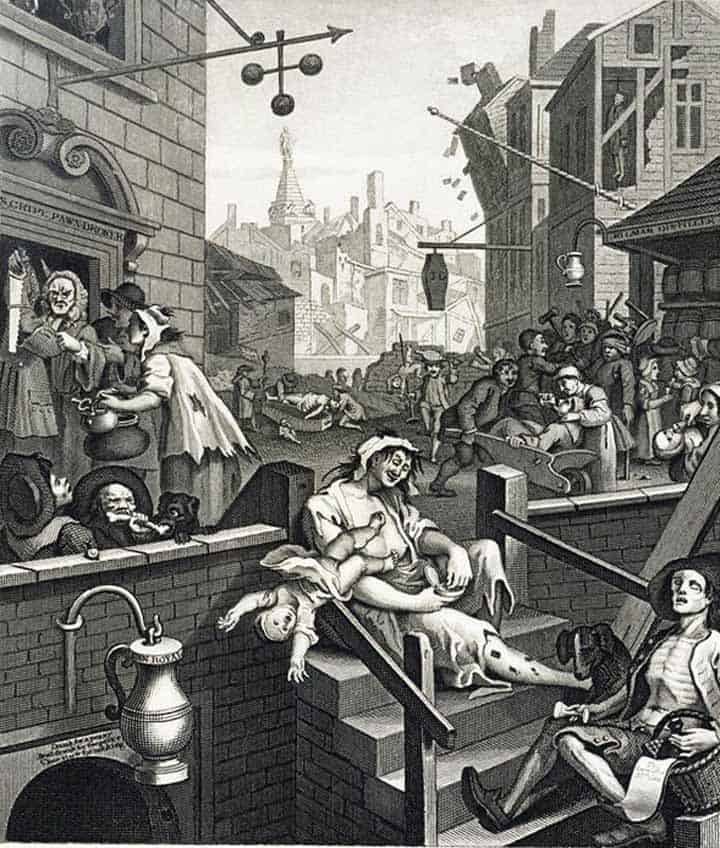
As a boy, in some forgotten book, I was horrified by a reproduction of William Hogarth’s Gin Lane (1751). The woman in the foreground, her face moronic with gin, her legs covered with syphilitic sores (Hogarthian shorthand for prostitution), drops her baby off the stone stairway. The inscription over the doorway in the lower left reads: “Drunk for a penny, dead drunk for two pence, clean straw for nothing.” To this day I find human monsters more disturbing than the monsters of fantasy. In Dr. Johnson’s London: Life in London 1740-1770 (2000), Liza Picard begins her chapter titled “Amusements” with a quote from Johnson: 

“`To amuse: to entertain with tranquility’: Dr. Johnson’s Dictionary. Perhaps amusement is not the right word for what the poor did in their free time. Tranquil it was not.” 

Picard gives a three-page history of what she calls the gin “mania” that swept London beginning late in the seventeenth century. The word’s etymology is amusing, from the French eau de genièvre, “juniper water.” English soldiers couldn’t pronounce it and anglicized it to geneva, which soon became gin. Picard gives us a review of folk poetry: 

“Before leaving it, here are some synonyms for gin: cock-my-cap, kill-grief, comfort, poverty, meat-and-drink, washing, lodging, bingo (also used to mean brandy), diddle, heart’s ease, a kick in the guts, tape, white wool and strip-me-naked. If you had been hicksius-doxius (drunk) you might well feel womblety cropt (hungover) the day after.” 

Hogarth and Johnson met in 1739 and became friends. When Hogarth died in 1764, Johnson wrote four lines about him, quoted in a footnote by Boswell:

“The hand of him here torpid lies,
 That drew the essential form of grace;
 Here clos’d in death the attentive eyes,
 That saw the manners in the face.” 

Having read that, look again at the unfortunate mother in Gin Lane.

Monday, July 21, 2014

`My Efforts at Their Best Are Negative'

“I look and look, / As though I could be saved simply by looking,” says Anthony Hecht’s speaker near the end of “The Venetian Vespers,” the long title poem (more than eight-hundred lines) from his 1979 collection. The speaker is an aging American expatriate living in Venice. In a letter written in 1977 to the poet Howard Moss, poetry editor of The New Yorker, Hecht describes his speaker as “a man in a deeply troubled and turbulent state of mind, whose chief torture is that his troubled mind can never be set at ease and satisfied.” Without detailing the family hell he has inherited, it’s sufficient to say we’ve known people like him, and perhaps we ourselves resemble him, and such people will never know the more banal sorts of happiness or even rest. The best they can hope for is to not inflict misery on others. 

One of our neighbors, a middle-aged woman who works in corporate middle-management, lives alone and keeps to herself. On the rare occasions we see her outdoors, her conversation is affable but terse. Her wit is sharp and she appreciates a tart tongue in others. She likes acidic quips. They amuse her and are quickly done with, so she can move on. She has little tolerance for happy talk, what passes for conversation in many quarters today. None of this I report critically. In fact, I like her. People make accommodations with life. We can’t hope to fully understand them because we hardly understand ourselves. Sunday morning, our neighbor’s car – a new and expensive model -- was parked in the street, not in her driveway, as is her custom. Both tires on the driver’s side were flat. More than flat, they were shredded. She drove home on the rims. No explanation, and we never saw her all day. Her newspaper remained on the sidewalk. The neighbors talked, as neighbors will. Concern, potentially juicy gossip, but no ill will. In the sixth and final section of Hecht’s poem he writes:

“My efforts at their best are negative:
A poor attempt not to hurt anyone,
A goal which, in the very nature of things,
Is ludicrous because impossible.” 

Hecht goes on to quote the final three lines of Swift’s “Description of a City Shower,” and writes: “At least I pass them on to nobody, / Not having married, or authored any children, / Leading a monkish life of modest means…”

Sunday, July 20, 2014

`To Enchant or at Least Entertain Myself'

Among living novelists are only three whose entire body of work I have read, in part because their writing lives have closely overlapped my reading life, and because I admired and enjoyed all of them from the start – Philip Roth, Cynthia Ozick and Thomas Berger. The first two will surprise no one. The third, if remembered at all, is associated with a single title, Little Big Man (1964), and the lousy movie adapted from it. Unlike Roth, Berger has never published a bad or mediocre book. His career has been steady, single-minded and utterly independent. His twenty-three novels are among the funniest ever written, though Berger has steadfastly defied pigeonholing as a humorist. He has identified his favorite novelists as Anthony Powell, Barbara Pym, Proust and Frank Norris, making him as uncategorizeable a reader as writer. His humor is in his prose, a supple, American instrument. Though paid critical lip service, often laced with condescension, he remains insufficiently appreciated and understood, as do such comparably gifted and taken-for-granted writers as Janet Lewis and Evan S. Connell. 

For the uninitiated, I recommend starting with Little Big Man, followed by the Carlo Reinhart tetralogy -- Crazy in Berlin (1958), Reinhart in Love (1962), Vital Parts (1970) and Reinhart’s Women (1981). Move on to Sneaky People (1975), The Feud (1983) and Meeting Evil (1992), and then graze contentedly at will among the other fifteen titles. Berger speaks for many of us when he tells David Madden in an interview collected in Critical Essays on Thomas Berger (1995): 

“As a child I always loved to read and exercise my imagination. I have a vague memory of wanting to grow up to be a foreign correspondent, but that had to do almost entirely with wearing a trench coat, and I think that before I got too old I understood the difference between journalism and fiction and came to prefer the latter as being more likely to serve the truth: I mean, of course, using Pascal’s distinction, the truth of the heart and not of the reason, which is to say the serious truth as opposed to that of expedience and vulgarity. I regard myself as a teller of tales that are intended primarily to enchant or at least entertain myself. Only by living in the imagination can I successfully pretend I am a human being.” 

Berger was born in one America’s great cities, Cincinnati, on this date, July 20, in 1924. Happy ninetieth birthday, Thomas Berger.

Saturday, July 19, 2014

`The Long-Awaited Conversation'

When I borrow books from my university library I check the card at the back stamped with the last date of circulation. On Friday, for instance, I took out Mavis Gallant’s first novel, Green Water, Green Sky, published in 1959. The last prior due date was April 4, 1980, a mere thirty-four years ago. On occasion I’ve taken out books that collected dust for almost a century. I never borrow a book because it hasn’t circulated in a long time, but I feel a tingle of pride when I revive one from its long dormancy, and a sense of kinship with an anonymous, long-ago reader. We share something, however attenuated, for there is a fellowship of true readers and the membership rolls are secret, even to members. Jeff Worley begins “Unlocked, 2047” (A Little Luck, Texas Review Press, 2013) with an unsourced sentence from Marianne Moore: 

“Life is energy, and energy is creativity. And even when individuals pass on, the energy is retained in the work of art, locked in it and awaiting release if only someone will take the time and the care to unlock it.” 

It sounds like late-period Moore, from the Brooklyn-Dodgers-Ford-Motor-Company era, when the great poet had evolved into a great celebrity, and she uses that odious word “creativity,” a sure sign of mental slippage. But the trope is a pleasant one, a writer’s essence lodged in his books, to be released only with the aid of the reader, like the genie from his lamp. Here is Worley’s poem: 

“I imagine it will be early evening,
light prisming through a tall window. 

“A young woman prowls
the shelves of a library, hunting 

“and gathering books the old way.
Thousands of us old literary soldiers 

“are lined up, stiff at attention
in our true final resting spots. 

“She traces our spines with the delicate
tips of her fingers. She’s not in a hurry. 

“She’s humming some popular tune,
some hard to dislodge music… 

“Williams, Worley, Wrigley. Wait a minute.
Worley. Funny name. What kind of stuff 

“did he write? She slides me out and into
her warm palm. I’m hers now. 

“She creaks the book open, settles onto
A pillowed window seat, and we begin 

“the long-awaited conversation.” 

A book unread dwells in a torpid state, not dead but giving the appearance of death – benumbed, the OED suggests, like a patient on the surgeon’s table. Open Tristram Shandy to Book II, Chapter XI (page 79 in my old Everyman’s Library edition), and read: 

“Writing, when properly managed (as you may be sure I think mine is) is but a different name for conversation. As no one, who knows what he is about in good company, would venture to talk all; -- so no author, who understands the just boundaries of decorum and good-breeding, would pressure to think all: The truest respect which you can pay to the reader’s understanding, is to halve this matter amicably, and leave him something to imagine, in his turn, as well as yourself.”

[Dave Lull points out that Worley misattributes the quotation. The speaker is not Marianne Moore but Joyce Carol Oates. See the final sentences in Oates' Paris Review interview. Now the sentiment's semi-insipidity makes sense.]

Friday, July 18, 2014

`Direct Oppugnancy to the Good'

What follows is a brief digressive detour illustrating the way one reader reads and suggesting how everything seems to be connected, at least to those who try to pay attention. Coleridge is a long-standing interest, as writer and man. He is sad and often infuriating, and his example reminds us how even genius is prey to self-sabotage. Richard Holmes’s biography, The Early Visions, 1772-1804 (1989) and Darker Reflections, 1804-1834 (1998), is the urtext for this long, sorry story. That Coleridge wrote anything coherently readable is a miracle, as is the sheer volume of work (sixteen titles in twenty-three bulky volumes in the collected edition from Princeton University Press) he managed to accumulate. It says something that the scholar who wrote a brief critical biography of Coleridge in 1968 (and co-edited the Princeton Biographia Literaria), W. Jackson Bate, also wrote the great modern biography of Dr. Johnson. 

Aids to Reflection (1825) contains the poet’s musings on religion. The prose is dense, the theological references often obscure and the arguments recondite, and I confess to doing some skimming. It’s one of those volumes I had read about but never in. Occasionally, the narcotic mists will part and Coleridge will write with pithy tartness. Here, from the section titled “Aphorisms on Spiritual Religion,” which is seldom aphoristic, is a focused point of light (characteristically, in parentheses): “(And whatever is placed in active and direct Oppugnancy to the Good is, ipso facto, positive Evil.)” 

Three things impress me: 1. The anomalous terseness of the sentence, by Coleridge’s customary standards. 2. Its bracing certainty of tone. 3. Oppugnancy. The word spelled love at first sight for this reader. By context and etymology I gauged its meaning -- from oppugnantia, resistance or opposition. Its power as a word in English is amplified by echoes of repugnance and pugnacity. It sounds like the name of a stage Irishman – Kevin O’Pugnacity. In comparison, the OED is disappointingly sober: “opposition; antagonism; conflict.” But the dictionary also reminds us that Shakespeare put the word to memorable use in Ulysses’ rousing speech in Troilus and Cressida, Act I, Scene 3: 

“O, when degree is shaked,
Which is the ladder to all high designs,
Then enterprise is sick! How could communities,
Degrees in schools and brotherhoods in cities,
Peaceful commerce from dividable shores,
The primogenitive and due of birth,
Prerogative of age, crowns, sceptres, laurels,
But by degree, stand in authentic place?
Take but degree away, untune that string,
And, hark, what discord follows! each thing meets
In mere oppugnancy.” 

This is one of the great articulations of the conservative spirit, the will to preserve order and dwell within an honored tradition, the opposite of what what the death-cultists are trying to do to Israel. Ulysses' speech recalls Evelyn Waugh in Robbery Under Law (1939): 

“Civilization has no force of its own beyond what is given it from within. It is under constant assault and it takes most of the energies of civilised man to keep going at all. There are criminal ideas and a criminal class in every nation and the first action of every revolution, figuratively and literally, is to open the prisons. Barbarism is never finally defeated; given propitious circumstances, men and women who seem quite orderly, will commit every conceivable atrocity. The danger does not come from merely habitual hooligans; we are all potential recruits for anarchy. Unremitting effort is needed to keep men living together at peace; there is only a margin of energy left over for experiment however beneficent. Once the prisons of the mind have been opened, the orgy is on.”

Thursday, July 17, 2014

`Praise for the Names of Songbirds'

A friend told me recently, “Even if you don’t pray you can say thank you,” and not as an admonition. She was reminding me that life is good, I’m more fortunate than I deserve and our chief obligation is to be grateful. The rest flows out of that. Wednesday gave me another cause for gratitude when I spotted a new book on the library shelf -- Before the Door of God: An Anthology of Devotional Poetry (Yale University Press, 2013), edited by Jay Hopler and Kimberly Johnson. The selection through the first half of the twentieth century is exceptional, though, of course, the supply is bountiful (Shakespeare’s absence surprised me until I thought about it). The subsequent pickings are slim and the editors are more generous than I could ever be. They find room for Allen Ginsburg but leave out our greatest living devotional poet, Helen Pinkerton, who reminds us that “Grace is the gift.” The book’s most pleasant surprise is Katharine Jager, a medievalist who teaches in my backyard, at the University of Houston-Downtown. Her selection is “Vita Brevis, Ars Longa”: 

“Praise for the names of songbirds
for the edge of metal
Praise for the finger’s whorl of grease
for the traffic rattle. 

“Praise for fire’s raw alchemy
for the boiling lettuce
Praise for the border that invention serves
for the silt of rivers. 

“Praise for the dog retrieving geese
for the lathe-wrought vessel
Praise for the red barn’s poetry
for the work and wrestle.” 

It’s the seeming randomness and even triviality of the things Jager chooses to praise that I especially like. Anyone can write “Praise for good health” or “Praise for lots and lots of money,” but who would single out for praise “the names of songbirds?” Christopher Smart (1722-1771) might have, of course (Hopler and Johnson include him). His “Jubilate Agno” is comparably surprising in its objects of gratitude, though more encyclopedic, especially in the well-known section beginning “For I will consider my Cat Jeoffry,” as in these lines: 

“For he is the cleanest in the use of his forepaws of any quadruped.
For the dexterity of his defence is an instance of the love of God to him exceedingly.
For he is the quickest to his mark of any creature.
For he is tenacious of his point.
For he is a mixture of gravity and waggery.
For he knows that God is his Saviour.
For there is nothing sweeter than his peace when at rest.
For there is nothing brisker than his life when in motion.” 

Smart, of course, was often quite mad and several times was confined to asylums, but he was sane enough to praise. Boswell reports that Dr. Johnson, another sane man acquainted with madness, forcefully defended Smart:  

“My poor friend Smart shewed the disturbance of his mind, by falling upon his knees, and saying his prayers in the street, or in any other unusual place…’ Concerning this unfortunate poet, Christopher Smart, who was confined in a madhouse, [Johnson] had, at another time, the following conversation with Dr Burney… `I did not think he ought to be shut up. His infirmities were not noxious to society. He insisted on people praying with him; and I’d as lief pray with Kit Smart as any one else.’”

Wednesday, July 16, 2014

`Lies Dress the Best'

In the final stanza of “A Desert Cure” (The Laughing Hyena and Other Poems, 1953), probably colored by the three years (1947-50) he spent teaching English in Egypt, D.J. Enright prescribes austerity in the deployment of words: 

“Lies dress the best. Leave them to dry there—words—
On the verge of meaning, or purge in the open desert:
Shaken by the silent wind, shattered by the speechless sand.” 

The best lies dress the best, we might add. A gifted liar dresses his fabrications in fine fabrics, not in chintz, but not in too fine a finery either, so as to raise suspicions. The best lies dress down. They’re drab, dressed to discourage the second look. Though suspicious of language, Enright remains abjectly in love with it, as every writer ought to be. In “Johnson without Boswell,” in a collection of reviews from the Times Literary Supplement titled Poets and Poetry (Clarendon Press, 1911), John Bailey writes: “The signal merit of Johnson’s writings is that he always means what he says and always says what he means. He may always have talked for victory; but, except, perhaps in the political pamphlets, he always wrote for truth.” The congruence of saying and meaning ought to be self-evident, but we’re daily fed words intended for satiety not sustenance. In contrast, consider The Rambler #54, in which Johnson assumes the voice of Athanatus, whose friend has died. “The friend whom I have lost,” he writes, “was a man eminent for genius, and, like others of the same class, sufficiently pleased with acceptance and applause. Being caressed by those who have preferments and riches in their disposal, he considered himself as in the direct road of advancement, and had caught the flame of ambition by approaches to its object.” 

Johnson describes the fate that awaits some of the best among us; not merely premature death, but the scuttling of unrealized dreams and the befuddlement felt by survivors: 

“But in the midst of his hopes, his projects, and his gaieties he was seized by a lingering disease, which, from its first stage, he knew to be incurable. Here was an end of all his visions of greatness and happiness; from the first hour that his health declined, all his former pleasures grew tasteless. His friends expected to please him by those accounts of the growth of his reputation, which were formerly certain of being well received; but they soon found how little he was now affected by compliments, and how vainly they attempted, by flattery, to exhilarate the languor of weakness, and relieve the solicitude of approaching death.” 

When he edited The Oxford Book of Death (1983), Enright quoted Johnson more than any writer except Shakespeare.