Saturday, April 30, 2016

`The Sheer Beauty of It'

One occasionally meets a person without an aesthetic sense, someone who would never think to describe a landscape, a woman, an equation or a sonnet as beautiful. One pities them, but only so long they do not mistake their indifference to beauty for a philosophy. At that point they become theorists or garden-variety boors, and beyond the limits of tolerance. Cousins to the beauty-bereft are the socially aesthetic, those for whom beauty is to life as the extended pinky is to teatime. Speaking of the changes in culture that occurred late in the nineteenth century, Jacques Barzun writes in A Stroll with William James (1983):

“The triumph of art as a cult meant another change that we also take for granted: it is no longer the work, the craft, that defines the species `artist,’ but the love of art. So the critic, too, is called an artist, and the connoisseur, and the bourgeois who has seen the light and who `collects’ or `subscribes’ or `follows.’ Every educated person must take or pretend an interest in art; he or she owes it to the social self, just as formerly everyone must go to church and say family prayers.”

One need not be an aesthete in the Beardsley mode to unselfconsciously revel in beauty. Some of us go through life careening from one perception of beauty to another. We’re not blind to ugliness and horror but on most days see the world as a vast opportunity for enjoyment. On the radio Friday morning, on the way to work, I heard the Everly Brothers singing “Let It Be Me” and the third movement of Dvorak’s Violin Concerto. Marissa Skudlarek, a woman whose name I had never heard before Friday, tweeted what I’m trying to say:

“Wandering streets of Oxford composing a sonnet on Shakespeare's death. Tears in my eyes at Blackwell's Books from the sheer beauty of it.”

Friday, April 29, 2016

`His Courage Cannot Be Overstated'

The closest I’m likely to get to London is Dr. Johnson’s poem. Besides, my London is a semi-mythical place spanning more than half a millennium of writers. As Michael McNay reports in his introduction to Hidden Treasures of London (Random House, 2015), the city’s population is estimated to have been 543,520 in 1777, the year Johnson famously remarked that “when a man is tired of London, he is tired of life.” Today, the city’s population exceeds 8.6 million. I’ll hold on to my bookish myth.

For a man born more than three centuries ago (and in Lichfield, not London), Johnson shows up with pleasing frequency in McNay’s book. His longest appearance is the entry devoted to his house at 17 Gough Square, off Fleet Street, where he lived from 1748 to 1759. In the garret at that address, Johnson assembled A Dictionary of the English Language (1755). “Here he could install desks and bookcases for himself and the six copyists he hired to help him in compiling the first great English dictionary,” McNay writes. Few books rival it for sheer browsability. Long before the internet, the dictionary (which doubles as a generous book of quotations – almost 114,000 of them) offered an inexpensive way to while away the day. Johnson’s labor was heroic and probably would have broken a lesser man. In Samuel Johnson: A Biography (2008), Peter Martin writes of the lexicographer:

“He was beset with doubts, plagued with persistent melancholia, and not entirely certain how to proceed. He was working in a vacuum, without a useful model. Nobody had done before what he wanted to do, not at any rate the way he wanted to do it. . . . His courage cannot be overstated.”

McNay makes Johnson’s house today sound rather disappointing: “. . . there is no real sense of his presence. Of his abundant eccentricities, voluble speech, affliction by violent spasms, his scorn and generosity, nothing remains.” How could there be? That’s why we have Boswell and Johnson to renew our acquaintance. As Howard Baker writes in “To Dr. Johnson” (Ode to the Sea and Other Poems, 1966): “We are all Boswells harkening the worms.”

Thursday, April 28, 2016

`Equal Wasters of Human Life'

“We grow tired of seeing our experience choked by the vegetation in our sentences. We opt for the pithy, the personal, and the unapologetic. For years we have had a crowd of random thoughts waiting on our doorstep, orphans or foundlings of the mind that we have not adopted: the moment of the aphorism, the epigram, the clinching quotation has come.”

No, it’s not lifted from the manifesto of a blogger (few bloggers write so well), though its author was certainly a master of short forms, in fiction and essays. This is V.S. Pritchett writing in 1979 about his old friend Gerald Brenan on the publication of the latter’s commonplace book Thoughts in a Dry Season. Pritchett relates a taste for brevity to age, not because of short-windedness but from impatience with verbosity. Time is short. No need to blather. Pritchett turned seventy-nine the year his review was published; Brenan, eighty-five. The commonplace notion is that old people are the genuine gas bags, ever saying nothing at great length. That has only occasionally been my experience. Rather, youth inclines toward motor-mouthed wordiness, which may explain the vogue for Kerouac and Bukowski among certain young readers. They mistake bulk for worth. In The Idler #85, Dr. Johnson writes:

“But such is the present state of our literature, that the ancient sage, who thought a great book a great evil, would now think the multitude of books a multitude of evils. He would consider a bulky writer who engrossed a year, and a swarm of pamphleteers who stole each an hour, as equal wasters of human life, and would make no other difference between them, than between a beast of prey and a flight of locusts.”

The “ancient sage” is Callimachus, composer of epigrams.     

Wednesday, April 27, 2016

`As If They Could Have Been Here All Along'

“When we hear a poet's voice speaking from the page, we hear it internally: The tempo, the emphasis, the feelings are synthesized in us—which is why I prefer to read a poem rather than hear it read aloud.”

When not simply dull, poetry readings are embarrassing because the poet is usually a ham unaware of the feebleness of his lines. Few read well and fewer still write well. Poets tend to get in the way of poems, so it’s best to eliminate the middleman. All in all, I’ll stick to the page, as Arthur Krystal suggests above in “Listen to the Sound It Makes” (This Thing We Call Literature, 2016). I remembered Krystal’s observation during my first reading of Compass and Clock (Swallow Press/Ohio University Press, 2016) by David Sanders. Sanders is not a kid – the collection gathers thirty years of work -- and the voice in his poems is the opposite of callow. The tempo, to follow Krystal’s outline, is largo – thoughtful and meditative, not nervous or jumpy. The emphasis is on details, often of the natural world (not to be confused with that unholy creature “nature poetry”) and layered with memory. The “feelings?” Well, that will depend on the reader. In “Pianos,” Sanders writes:

“So much that wasn’t played,
The silence resonating like the dusk
That ushers out the fall . . .”

From this brief sample alone you might detect a familiar echo, that mingling of nostalgia and wistful regret without sentimentality that Donald Justice made his own. Think of his suite of poems in The Sunset Maker (1987) devoted to studying piano in Miami when he was a boy in the nineteen-thirties. This is from "The Pupil": “Back then time was still harmony, not money, / And I could spend a whole week practicing for / The moment on the threshold.” One of the best poems in Compass and Clock, “Some Color,” carries an epigraph from a Justice poem, “Absences”: “It's snowing this afternoon and there are no flowers.” In “Some Color,” Sanders moves from a nicely sketched “caravan that never broke camp” in Southern Ohio (“Bondoed pickup trucks abandoned”) to an internet search for “names / that I last wrote on classroom valentines,” to a flower farm near the Ohio River. The flowers will be harvested and shipped and finally planted “for their one quick season”:

“Once they’re out on the cul-de-sacs, on lawns,
Or massed under saplings that buttress municipal buildings,
And set in the dirt, treat them lovingly,
As if they could have been here all along
And belong here, as they do now, being
What and where they are so well: some color
Introduced into the indigenous green.”

As the title Compass and Clock suggests, Sanders is looking for a place and time where we might feel at home, even if only for our “one quick season.” On first reading, I recognized an unexpected affinity with “Some Color,” almost a personal memory, as though Sanders were speaking to me from among all his readers. Krystal would understand this rare and privileged experience: “A poem speaking to me from the page is private and makes itself felt as no stranger’s voice possibly could.”

Tuesday, April 26, 2016

`In the Guise of Poems'

Several times on each page Arthur Krystal writes something you want to remember, something you know will come in handy and qualify as what Kenneth Burke called “equipment for living.” This slows down reading, of course, which is always a good thing, and leaves some pages almost opaque with underlinings and notes, but Krystal regularly writes things you may have thought in passing, or wish you had, but failed to articulate in words. Here, at random, is a nugget from Page 70 of his fourth collection of essays, This Thing We Call Literature (Oxford University Press, 2016): “It’s presumptuous of me to say it, but I don’t think our poets live for poetry as much as for the act of sharing their thoughts and feelings in the guise of poems.” Precisely. Most poets no longer write poetry. We know that. They make gestures that vaguely resemble poems. The problem is they continue to appropriate the name “poetry,” which only confuses the civilians. If we don’t call it “poetry,” what do we call it? Prose? Krystal identifies the problem with contemporary lineated language as “site-specific, tonal rather than dispositive.” He “miss[es] the sound it used to make.” Who cares what a poet thinks or feels? Just play the music.

Krystal is no crank. Detractors will dismiss him as “elitist” or “reactionary” but he is neither. He really loves literature. That used to be a not uncommon condition, like being able to sing in key or do the backstroke. Now it’s come to feel like having a notably trivial hobby, and this has happened in a remarkably short time. My parents were not readers and never went to college. We had few books in the house, and my taste for literature was deemed a little exotic (although, bafflingly, my mother once read Richard Yates’ excellent novel The Easter Parade). But if challenged they would have expressed respect and something like awe for book learning and the canon. Their reaction might have been reflexive and unthinking but it was genuine, an acknowledgement that our cultural inheritance, regardless of one’s familiarity with it, was worthy of preservation. Krystal writes about a lot of things in This Thing We Call Literature and he gives this reader much to think about, but for now I’ll quote this from “Listen to the Sound it Makes,” the essay cited above:

“Perhaps I’m a dinosaur who can’t make the shift from Palgrave to Pinsky—but I take no pride in it. I’m perfectly happy to be shown for a fool. But just as people can tell a good musician from a bad one, or a competent athlete from an extraordinary one, I believe I can distinguish among poets. I have a prejudice, however. While I think there are shadings or levels of skill among accomplished musicians and athletes, I feel that a poem without music is almost oxymoronic. Either you can write metrical verse or you can’t, no matter how well you express yourself. The problem is that too many people who cannot write in musical form champion others who are likewise unskilled.”

A well-read person is more likely to be good company than an illiterate. A love of books implies, but doesn’t guarantee, a sensibility of substance. The world is littered with bookish boors and monsters. Perhaps literature is merely the thing that fills the literature-shaped hole inside some of us. Or not.

Monday, April 25, 2016

`Piping'

It’s heretical, I know, but my musical sympathies have always been not with Billie Holiday but Ella Fitzgerald. It’s a matter of temperament, I’m sure. Holiday is always complaining about something, a quality often mistaken for the blues. There’s a woe-is-me tone of self-pity in her voice which I would hear without knowing anything about her unhappy life. I’m a sucker for the televised version of “Fine and Mellow,” and I’m always touched by her unspoken exchange of emotions with Lester Young. But Fitzgerald, in my book, does what an artist is supposed to do – create a beautiful object distinct from herself. I like her coolness, her refusal to milk emotion. She suggests without gushing, without melodrama.      

Whitney Balliett had his reservations about Fitzgerald. In the nineteen-fifties he referred to her “clear, scrubbed voice [which] often takes on a blank perfection.” In the seventies, he wrote that “a singer’s weight is to the voice what yeast is to bread. She has slimmed down and so has her voice. It has the high, bobby-sox quality of her `Tisket-a-Tasket’ days, and it made her songs, which ranged from `Satin Doll’ to `Raindrops Keep Falling,’ sound piping.” By the nineties, Balliett distinguished Fitzgerald and Holiday by calling the former “the most celebrated of female popular singers,” and the latter “the most celebrated of female American jazz singers.” I won’t enter that dog fight. I love her song books and the album with Louis Armstrong (the latter I know almost by heart). On the Ellington record, she covers Billy Strayhorn’s “Lush Life,” a version topped for this listener only by the Johnny Hartman/John Coltrane collaboration.

My brother has the good fortune to share his birthday, April 25, with Fitzgerald and with Oliver Cromwell, Walter de la Mare, Guglielmo Marconi and Earl Bostic. Happy birthday, Ken.

Sunday, April 24, 2016

`Under Cover of Delectable Wordcraft'

On this date, April 24, in 1954, Philip Larkin completed a poem he published only in 1973, in A Keepsake for a New Library, a small-circulation dedicatory volume for the University of London’s School of African and Oriental Studies. Otherwise, “Continuing to Live” remained unpublished until 1988, three years after Larkin’s death, when Anthony Thwaite included it in Collected Poems.  Larkin deemed it “mediocre.” It is perhaps, less flamboyantly despairing than Larkin’s best, but technically it’s elegant and some of us will find it amusing. Here is Beckett (in Proust, 1930): “Life is habit. Or rather life is a succession of habits.” Here is Larkin: Continuing to live — that is, repeat / A habit formed to get necessaries —.”

No blogger writes or thinks better than Bill Vallicella at The Maverick Philosopher. Last year, Bill read “Continuing to Live” and concluded Larkin was “a very good poet indeed,” adding, “And like most good poets, he knows enough not to send a poem on a prose errand, to borrow an apt phrase from John Ciardi. So one will look in vain for a clearly stated philosophical thesis packaged poetically.” At least we can get that out of the way. I know from my sons’ experience that teachers still assign poems, usually lousy ones, for their students to “interpret,” as though poetry were a species of cryptography. The assumption seems to be that a poem is a wordy nuisance that requires boiling down to its essence, its “meaning.” Pleasure is not only optional, it is discouraged. Bill tempers his admiration of Larkin’s poem:

“This philosopher asks: what’s the ultimate good of suggesting momentous theses with nary an attempt at justification? Of smuggling them into our minds under cover of delectable wordcraft? Poetry is a delightful adjunct to a civilized life, but philosophy rules. It would be very foolish, however, to try to convince any poet of this unless he were also a philosopher.”

We’re back to Plato. Some of our worst poets and some entire schools of poetry have tried practicing philosophy in verse. The result is predictably tiresome. No poet is obliged to provide his axioms, though axioms might be turned into poetry in the right hands. Philosophy rules? Sorry, Bill. Tell that to Horace and Shakespeare, and their readers. Thanks to Archie Burnett, editor of The Complete Poems (2012), we know Larkin completed “Continuing to Live” on April 24, 1954, the same day he began writing one of his masterpieces, “Church Going,” completed the following July. Burnett’s edition is full of such connections, and is essential to serious readers of Larkin. Burnett, for instance, traces the phrase in line seventeen of “Continuing to Live,” “the green evening,” to Book II of “Endymion”: “And like a new-born spirit did he pass / Through the green evening quiet in the sun.” This information is pleasing to know and quite useless.

Saturday, April 23, 2016

`I May Be Elsewhere'

A fellow lover of metaphors shares a few:

“Dickinson’s poetry is full of [them]. She is fond of beginning her poems with a startling metaphor: `Hope is the thing with feathers,’ `Remorse is memory awake,’ `Presentiment—is that long shadow—on the lawn / Indicative that suns go down—.’ I’ve always liked this one, the almost cavalier way she tosses it at us: `Death is a hard night and a new road.’ Aye, that it is—and more too.”

I didn’t recognize that line and had to look it up. It’s from a letter the poet wrote in October 1869 to her cousin Perez Dickinson Cowan. My friend’s memory is a little off, but here is the original: “It grieves me that you speak of Death with so much expectation. I know there is no pang like that for those we love, nor any leisure like the one they leave so closed behind them, but Dying is a wild Night and a new Road.” I think of Dickinson as a metaphysical comedian, and here she is in high gnomic mode. I wonder: did her cousin find solace in her words? Cowan’s older sister, the wonderfully named Nannie Cowan Meem, had recently died, and he anticipated a joyful reunion with her in the afterlife. Dickinson writes: “You speak with so much trust of that which only trust can prove, it makes me feel away, as if my English mates spoke sudden in Italian” – not exactly a hearty endorsement of immortality.

Dickinson’s wisecrack reminds me of Chico Marx. One can admire her honesty and forthrightness – and the quality of her prose (“more Peace than Pang”) – while questioning her tact. What does she mean by “wild Night”? Probably not what we mean. The phrase for her was not new. In a poem written some eight years before the letter, Dickinson exults: “Wild nights - Wild nights! / Were I with thee / Wild nights should be / Our luxury!” God? Death? In a blindfold test, most of the lines quoted above from Dickinson might be mistaken for the work of Stevie Smith, another condescendingly misunderstood, death-smitten poet. Here is a typical couplet from Smith:

“If I lie down upon my bed I must be here,
But if I lie down in my grave I may be elsewhere.”

Friday, April 22, 2016

`The Permanent College of Rhetoric'

Some of us are blessed and cursed with a peculiar species of double vision. We see something – say, a fallen tree leaning on a fence – and we promptly see something else. In this case, that would be an artillery piece. I cite this example because it happened to me when I was a boy. Foolishly, I reported the cannon to my father, the most literal-minded of men, and he observed that I was a moron: “It’s a tree. Got it?” What I’m describing is more than a habit of mind, and probably has a neurological origin, because the metaphor seems to hover around its object like an aura. People can learn to think metaphorically but what I’m describing is hard-wired and automatic, something like synesthesia. I seldom have to reach for a metaphor. It’s there when I need it, as though my senses came from the factory equipped with the metaphor option. From the start I found comfort in this gift. It made the world more interesting and familiar, and less random. It implied that disparate things are, in fact, related. Metaphor suggests order, however covert it may be.

Farnsworth’s Classical English Metaphor (David R. Godine, 2016) is a book to linger in, like an imaginatively interactive museum. Ward Farnsworth’s working thesis is that good prose is never passive. Even when it attains Orwell’s virtue of transparency, it is quietly bringing light to a dark and confused world. Farnworth writes in his preface: “Metaphor may be viewed as a language that we use to interpret and explain things to ourselves as well as to others. This book outlines an elementary vocabulary and grammar of one dialect of the language. The result may be useful to those who wish to improve their fluency in order to better communicate, but also to those who enjoy the language for its own sake.” You might call Farnsworth an aesthete with a utilitarian streak.

Farnsworth has structured his book as a sampler of taxonomically arranged quotations from English, Irish and American writers of prose, largely from the eighteenth and nineteenth centuries but with frequents visits to the King James Bible and Shakespeare in the past, and Churchill and Wodehouse in the future. Farnsworth says (and in the process spins a nice metaphor of his own):

“Some gifted and canonical talkers and writers appear often. We should seek to learn from the best, which means Johnson and Melville and various other distinguished faculty in the permanent college of rhetoric.”

In his fourth chapter, “The Use of Nature to Describe Inner States,” Farnsworth chooses a brief tour de force of metaphor-making from Book V, Chapter 2 of Henry James’ The Ambassadors (1903). This comes immediately after the better-known passage beginning “Live all you can; it's a mistake not to.” Lambert Strether says:

“The affair — I mean the affair of life — couldn't, no doubt, have been different for me; for it's at the best a tin mould, either fluted and embossed, with ornamental excrescences, or else smooth and dreadfully plain, into which, a helpless jelly, one's consciousness is poured — so that one 'takes' the form as the great cook says, and is more or less compactly held by it: one lives in fine as one can.”

The passage might have come from James’ brother’s masterwork The Principles of Psychology. In his eleventh chapter, “Architecture & Other Man-Made Things,” Farnsworth cites a marvelous excerpt from Section II of Swift’s A Tale of a Tub (1704):

“To instance no more, is not religion a cloak, honesty a pair of shoes worn out in the dirt, self-love a surtout, vanity a shirt, and conscience a pair of breeches, which, though a cover for lewdness as well as nastiness, is easily slipped down for the service of both?”

Two writers rich in metaphor who are not plundered by Farnsworth are A.J. Liebling and Whitney Balliett. Here’s Liebling in “Ahab and Nemesis” (The Sweet Science, 1956), in which he piles on the metaphors for comic effect:

“He had hit him right if ever I saw a boxer hit right, with a classic brevity and conciseness. Marciano stayed down for two seconds. I do not know what took place in Mr. Moore’s breast when he saw him get up. He may have felt, for the moment, like Don Giovanni when the Commendatore’s statue grabbed at him—startled because he thought he had killed the guy already—or like Ahab when he saw the Whale take down Fedallah, harpoons and all.” 

And here’s Balliett on the great tenor saxophonist Ben Webster (Collected Works: A Journal of Jazz 1954-2000, 2000): “In a slow ballad number, Webster’s tone is soft and enormous, and he is apt to start his phrases with whooshing smears that give one the impression of being suddenly picked up by a breaker and carried smoothly to shore.”

Thursday, April 21, 2016

`To Share His Enjoyment with Others'

Yesterday’s genial chattiness sounds today like the seasoned judgment of a peculiarly well-read man: “Boswell is essentially a book for the pocket, to be opened at random while waiting for a train or a doctor or a dentist; busy men of affairs like Lord Rosebery have recognised it as the finest `night-cap’ in the world. It is the fallacy of thinking that `skipping’ is the sign of a shallow mind that has led to the avoidance of what is really the most absorbing study in the world.” One would look forward to meeting such a fellow, for whom a book is a reliable companion not an odious burden. And one would like to see a pocket large enough to hold the Life of Johnson.

The author, S.P.B.Mais (1885-1975), is one of those literary phantoms who write and publish prolifically and are known by name to a broad reading public, only to evaporate, sometimes before their earthly deaths. Mais published some two-hundred books and for years was a BBC broadcaster. The volume I have read is Why We Should Read (1921), a collection of brief essays, few longer than four or five pages and all published in such long-vanished journals as John o’ London’s Weekly. What impresses a twenty-first-century reader are the casual literary assumptions made by Mais that would stump today’s English majors:

“I suppose there is still somebody living who has not read Tom Jones: it seems inconceivable that it should be so, but queer things of this sort do happen.”

“We all know what Swinburne thought about [Walter Savage Landor]: the trouble has been that so few people have taken any pains to go further and rediscover this great, imaginative artist for themselves.”

“The majority of men and women are very much like myself, I imagine. They read with equal interest a modern novel, say, of Sheila Kaye-Smith, an exposition of the Relativity Theory like Eddington’s Space, Time and Gravitation, E.V. Lucas’s essays, Henri Fabre and Trotter, and at the same time keep harking back to reread Don Quixote, Tristram Shandy, Shelley and other favorites among the classics.”

This is the opposite of “elitist,” the kneejerk epithet it would elicit today. In fact, in spirit it is democratic and refreshingly free of snobbery. Mais assumes his readers are as broadly well read as he is, and share his enthusiasm for a variety of books. We all know readers and critics who inhabit self-constructed provincial enclaves, whether dedicated to William H. Gass or science fiction.

Mais’ cosmopolitan appetites are evident in Part IV of Why We Should Read. Titled “Certain Foreigners,” the section consists of an essay about Montaigne (“this most lovable man”) and nine devoted to Russian writers, many of whom by 1921 had been translated into English by Constance Garnett. Mais extolls Nekrasov, Pushkin, Lermontov, Gogol, Turgenev, Goncharov, Dostoevsky, Tolstoy and Chekhov. Of Dead Souls he says: “it makes boys laugh, young men think and old men weep.” Of the often misunderstood Oblomov: “he had a heart of gold, a chaste mind and clear soul: it was just that his will was sapped.” He has the chutzpah to say of Tolstoy (unfairly): “There are in [his] books no heroes, no characters, no personalities, and hence there is no tragedy, no catastrophe, no redeeming horror, no redeeming laughter.” Chekhov’s great “In the Ravine” he calls “a picture of a girl not very different in her calculated brutality and heartlessness from Regan and Goneril.”

Mais formulates his critical credo in his introduction: “The object of any man who enjoys life is to share his enjoyment with others. If a book appeals to me I want as many people as possible to derive the pleasure that I derived from it.”

Wednesday, April 20, 2016

`And Now I Cannot Even Watch the Spring'

Two English poets, both given to reflexively defying expectations, write poems blandly, unpoetically titled “Money.” “Unpoetically” because post-Romantic poets, connoisseurs of their own finest perceptions, are supposed to be above that sort of thing. How positively common and middle-class a subject. One likes money, of course, but tastefully. How else to dress well, drink well and otherwise live like a poet? Money is the other dirty little obsession.

The better-known of the two is Philip Larkin’s “Money,” a late masterpiece, completed in 1973, when Larkin was flush for the first time in his life with the publication of The Oxford Book of Twentieth Century English Verse. Larkin speaks with faux-naïf immediacy:Clearly money has something to do with life.” The poem skirts light verse, intentionally, until the final stanza, and at that point, a neat reversal turns it into a masterpiece: “It is intensely sad.”

The other “Money” is C.H. Sisson’s, also an early work, one written while Sisson was still working for the Ministry of Labour. Judging by appearances, Sisson’s understanding of money ought to be more sophisticated and tempered than Larkin’s. Money is a serious temptation, like illicit sex, Sisson suggests. If Larkin’s reaction to money is confusion and sadness, Sisson’s is Swiftian revulsion – “bitch business,” “Money the she-devil,” “a screeching tear-sheet,” “fallen udders and sharp bones.” Perhaps poets aren’t that different from the rest of us, only more articulate about the botch we make of life:

“And now I cannot even watch the spring
The itch for subsistence having become responsibility.”

Tuesday, April 19, 2016

`The Most Pleasant Item on the Schedule'

In the dark, flooded streets don’t look flooded, even under streetlights. Water lapped at the undercarriage, making a sound like a lightly thumped tabla. My brakes softened but held and the engine never sputtered, but a light on the dashboard came on: “low tire pressure.” Two miles from home, I pulled into the parking lot of a shuttered gas station. I’d seen a dozen abandoned cars, some parked at awkward angles, blocking two lanes. It was 6 a.m. The front tire on the driver’s side looked a little low, but without the warning light I would never have noticed. Another guy was already standing under the awning above the pumps, smoking. “What do you hear?” I asked. “Shit, man. Nothing. Enjoying the rain.” I liked his attitude – not a whiner – and we stood together for awhile enjoying the rain. He smoked one cigarette after another and told me he was never in a hurry to get to work. I called AAA for road service but never got through. Other people had bigger problems than mine.

Passing trucks sloshed waves of dirty water ten feet off the pavement, almost hitting the gasoline pumps. In the fire station across the street, firefighters stood in the open doors, drinking coffee, watching the rain. We watched a white SUV stop in the street, and then drive backwards in the direction he had just come until we lost him on a curve. “Dumb fuck,” my companion observed. His head was shaved and almost spherical, and he looked a little like Ben Kingsley in Gandhi. He left before me, saying he wanted breakfast. My tire hadn’t gotten any flatter. I figured I’d sit in the car and read until the water receded, assuming the tire never went flat. I pulled out my lunchtime reading – Zbigniew Herbert’s Barbarian in the Garden (trans. Michael March and Jarosław Anders, 1985), essays about his travels in Western Europe, viewing art and architecture. It’s a book I never really ever stop reading – the account of a civilized man’s pilgrimage to his civilization. In “Memories of Valois,” he describes a visit to Senlis and its museum and twelfth-century cathedral. After his cultural tour, Herbert gives a fanciful itinerary for the rest of his stay, a list that almost reads like one of his poems:


“I pocket both note-book and sketch-pad. It’s time for the most pleasant item on the schedule—loafing around,


“wandering aimlessly, a guest of perspective,


“looking at exotic workshops and stores: the locksmith’s, a travel office,

the undertaker’s,

“staring,


“picking up pebbles, and throwing them away,


“drinking wine in the darkest spots: Chez Jean, Petit Vatel,


“meeting people


“smiling at girls”


And so on for another eleven lines. Herbert concludes: “The French are a rich nation.”

I started the car, and drove home carefully without a flat tire.

Monday, April 18, 2016

`Through Your Body in an Instant'

One is always tracking down something, pursuing tidbits of information, turning hunches into certainties or dead ends. One develops an instinct for the promising and the futile. The internet is a blessing, of course, but also a lazy man’s curse, lending the appearance of learning when we are merely fact-checking clerks. On this date, April 18, in 1775, Dr. Johnson, Boswell and Sir Joshua Reynolds were visiting Richard Owen Cambridge at his home on the Thames, near Twickenham.

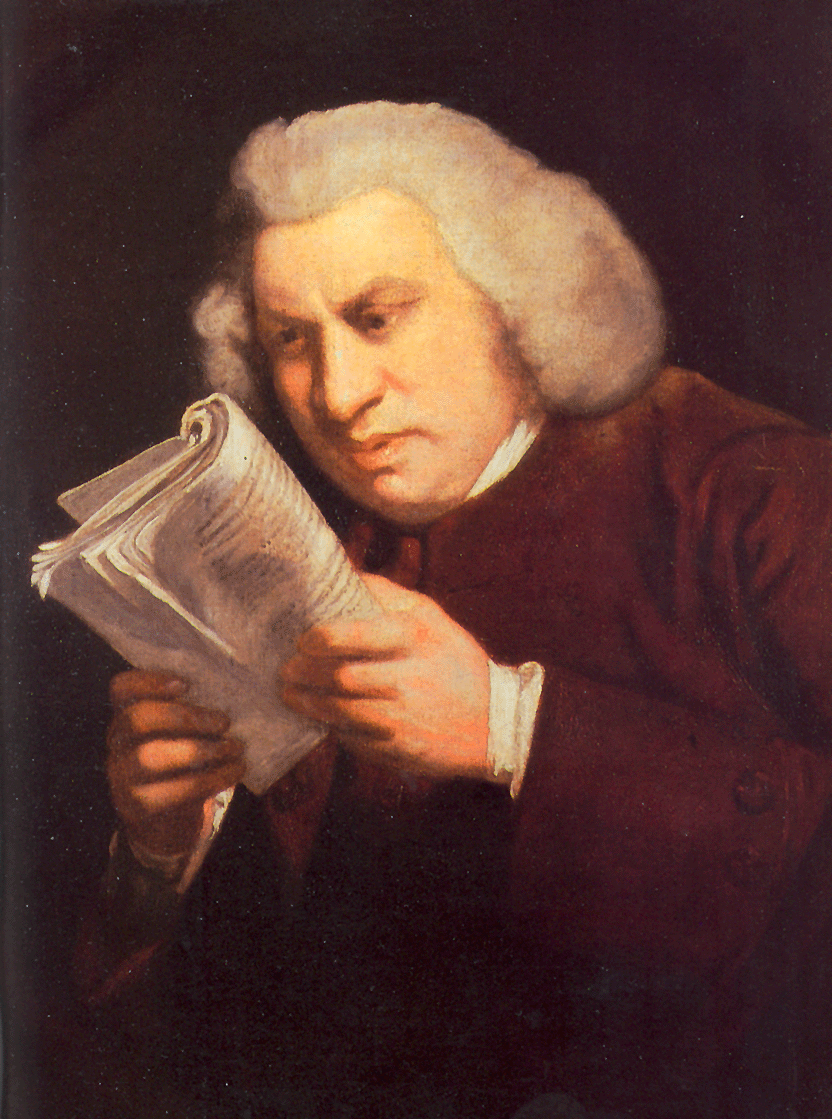
Boswell, who recounts the meeting in his Life, was already acquainted with Cambridge, whom he introduced to Johnson in the library. With pleasantries out of the way, Johnson “ran eagerly to one side of the room intent on poring over the backs [spines] of the books.” Boswell quotes Reynolds as saying, “He runs to the books as I do to the pictures: but I have the advantage. I can see much more of the pictures than he can of the books.” (See Reynolds’ portrait of Johnson reading.) Cambridge, by all appearances a cultivated and courteous man, says to Johnson:

“Dr. Johnson, I am going with your pardon, to accuse myself, for I have the same custom which I perceive you have. But it seems odd that one should have such a desire to look at the back of books.” Boswell observes that Johnson, “ever ready for contest, instantly started from his reverie, wheeled about and answered”:

“Knowledge is of two kinds. We know a subject ourselves, or we know where we can find information upon it. When we enquire into any subject, the first thing we have to do is to know what books have treated of it. This leads us to look at catalogues, and at the backs of books in libraries.”

Something else was going on. Many of us, when visiting, examine our host’s book shelves forensically. Is this the library of one who reads broadly and deeply, and with taste? The mere presence of books, even many books, means little. What sort of books has our host accumulated? Do they appear to have been used enthusiastically and often, or are they interior decoration, put up to impress credulous guests? Also, from childhood Johnson’s vision was severely limited. He would, without embarrassment, lean close to volumes and gaze intently. Commenting on Johnson’s testy response to Cambridge, his “extraordinary promptitude with which [he] flew upon an argument,” Reynolds says:

“Yes . . . he has no formal preparation, no flourishing with his sword; he is through your body in an instant.”

Sunday, April 17, 2016

`I Find I Cannot Exist Without Poetry'

I find that I cannot exist without poetry – without eternal poetry – half the day will not do – the whole of it – I began with a little, but habit has made me a Leviathan.”

What moves Keats to such a gleeful declaration? The poet was twenty-one and had already reached his adult height of five feet – a modest Leviathan, more Pip than Moby-Dick. His finest poems are two years in the future, his death less than four. He begins writing a letter to his friend John Hamilton Reynolds on this date, April 17, in 1817, and completes it the following day. Reynolds was a poet, playwright and journalist who for several years worked as clerk for a London insurance company, the marvelously named Amicable Society for Perpetual Assurance, which nicely encapsulates the role Reynolds played in Keats’ life.

Earlier in the letter, written from Carisbrooke on the Isle of Wight, Keats tells Reynolds he found a portrait of Shakespeare hanging in the inn where he stayed. “Well—this head I have hung over my books.” Many of us do this. Propped on my shelves are postcards of Chekhov, Ulysses Grant and Louis Armstrong – tutelary spirits. Keats’ first Shakespeare allusion is unannounced: “I see Carisbrooke Castle from my window, and have found several delightful wood-alleys, and copses, and quick freshes.” In The Tempest (Act III, Scene 2), Caliban chirps:  

“What a pied ninny’s this! Thou scurvy patch! 
I do beseech thy greatness, give him blows 
And take his bottle from him: when that's gone 
He shall drink nought but brine; for I'll not show him 
Where the quick freshes are.”

The meaning is apparent from context but the OED gives “of water: Not salt or bitter; fit for drinking.” Clean water, unpolluted, potable. Though young, Keats has absorbed Shakespeare, sees with his eyes, hears with his ears. Two lesser references follow, from A Midsummer Night’s Dream and The Merry Wives of Windsor. Again, Keats makes no big show of his Shakespeare-suffused sensibility:

“The wind is in a sulky fit, and I feel that it would be no bad thing to be the favorite of some Fairy, who would give one the power of seeing how our Friends got on, at a Distance - I should like, of all Loves, a sketch of you and Tom and George [Keats’ brothers] in ink which [Robert] Haydon will do if you tell him how I want them.”

Finally, Keats writes: “From want of regular rest, I have been rather narvus - and the passage in Lear -- `Do you not hear the Sea?’ -- has haunted me intensely.” The allusion is to Act IV, Scene 6, Edgar’s cruel charade to Gloucester: “Hark, do you hear the sea?” He includes a new sonnet, “On the Sea,” and returns to Shakespeare the following day:

“I'll tell you what - on the 23rd [of April] was Shakespeare born - now if I should receive a letter from you and another from my Brothers on that day ’twould be a parlous good thing. Whenever you write say a word or two on some Passage in Shakespeare that may have come rather new to you, which must be continually happening, not withstanding that we read the same Play forty times.”

Which he surely had. Only at this point in his letter does he declare to Reynolds: “I find I cannot exist without Poetry.”

Saturday, April 16, 2016

`People and Traditions Like That'

Books are sustenance, and some readers will risk everything to preserve their reliable supply of reading matter. Andrei Sinyavsky (1925-1997) wrote under a pseudonym he borrowed from the legendary Russian-Jewish gangster, Abram Tertz. The genesis of the dissident movement in the Soviet Union can be traced to the 1966 trial of Sinyavsky and Yuli Daniel, who were found guilty of smuggling anti-Soviet manuscripts out of the country. Sinyavsky was sentenced to seven years in a forced labor camp; Daniel, five. One of the masterpieces of literature inadvertently produced by Soviet injustice is A Voice from the Chorus (trans. Kyril Fitzlyon and Max Hayward, 1976), a volume based on the two letters per month the Soviets permitted Sinyavsky to send to his wife. During his six years in the camp, he was not otherwise permitted to write.

I thought I had read most of Sinyavsky’s books available in English until I happened on Ivan the Fool: Russian Folk Belief, a Cultural History (trans. Joanne Turnbull and Nikolai Formozov, Glas Publishers, 2007). The book is based on a course he taught at the Sorbonne in the late nineteen-seventies, after his release from the labor camp in 1971 and his emigration to France in 1973. Sinyavsky’s working thesis is that Russian folk beliefs and folklore ran parallel to Holy Scripture and sustained the Russian people – “a delicate and flexible balance between various aspects of the human soul and life—knowledge and intuition, truth and dream, memory of the past and the actual reality.”

In the labor camp the Bible was forbidden, but prisoners smuggled in Scripture and, by hand, make copies to pass among the prisoners. Shortly after his arrival, another inmate asks Sinyavsky if he wished to hear a reading of the Apocalypse. They went to the camp’s boiler room, “where it was easier to escape the notice of informers and camp authorities.” Expecting to see someone pull out a Bible and begin reading, Sinyavsky was surprised when a prisoner began reciting the Apocalypse from memory. When he finished, another prisoner resumed the text from the point where the previous reader left off. The next section was skipped because “the man who knew the chapters after that had gone to work the night shift.” Sinyavsky writes:

“It was then that I realized that the main texts from the Holy Scripture had been divided  up among these prisoners, simple men who had been sentenced to 10, 15, 20 years in camp. They knew these texts by heart and recited them from time to time, at these secret meetings, so as not to forget them.”

Inevitably, Sinyavsky is reminded of Fahrenheit 451. He recalls that characters in that novel memorize texts and introduce themselves by saying “I’m Shakespeare” or “I’m Dante.” More than just moving, Sinyavsky finds the practice philosophically profound:

“. . . this was culture in its continuity, in its primordial essence, continuing to exist at the lowest, most primitive, underground level. From one person to the next. From one generation to the next. From one camp to the next. But this was culture in perhaps one of its purest and noblest forms. If not for people and traditions like that, man’s life on earth would lose all meaning.”

Friday, April 15, 2016

`What Interests Me Is Human Fate'

“The language of politics and literature are entirely different and so are the mentalities. Politicians are concerned with `far-reaching’ goals, personal games, gangster-style tricks. What interests me is human fate. What does me good is bad for politicians: what suits them I find indigestible. We use two separate styles. I have tried to use the conditional. I hesitate, I appeal to conscience. I dislike the imperative, exclamation mark, black and white divisions.”

In 2011, during the short-lived vogue for Occupy Wall Street and related tantrums, the late D.G. Myers wrote for Commentary about the manifesto signed by almost a thousand writers in support of the movement. The number, according to the online version of the declaration, has swollen to “3,277-and-counting.” No surprises here. Self-sabotage is at least as common among writers as among the rest of the species. I reminded David that on Shakespeare’s birthday in 1932, the Central Committee of the Communist Party announced creation of the Union of Soviet Writers. Those who did not join were, in effect, blacklisted. They couldn’t get published. Isaac Babel protested by no longer writing. In 1934, Babel told the Congress of Soviet Writers, “I have invented a new genre--the genre of silence.” (David loved that, and wished he had included it in his essay.) An honest writer will always choose silence over lies. In 1940, after his murder in the Lubyanka, Babel’s silence became permanent.

The passage at the top is spoken by another veteran of Soviet-style politics, Zbigniew Herbert. I found it in a 1981 interview excerpted in The Burning Forest (Bloodaxe Books, 1988), an anthology of Polish poetry translated and edited by Adam Czerniawski. The full interview, with journalist Marek Oramus, was translated into English and published in PN Review in 1982 under the title “A Poet of Exact Meaning.” Oramus traces Herbert’s interest in history to his dissatisfaction with reality. Herbert replies:

“But you see – all my life, and I am nearly sixty, I have virtually stayed in one place and yet my citizenship has changed four times. I was a citizen in pre-war Poland, the Second Commonwealth; then Lwów was annexed to West Ukraine, there is still a note in my passport stating that I was born in the USSR; then I became a Kennkarte citizen in the German Government General and eventually I came to live in People’s Poland. I lived through four distinct political systems. This specific condensation is responsible for my sense of history—some kind of empathy, an ability to understand people of distant epochs.”

Thursday, April 14, 2016

`This Banquet of Words'

“Our first substantial knowledge of Mandelstam’s writing was Clarence Brown’s translation of three prose pieces (The Noise of Time, Theodosia, The Egyptian Stamp) – three delightful, lapidary, bright narratives.  They seem to have been achieved by applying the severest rules of Imagism to the art of the novel. Mandelstam’s economy with words was Spartan. He envied the medieval philosophers their clarity and precision. Fragmentary and capricious as his prose seems, it has a sense of wholeness.”

So writes Guy Davenport in “The Man Without Contemporaries,” collected in The Geography of the Imagination (1981). Across a lifetime of reading, a handful of writers alter our understanding of the world in lasting ways. The critical year for me was 1973, when Brown published Mandelstam (Cambridge University Press), his biography of the poet, the first in any language. That led me to Brown’s 1965 translation of The Prose of Osip Mandelstam (an expanded edition, The Noise of Time: Selected Prose, was published by North Point Press in 1986). Soon came Selected Poems (1974), translated by Brown and W. S. Merwin, and the memoirs of the poet’s widow, Hope Against Hope (1970) and Hope Abandoned (1974). Both of the latter volumes were then being published for the first time anywhere, in the English, translations of Max Hayward.

I discovered two great writers – Mandelstam, Brown -- at the same time the world was discovering them. In aggregate, these five books erased any lingering sense of naïveté I may have had regarding the Soviet Union, socialism and other utopian schemes. Years later, after reading Davenport’s Mandelstam essay, I learned he had known Brown from childhood. Both were born in Anderson, S.C., where they attended Boys High School and worked together on the school newspaper, the Yellow Jacket. Both went on to attend Duke University. Davenport died in 2005. Now I’ve learned that Brown died last year at age eighty-six, and Princeton has posted a fine obituary. Here is Davenport again, on Mandelstam’s poems in English:

“A Mandelstam poem lives inside itself. As in Keats, Mallarmé, or Shakespeare, the words breed meaning. Again and again Professor Brown makes anguished statements about the impossibility of translating Mandelstam into English. In order to make the attempt he turned to the poet W.S. Merwin (who knows bushels of languages but not Russian) and entered into one of the happier collaborations of literary history.”

Brown is old-fashioned in his love for literature. Inevitably, in dealing with Mandelstam he must deal with politics, but his senses are roused primarily by the literary. In 1985 (the year Gorbachev was elected General Secretary by the Politburo), Brown edited The Portable Twentieth-Century Russian Reader, a selection ranging from Tolstoy and Chekhov to Voinovich and Sokolov (and including Mandelstam). In his introduction he says provocatively and probably correctly:

“I now look back on this banquet of words with much pleasure, which I hope nothing will prevent your sharing. These writers, after all continue in our time the tradition that has made Russian, along with English and classical Greek, one of the three supreme literatures of the world.”

In his essay, Davenport praises Brown not only as an enterprising scholar but as a writer. What he writes might serve as a Brown’s epitaph:

“There is no greater success for scholarship than to recover, establish, and interpret an unknown figure. It is a recompense for a luckless life that Mandelstam is served in posterity by two masters of prose, for the critics are already noting that Nadezhda Mandelstam is a very great writer. And Clarence Brown is a prose stylist of the first rank, if so few people might constitute a rank, for what is rarer than a scholar who can write lucid, strong, and graceful prose? He has a great deal of the Mandelstamian wit and sense of the absurd; he has the unflagging curiosity to have tracked down everything trackable down; and has mercy on the Russianless reader, and always makes allowance for him.”

Years ago as a newspaper reporter I was assigned to interview the residents of a Jewish retirement home, many of them recent arrivals from the former Soviet Union. The pretext was something to do with their observance of the Jewish Holy Days in the age of glasnost and in the United States. In a large meeting room were seated fifteen or twenty men and women, several in wheelchairs. I heard overlapping conversations in Russian, Yiddish and English. I began asking questions about religious observance under the Soviets. Between their limited English and my monolingualism, the going was slow. When I was almost ready to leave, I asked if anyone read Russian literature. Almost everyone said yes and trotted out the canonical names – Pushkin, Tolstoy, Chekhov. I asked, “How about Babel?” and I heard murmurs and sighs and observed nodding heads and smiles. “How about Mandelstam?” The din grew in volume. Old ladies squeezed my hands and several began to cry. Thanks to Brown.

Wednesday, April 13, 2016

`Air that Once Was Breath'

I know a Russian-born engineer who reads Chekhov and Babel, and one from Israel who reads Spinoza and Miklos Radnoti, but never have I known so book-smitten an engineer or mathematician as the late Michael M. Carroll. Not bookish like an English prof, but widely read for the joy of it. Michael reveled in words, loved puns and Scrabble, spoke English and Irish from childhood, wrote and had produced two plays, and published crossword puzzles in the New York Times. Even his memorial service on Monday in the campus chapel was a celebration of language. Michael’s son read from three poems by Yeats -- “The Lake Isle of Innisfree,” “Under ben Bulben” and “An Irish Airman Foresees His Death.” From conversations with Michael I knew Irish writing for him primarily meant Yeats, Joyce and Flann O’Brien (he grew up reading Myles na gCopaleen’s “Cruiskeen Lawn” in The Irish Times, and from memory could quote “Keats and Chapman” routines), and I remember talking to Michael several times about John McGahern.

Printed on the back of the program for the memorial service were three quotations. The first was Romans 12:12: “Be joyful in hope, patient in affliction, faithful in prayer,” followed by the first stanza of Dickinson’s 314:

“`Hope’ is the thing with feathers -
That perches in the soul -
And sings the tune without the words -
And never stops - at all –”

Then came a surprise, a poem I prize by a poet few seem to have read: Caelica LXXXII by Shakespeare’s contemporary, Fulke Greville (1554-1628):

“You that seek what life is in death,
Now find it air that once was breath.
New names unknown, old names gone:
Till time end bodies, but souls none.
            Reader! then make time, while you be,
            But steps to your eternity.”

I have no idea if Michael ever read Greville, and I’m certain we never talked about him, but even if a family member pulled the poem from a book of quotations, the lines are full of bracing realism if not conventional consolation. I’ve seldom been so delighted to see, without warning, a poem. Greville is a poet I have urged, without success, on many readers. His great modern champions have been Yvor Winters and his student Thom Gunn. The latter edited Selected Poems of Fulke Greville in 1968, and the University of Chicago Press published a new edition in 2009. Here is Winters in “Problems for the Modern Critic of Literature” (The Function of Criticism: Problems and Exercises, 1957):

“The language of metaphysics from Plato onward is a concentration of the theoretical understanding of human experience; and that language as it was refined by the great theologians is even more obviously so. The writings of Aquinas have latent in them the most profound and intense experiences of our race. It is the command of scholastic thought, the realization in terms of experience and feeling of the meaning of scholastic language, that gives Shakespeare his peculiar power among dramatists and Fulke Greville his peculiar power among the English masters of the short poem. I do not mean that other writers of the period were ignorant of these matters, for they were not, and so far as the short poem is concerned there were a good many great poets, four or five of whom wrote one or more poems apiece as great as any by Greville; but the command in these two men is not merely knowledge, it is command, and it gives to three or four tragedies by Shakespeare, and to fifteen or twenty poems by Greville, a concentration of meaning, a kind of somber power, which one will scarcely find matched elsewhere at such great length in the respective forms.”

Tuesday, April 12, 2016

`I Could Not Sit in My Room Doing Nothing'

“I did not take hold of my studies with avidity, in fact I rarely ever read over a lesson the second time during my entire cadetship. I could not sit in my room doing nothing.”

I’m appalled by the good students, the ones with purpose and focus, who arrive on campus knowing what they want and how to get it. They seem blessed with a freakish maturity. I was lost, and like any devoted lay-about, I resolved to get even more lost. In high school I had coasted and earned good grades without effort or application. That regimen didn’t work for long at the university. My refuge was the library. Instead of studying or even going to class, I went there daily, trolled the shelves, found what I didn’t know I wanted, and carried it back to my carrel. That’s where I first read Tristram Shandy, At Swim-Two Birds, Auto-da-Fé, and bound volumes of an English film journal, the name of which I no longer remember. This curriculum sustained me for three years, and then I dropped out, and didn’t return to earn my degree for another thirty years.

The author of the passage quoted at the top is Ulysses S. Grant, describing his time at West Point in Chapter II of Personal Memoirs (1885). That’s another volume I first read in my carrel. Except for Lincoln, no president has written better prose. Grant attend the U.S. Military Academy starting in 1839, and graduated in 1843 (twenty-first in a class of thirty-nine). Besides sharing Ohio as our birthplace, Grant and I took a similar approach to study:

“There is a fine library connected with the Academy from which cadets can get books to read in their quarters. I devoted more time to these, than to books relating to the course of studies. Much of the time, I am sorry to say, was devoted to novels, but not those of a trashy sort. I read all of Bulwer’s then published, Cooper’s, Marryat’s, Scott’s, Washington Irving’s works, Lever’s, and many others that I do not now remember.”

The unfamiliar name on Grant’s reading list is Charles Lever (1806-1872), an Irish novelist and occasional con man who was touted by Trollope. In short, Grant’s tastes in fiction favored the popular and romantic, what later critics might have dismissed, at best, as middlebrow but "not those of a trashy sort." About the rest of his studies, Grant writes:

“Mathematics was very easy to me, so that when January came, I passed the examination, taking a good standing in that branch. In French, the only other study at that time in the first year’s course, my standing was very low. In fact, if the class had been turned the other end foremost I should have been near head. I never succeeded in getting squarely at either end of my class, in any one study, during the four years. I came near it in French, artillery, infantry and cavalry tactics, and conduct.”

Monday, April 11, 2016

`By Bards of Sentence'

“Sloomy of face,
Snudge of spirit,
Snoachy of speech”
 

No, it’s not Finnegans Wake, Lewis Carroll or a dyslexic’s best effort at poetry. It’s W. H. Auden’s “A Bad Night,” subtitled “(A Lexical Exercise)”, From Epistle to a Godson (1972). English is dense with words that are big, rare, obsolete and funny-sounding, especially to linguistically impoverished contemporaries with a working vocabulary of three-hundred words. An adept of the Oxford English Dictionary, Auden seems, like Shakespeare, never to have met a word he didn’t like. In his biography of the poet, Humphrey Carpenter reports the most conspicuous object in Auden’s workroom in Kirchstetten, Austria, was the OED, and as he got older he pillaged it with increasing frequency. Some lines in “A Bad Night” resemble sub-Edward Lear nonsense verse, but all his rarities are real, and at one time or another came out of the mouths of human beings. 

One might argue that no word is obsolete if a poet can find a use for it. In “The Permanent Auden” (Experiments Against Reality: The Fate of Culture in the Postmodern Age, 2000), Roger Kimball writes of Auden’s penchant for linguistic oddities: 

“How many do you know? [Two, and not knowing the rest is part of the fun. A dictionary is the favorite tool of readers and writers.] How many were chosen because the poet felt he had stumbled upon the one absolutely right word for the thought or feeling he was trying to express? How many did he adopt because he happened to pick them up from yesterday’s trip through the dictionary and they filled a metrical hole? Auden regularly described poetry as a verbal, akin to a crossword. Well, it is and it isn’t. Not all poems are verbal puzzles—not even all good ones—and it should go without saying that not all verbal puzzles are poems.” 

Well put. Some very good poets adopt a variation on the plain style – Ben Jonson, Yvor Winters, Philip Larkin. Others favor the baroque – Milton and Geoffrey Hill. Others alternate at will – Shakespeare and Auden. Good poetry is not a monolith but a lot of little, non-programmatic triumphs. “A Bad Night” is not a great poem but, as the subtitle suggests, it’s a pleasant stunt, a display of Auden’s dexterity, and one feels he could do almost anything he wished with words: 

“To re-faith himself,
He rummages lines,
Plangent or pungent,
By bards of sentence,
But all to his sample
Ring fribble or fop,
Not one of them worth
A hangman's wages.

Sunday, April 10, 2016

`Not of Much Use to Us'

Walter Savage Landor is one of literature’s pungent gag writers. His timing is flawless, his conscience unburdened with delicacy, his prose pithy. To his credit, he never sets himself up as a comedian, which, of course, boosts the humor. He merely speaks his mind, and often it’s funny, usually intentionally. While looking up something else in John Forster’s Walter Savage Landor: A Biography (1869) I happened on this:

“Hazlitt’s books are delightful to read, pleasant always, often eloquent and affecting in the extreme. But I don't get much valuable criticism out of them. Coleridge was worth fifty of him in that respect. A point may be very sharp, and yet not go very deep; and the deficiency of penetrating may be the result of its fineness. A shoemaker whose shoes are always well pollisht and always neatly cut out, but rarely fit, is not of much use to us.”

Hazlitt (born on this date, April 10, in 1778) wrote some of the best prose in the language, had silly things to say about Dr. Johnson, but was on-the-money when it came to Shelley: “Though a man in knowledge, he is a child in feeling.” And here is Landor on a forgotten figure, William Gifford, a critic and poet, author of The Baviad and The Maeviad:

“I am reading another volume of Southey’s Letters. What an invidious knave it shows Gifford to have been, and how much trouble he took to spoil Southey's reviews! This cobbler cut away so much of leather, The shoe would neither fit nor hold together. His tastes were detestable. He ought to have kept his nose eternally over Juvenal’s full cess-pool.”

Not that Landor always played the attack dog. Here he is on the master pit bull, Swift:

“I am reading once more the work I have read oftener than any other prose work in our language [A Tale of a Tub]. I cannot bring to my recollection the number of copies I have given away, chiefly to young Catholic ladies. I really believe I converted one by it unintentionally. What a writer! not the most imaginative or the most simple, not Bacon or Goldsmith, had the power of saying more forcibly or completely whatever he meant to say!”

Saturday, April 09, 2016

`The Joinery and Embellishment of His Sentences'

“My primary impression of my father was of a gentle melancholic man whose chief pleasure lay in parodying his condition.”

Evelyn Waugh was the master parodist of Evelyn Waugh. Detractors can’t touch him, largely because Waugh’s pose as a monster was less than a perfect alignment with reality and because he could write better than almost anyone. The passage quoted above was written recently by the youngest of the novelist’s children, Septimus Waugh, who is identified as “a woodcarver, cabinet-maker and joiner” – a career appropriate to the son of another sort of craftsman. In his novel Helena (1950), Evelyn writes:

“He delighted in writing, in the joinery and embellishment of his sentences, in the consciousness of high rare virtue when every word had been used in its purest and most precise sense, in the kitten games of syntax and rhetoric. Words could do anything except generate their own meaning.”

Septimus Waugh’s assessment of his father, craftsman to craftsman, is shrewd, empathetic and fair. Waugh’s paternal reputation will never be confused with our contemporary preference for warm and fuzzy. In 1946, he wrote to Lady Diana Cooper: “I have my two oldest children with me. I abhor their company because I can only regard children as defective adults, hate their physical ineptitude, find their jokes flat and monotonous. . . . The presence of my children affects me with deep weariness and depression.” Every honest parent will nod in silent agreement. The Waughs were a notably rare breed, though most families are. Each is a culture unto itself that might profitably be studied by a grant-endowed team of anthropologists. Septimus writes:

“When his friends died he would cheer feebly, because he felt doomed and he had outlasted them in the race of life. When Ian Fleming snuffed it, he even acted out his death-rattle during Christmas charades. How we laughed.”

On Sunday, April 10, readers will observe the fiftieth anniversary of Waugh’s death.  That too was a Sunday, Easter Sunday, and one recalls that Samuel Beckett was born on Good Friday and died three days before Christmas. The truest way to honor Waugh’s memory, or the memory of any writer, is to read him. His seven travel books, particularly the early titles, are superb, and have been collected in Waugh Abroad: The Collected Travel Writing (Everyman’s Library, 2003). Remote People (1931) is his account of a journey through Africa, beginning with the coronation of Haile Selassie I in Abyssinia. Two of Waugh’s guides are Armenian, “a race of rare countenance and the most delicate sensibility.” (So much for Waugh the bigot.) He describes them as “the only genuine `men of the world.’” This prompts a tour de force of self-analysis, generosity and prose:

“I suppose everyone at times likes to picture himself as such as person. Sometimes, when I find that elusive ideal looming too attractively, when I envy among my friends this one’s adaptability to diverse company, this one’s cosmopolitan experience, this one’s impenetrable armour against sentimentality and humbug, that one’s freedom from conventional prejudices, this one’s astute ordering of his finances and nicely calculated hospitality, and realise that, whatever happens to me and however I deplore it, I shall never in fact become a `hard-boiled man of the world’ of the kind I read about in the novels I sometimes obtain at bookstalls for short railway journeys; that I shall always be ill at ease with nine out of every ten people I meet; that I shall always find something startling and rather abhorrent in the things most other people think worth doing, and something puzzling in their standards of importance; that I shall probably be increasingly, rather than decreasingly, vulnerable to the inevitable minor disasters and injustices of life -- then I comfort myself a little by thinking that, perhaps if I were an Armenian I should find things easier.”

Friday, April 08, 2016

`Thick'ning Horror'

A friend sent me a link to George Green’s “Poor Collins,” about the mad eighteenth-century poet, and told me how it reminded him of his cousin stricken with “wild dementia” and “unsurpassed madness.” Like many of the seriously crazy, this poor fellow thought himself a spokesman for God and His long-deferred Apocalypse. Recalling a visit to his cousin in the asylum, my friend writes:  

“What I remember most is that while he ranted and raged, rocking back and forth in his flimsy robe spotted with food stains, is my looking from the window into the lovely summer’s afternoon and seeing just on the other side of the parking lot the tassels waving atop the green corn stalks in the afternoon breeze, all the greener for the unimpeded sunlight splashing around them like the sea. How easily a sane man can live in a world of such contrasts. We do it every day.”

It’s healthy to remind ourselves that no one is immune, madness is never far away, waiting on the other side of a highly permeable membrane. The sanest of men – Dr. Johnson, Evelyn Waugh – have lived with an acute awareness of its proximity. Collins (1721-1759) seems to have been ambushed by madness around the age of thirty. In the epitaph he wrote for Collins, William Hayler cites the “thick’ning horror” of the poet’s life. The mad are Manicheans. Like Luzhin, the chess master in Nabokov’s novel The Defense, Collins came to see the world as a vast geometry of black and white, ubiquitous evil and scarce goodness, horror and brief respites from it. In The Life of a Poet: A Biography of William Collins (1967), P.L. Carver dates the onset of Collins’ illness to Easter 1751.

About Green’s poem: “poor Collins” has become a sort of Homeric epithet for the poet, like “rosy-fingered dawn.” In a 1754 letter, Johnson refers to “the condition of poor Collins,” and Edward Gay Ainsworth Jr. titled his 1937 biography Poor Collins. In his first chapter, after describing the poet’s youth and his poetry, Ainsworth writes a chilling sentence: “The rest of Collins’s brief history is concerned with his madness.” In his “Life of Collins,” Johnson recalls his final visit to the poet, “for some time confined in a house of lunaticks”:

“After his return from France the writer of this character paid him a visit at Islington, where he was waiting for his sister, whom he had directed to meet him: there was then nothing of disorder discernible in his mind by any but himself, but he had withdrawn from study, and travelled with no other book than an English Testament, such as children carry to the school; when his friend took it into his hand, out of curiosity to see what companion a Man of Letters had chosen, `I have but one book,’ said Collins, `but that is the best.’”