Wednesday, May 31, 2017

`Its Power of Ontological Disclosure'

“A great work of literature cannot be approached in the objective, disinterested way proper to the natural sciences: we ourselves are at issue there.”

My understanding of Hamlet when I first read it in a high-school English class shared little with my teacher’s or fellow students’, and remains so. The Prince is a spoiled brat, forever throwing tantrums. A psychologically minded reader might diagnose him a narcissist, and like many narcissists he is intelligent and can be eerily charming. He flatters intelligent readers and playgoers. Other people for him are objects of varying degrees of usefulness. The play’s most sympathetic character is Polonius, the supposed gasbag. Like all the other characters, he didn’t deserve to have Hamlet in his life. To this day I’m intolerant of arrested adolescence, in literature and life.

“Nor does a text belong to some distanced aesthetic realm; our most intense experience of literature tells us that this is a fiction. It follows that our beliefs can never simply be set aside when we read.”

As a sophomore, a few years after first reading Hamlet, a professor attempted to convert me to Gertrude Stein. Flattery didn’t work. Neither did guilt and shame. To all honest readers, Stein’s writing is monstrously tedious and contemptuous of would-be readers. No one could read The Making of Americans for pleasure or instruction. It’s a text designed to be lied about by graduate students.

“Where do we read from if not from the center of our own being? Certainly we can entertain a variety of views about the world; it is part of the task of education to enlarge our limited range of opinions.”

The university taught me to be an autodidact. I came there ignorant, convinced of my learning. A few professors and my first access to a university library changed all that. I was given the gift of following any lead I wished. Long before the internet I could get my hands on virtually any book or journal. I was no scholar but I discovered that I loved to dig among the stacks, bang books together and make connections. In its vastness, the world could, on occasion, become intelligible.

The sequentially quoted passage above is from “Center of Resistance” (Instaurations: Essays in and Out of Literature, Pindar to Pound, 1979) by the late D.S. Carne-Ross. Even at so early a date, four decades ago, the literary tradition and the human essence it sustains were corroding. By now, we can no longer assume that the bearer of a college degree can read let alone parse a sonnet by Fulke Greville. No, the center stopped holding a long time ago. Resolute readers build their private canons, but its best to calibrate them with the canons of the past. Only the arrogant self-righteous ignore the tradition. The rest of us can’t make a move without it. Later in his essay, Carne-Ross tells us “literature provides not simply experience but knowledge.” He quotes Edgar in King Lear – “I would not take this from report—it is” – and writes: “This is how we respond to great literature. Though it can please beyond all pleasing, we turn to it not for aesthetic pleasure but for its power of ontological disclosure.”

Tuesday, May 30, 2017

`He Has Inherited No Elegances'

Sometimes in the middle of an otherwise dull poem, an image, line or single word used unexpectedly can briefly spark the poem into life and please the nodding reader: “. . . (as old Falstaff says) / Let us e’en talk a little like folks of this world.” The poem is Matthew Prior’s “A Better Answer,” in which the speaker is working hard to soothe a jealous lover. The Falstaff line is a retrofitted version of something he says in Henry IV, Part 2. Falstaff instructs Pistol to deliver the news that Prince Hal is now Henry V “like a man of this world.” Falstaff has great expectations after his former friend’s coronation, but ends up banished. One hopes the speaker’s mistress hasn’t lately brushed up on her Shakespeare.

D.S. Carne-Ross and Kenneth Haynes include Prior’s poem in Horace in English (Penguin, 1996), and note that it is a “pendent” to Horace’s Ode III.9, and that the title refers to “Answer to Chloe Jealous.” In their introduction to the poem, the editors write:

“Serving in his uncle’s Rhenish Tavern, Prior was found by Charles Sackville, the Earl of Dorset, sitting behind the bar reading Horace. Dorset asked him to construe a few passages and then to turn an ode into English. The twelve-year-old boy did this so successfully that Dorset offered to pay his tuition fees at Westminster School, from which he passed to St. John’s College, Cambridge.”

Later in “A Better Answer,” Prior comes up with a pair of lines I could have used when I was much younger: “I court others in verse; but I love thee in prose: / And they have my whimsies; but thou hast my heart.” Very smooth, Matt. The lines remind me of something Cowper said of Prior in a 1782 letter to his friend the Rev. William Unwin: Prior could “make verse speak the language of prose without being prosaic.” Prior, I sense, has been forgotten. Dryden, the greater poet, eclipses him. No critic is willing to call him great, but a patient reader will discover small pleasures among the middling lines. In his “Life of Prior,” Dr. Johnson treats him fairly and accurately:

“His phrases are original, but they are sometimes harsh; as he inherited no elegances, none has he bequeathed. His expression has every mark of laborious study; the line seldom seems to have been formed at once; the words did not come till they were called, and were then put by constraint into their places, where they do their duty, but do it sullenly. In his greater compositions there may be found more rigid stateliness than graceful dignity.”

Monday, May 29, 2017

`That Swing: Poems, 2008-2016'

My review of That Swing: Poems, 2008–2016 by X.J. Kennedy is published today in the Los Angeles Review of Books.

`What Changes All, Now Changes Me'

Not forgotten; never known. One could devote a life to reading such writers without wasting his time. Time is the cruelest critic, and readers conform to a narrow path. One of my favorite anthologies of any sort is Horace in English, edited by D.S. Carne-Ross and Kenneth Haynes, and published by Penguin in 1996. Even well-known names among the translators will surprise casual readers – John Quincey Adams, Tennyson, Kipling. But more intriguing are the mystery guests. Why have I never read the English poet K.W. Gransden (1925-1998)? He translated Virgil and devoted books to Donne, Forster, Angus Wilson and Tudor verse satire. Here is his loose and very personal “After Ode I.34,” subtitled “A Funny Thing Happened . . .”:

“I, master of philosophy,
Ex-adept of an idiot’s creed,
Lax and infrequent churchgoer,
Am now compelled to turn again
By something that I cannot read:
Thunder in blue skies, and no rain!
Whatever can so freak the weather
Must be the god of earth and sea
And hell and heaven, I now concede.
Jehovah, Paradox or Luck
Pulls down the proud. Promotes the meek:
What changes all, now changes me.”

Reality humbles. No one is immune to its mandates. Gransden Christianizes the Roman. Go here to read John Conington’s duller, more literal translation of Ode I.34, and then read David Ferry’s (Of No Country I Know: New and Selected Poems and Translations, 1999):

“Sparing and but perfunctory in my devotions,
Going my own way, wandering in my learned
Well-considered folly, now I must turn about

“And change my course, and sail for home and safety,
Jupiter, whose thunder and whose lightning
Require the clouds, just now, this minute, drove

“His thundering chariot and his thundering horses
Right straight across a perfectly cloudless sky,
Unsettling streams and shaking the heavy ground

“All the way down to the river Styx and out
To the end of the earth beyond Taenarus’ seat,
Where Atlas holds up the sky upon his shoulders.

 “Oh yes, the god has power. Oh yes, he can
Raise up the low and bring the high things down.
Fortune’s wings rustle as the choice is made.”

Sunday, May 28, 2017

`My Book is More Interesting Than Its Man'

A.E. Housman will never rank with Cowper and Keats among the great letter writers in the language. On most occasions he is too blunt, business-like and unself-revealing to digress and frolic and amuse readers who are less than infatuated with his life and work. But readers (or skimmers, like me) of The Letters of A.E. Housman (Oxford, 2007), edited by Archie Burnett, will discover a Housman at odds with the dour caricature of repressed sexuality accepted as gospel today. Burnett’s two-volume, 1,228-page act of reclamation is peppered with the wisecracks of a very funny man. (As a scholar, Burnett seems attracted to misunderstood poets, as his edition of Larkin’s Complete Poems attests.) On Sept. 27, 1921, Housman writes to his publisher Grant Richards, who is about to bring out the ironically mistitled Last Poems:

“Tell him that the wish to include a glimpse of my personality in a literary article is low, unworthy, and American. Tell him that some men are more interesting than their books but my book is more interesting than its man.”

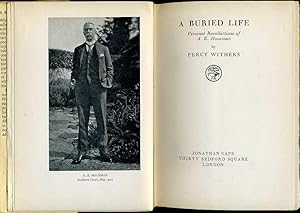
The ever-resourceful Burnett, who detects allusions where others nod, notes the echo of Dr. Johnson’s "The Plan of the English Dictionary": “my book is more learned than its author.” Another friend of Housman’s was Dr. Percy Withers, a physician and writer who after Housman death published A Buried Life: Personal Recollections of A.E. Housman (Burnett calls it “sympathetic but somewhat baffled”). In a June 12, 1922 letter, Housman thanks Withers’ wife for the jar of marmalade she had given him, and adds of a photograph taken of him a month earlier: “The photograph is not quite true to my own notion of my gentleness and sweetness of nature, but neither perhaps is my external appearance.” The sentence is a perfectly tuned instrument of ironic self-awareness.

To Richards on Nov. 30, 1922, Housman writes: “Mr Vickers can have what he wants, and any of his countrymen. I am told that Americans are human beings, though appearances are against them.” And here, to Richards again, on Jan. 23, 1923, my favorite: “I suppose the Braille people [The National Institute for the Blind] may do Last Poems as they did the other book. The blind want cheering up.”  

Saturday, May 27, 2017

`There Is Only One Subject'

Years ago I regularly read Carl T. Rowan’s syndicated newspaper column, but he died in 2000 and his name hadn’t entered my head in years – a familiar fate for journalists. In memory I associate him with a sober, commonsensical understanding of the world. He was no grandstander or provocateur, nor was he a masterful stylist. You read Rowen for his slightly dull and reassuring sense of reasonableness. This week I unexpectedly came upon his name in Brown: The Last Discovery of America (2002) by Richard Rodriguez, who tells us the first book by a black writer he read was Rowan’s Go South to Sorrow (1957). He found it shelved in his fifth-grade classroom.

“And as I read,” Rodriguez writes, “I became aware of warmth and comfort and optimism. I was made aware of my comfort by the knowledge that others were not, are not, comforted. Carl Rowan at my age was not comforted. The sensation was pleasurable.”

Rodriguez recalls the sensation of reading Rowan with a vividness some readers will recognize. He remembers the quality of sunlight on that Saturday morning in January, and the bond of understanding formed with a man he would never meet. In Brown, Rodriguez has recently learned of Rowan’s death, which prompts him to write:

“It is a kind of possession, reading. Willing the Other to abide in your present . . . I remember Carl T. Rowan, in other words, as myself, as I was. Perhaps that is what one mourns.”

Some readers are blessed with a remarkable capacity for imaginative projection. Most children have it but soon lose it. They can become the Other, briefly, and the lucky ones retain and cherish the experience. Another black writer, Ralph Ellison, performed a comparable sort of magic on me with Invisible Man, when I first read it at age seventeen. Slowly, less dramatically (probably due to age), I’m developing a similar respectful empathy for Rodriguez and his work. This marvelous passage, which gives us plenty to ponder, follows two pages after the one cited above:

“Books should confuse. Literature abhors the typical. Literature flows to the particular, the mundane, the greasiness of paper, the taste of warm beer, the smell of onion or quince. Auden has a line: `Ports have names they call the sea.’ Just so will literature describe life familiarly, regionally, in terms life is accustomed to use—high or low matters not. Literature cannot by this impulse betray the grandeur of its subject—there is only one subject: What it feels like to be alive. Nothing is irrelevant. Nothing is typical.”

Friday, May 26, 2017

`This Object of My Rage'

The earliest recorded use of “Boswell” as an eponym dates from 1858, when Oliver Wendell Holmes in The Autocrat of the Breakfast-Table declares in a very American spirit: “Every man his own Boswell.” The next usage, according to the OED, is likewise Holmesian: “‘I think that I had better go, Holmes.’ ‘Not a bit, Doctor. Stay where you are. I am lost without my Boswell.’” (“A Scandal in Bohemia,” 1892) Finally, Nancy Mitford, Evelyn Waugh’s chum, writes in her 1932 novel Christmas Pudding: “I never thought of biography, but of course that’s the very thing for me . . . May I be your Boswell, darling?” More recently, and not cited by the OED, Stanley Elkin titled his first novel Boswell: A Modern Comedy (1964).

In most of these allusions (the Elkin is ambiguous) “Boswell” is neutral or admiring. It suggests a devoted chronicler, a gifted amanuensis. The OED also has entries for Boswellian and Boswellism. The latter is the work of Thomas Macaulay, whose famous pan of Croker’s edition of Boswell’s Life of Johnson appeared in 1831. It’s not intended kindly: “That propensity which, for want of a better name, we will venture to christen Boswellism.” Macaulay was just getting warmed up:

“Many of the greatest men that ever lived have written biography. Boswell was one of the smallest men that ever lived, and he has beaten them all. He was, if we are to give any credit to his own account or to the united testimony of all who knew him, a man of the meanest and feeblest intellect. Johnson described him as a fellow who had missed his only chance of immortality by not having been alive when the Dunciad was written. [Topham] Beauclerk used his name as a proverbial expression for a bore. He was the laughing-stock of the whole of that brilliant society which has owed to him the greater part of its fame.”

Macaulay’s Boswell is a freak of nature, an idiot savant of biography. Macaulay had a little-known precursor who also judged Boswell a literary parasite. Her name was Elizabeth Moody (1737-1814) and she was a minor English poet and critic. Among her poems is “Dr. Johnson’s Ghost,” published in 1786, two years after Johnson’s death, five years before Boswell’s Life of Johnson was published. The poem is occasioned by the publication in 1785 of Boswell’s Journal of a Tour to the Hebrides with Samuel Johnson, LL.D., which Moody deems a purely mercenary act of self-aggrandizement on Boswell’s part. She has Johnson’s ghost say to Boswell:

“`Behold,’ he cried, ` perfidious man,
This object of my rage:
Bethink thee of the sordid plan
That formed this venal page.

“`Was it to make this base record
That you my friendship sought;
Thus to retain each vagrant word,
Each undigested thought?’”

The eighteenth century was a bruising, unforgiving time to be a writer. Reviews of various sorts – written, spoken, hurled – were often gleefully savage. The ghost accuses Boswell of perfidy, avariciousness and rapaciousness – a felony indictment in Moody’s reckoning. In the final line, in a Poe-esque pre-echo, Boswell is condemned to a future in which he “wrote never more.” Boswell had his everlasting revenge in 1791.

Thursday, May 25, 2017

`Orneriness Downright Bracing'

I was introduced to the novels of Tobias Smollett by a professor hopelessly in love with the humor of the English eighteenth century, a happy malady she passed on to me. I remember her standing in front of the class reading aloud from The Adventures of Roderick Random (1748) and laughing so hard she coughed and sputtered and wiped her eyes until she could compose herself and resume reading. Her sense of humor was the sort that used to be described as ribald. The hardest I ever saw her laugh was during an end-of-the-academic-year party held in a banquet room above a bar. Another student asked if we ever learn the first name of Mrs. Waters in Fielding’s Tom Jones.  I said, “Ethel,” and the professor howled and dripped.

The edition of Roderick Random we used in class was the 1964 Signet paperback with an afterword by John Barth, whose eighteenth-century pastiche The Sot-Weed Factor had been published in 1960. I recently found a chewed-up copy of this edition, paid my twenty-five cents and wallowed in nostalgia for a novel I haven’t read in forty-five years. Barth gets it right:

“The novel’s humor is mainly of the bedroom-and-chamberpot variety, running especially to more or less sadistic and unimaginative practical jokes. Money and sex Roderick values—enough, at least, to fawn, bribe, intrigue, smuggle, seduce, deceive, dissemble, and defraud to have them—but what he really gets his kicks from is revenge.”

That, in short, is the plot of every Smollett novel. Don’t open Roderick Random expecting Virginia Woolf. Smollett writes brilliantly (few novels move so fast) but, as Barth says, one should be prepared for his “antisentimental candor.” Barth writes that “if one has had a bellyful of Erich Fromm and J.D. Salinger [whose books seem more dated than Smollett’s], one may find Roderick Random’s orneriness downright bracing.” Smollett is one of literature’s virtuosos of complaint. Now I’m rereading The Expedition of Humphry Clinker (1771), an epistolary novel in which one of the letter-writers, Matthew Bramble, is Smollett’s stand-in and gets most of the best lines. Here is a taste of Bramble’s extended set-piece on the horrors of London:

“If I would drink water, I must quaff the mawkish contents of an open aqueduct, exposed to all manner of defilement, or swallow that which comes from the river Thames, impregnated with all the filth of London and Westminster. Human excrement is the least offensive part of the concrete, which is composed of all the drugs, minerals, and poisons used in mechanics and manufactures, enriched with the putrefying carcasses of beasts and men, and mixed with the scourings of all the washtubs, kennels, and common sewers, within the bills of mortality.”

Smollett echoes Swift’s “A Description of a City Shower” (1710):

“Now from all parts the swelling kennels flow,
And bear their trophies with them as they go:
Filth of all hues and odors seem to tell
What street they sailed from, by their sight and smell.
They, as each torrent drives with rapid force,
From Smithfield or St. Pulchre’s shape their course,
And in huge confluence joined at Snow Hill ridge,
Fall from the conduit prone to Holborn Bridge.
Sweepings from butchers’ stalls, dung, guts, and blood,
Drowned puppies, stinking sprats, all drenched in mud,
Dead cats, and turnip tops, come tumbling down the flood.”

Wednesday, May 24, 2017

`I Felt No Little Elation'

“He received me very courteously; but, it must be confessed, that his apartment, and furniture, and morning dress, were sufficiently uncouth.”

That final adjective has a long, elastic history. Today uncouth suggests coarse, crude, ill-mannered, loutish. In Beowulf it meant “unfamiliar, unaccustomed, strange” (OED). By the eighteenth century the word had morphed into “awkward and uncultured in appearance or manners.” Both meanings apply as Boswell uses it to describe Dr. Johnson. The occasion, on May 24, 1763, is Bowell’s first visit to Johnson’s living quarters. Eight days earlier occurred the momentous first meeting of future biographer and subject at the bookshop of Thomas Davies. Boswell was twenty-two; Johnson, fifty-three. In his Life, Boswell observes of that first visit:

“His Chambers were on the first floor of No. 1, Inner-Temple-lane, and I entered them with an impression given me by the Reverend Dr. Blair, of Edinburgh, who had been introduced to him not long before, and described his having ‘found the Giant in his den;’ an expression, which, when I came to be pretty well acquainted with Johnson, I repeated to him, and he was diverted at this picturesque account of himself.”

Often, Johnson was likened, even by friends and admirers, to some extra-human creature, a giant or beast. In his Life, on May 17, 1775, Boswell writes: “Johnson’s laugh was as remarkable as any circumstance in his manner. It was a kind of good humoured growl. Tom Davies described it drolly enough: `He laughs like a rhinoceros.’” The disparity of body and mind confounds us. An intelligent man ought to look intelligent, but Johnson resembled a shrewd grizzly bear. Boswell nicely captures the dissonance:

“His brown suit of cloaths looked very rusty; he had on a little old shrivelled unpowdered wig, which was too small for his head; his shirt-neck and knees of his breeches were loose; his black worsted stockings ill drawn up; and he had a pair of unbuckled shoes by way of slippers. But all these slovenly particularities were forgotten the moment that he began to talk.”

We shouldn’t confuse Johnson’s dishabille with the messy affectations of a hipster.  He had other things, not bohemian provocation, on his mind. Johnson’s manners, in fact, were superb, when he wished them to be. He was a true democrat in the moral and social sense, without snobbery or pretensions in a resolutely class-ridden society. In that first meeting he speaks to Boswell of his friend Christopher Smart, the mad poet, and reveals some of his own fears:

“‘Madness frequently discovers itself merely by unnecessary deviation from the usual modes of the world. My poor friend Smart shewed the disturbance of his mind, by falling upon his knees, and saying his prayers in the street, or in any other unusual place. Now although, rationally speaking, it is greater madness not to pray at all, than to pray as Smart did, I am afraid there are so many who do not pray, that their understanding is not called in question.’”

Johnson famously adds: “. . .  I’d as lief pray with Kit Smart as any one else.’” Boswell hardly believes his good fortune:

“Before we parted, he was so good as to promise to favour me with his company one evening at my lodgings; and, as I took my leave, shook me cordially by the hand. It is almost needless to add, that I felt no little elation at having now so happily established an acquaintance of which I had been so long ambitious.”

Tuesday, May 23, 2017

`I'd Rather Let Them Surprise Me'

The first writer I met was Max Ellison (1914-1985), a bearded Michigan poet who visited my high school in suburban Cleveland in 1969. He had just self-published a collection, The Underbark. I bought a copy for $2.50 and he signed it. Even then I recognized his poems were folksy, sub-Sandburg and not very good, but what I remember is sitting with him in the school library, just the two of us, talking. I was awed to meet a guy who had actually written a book and published it – in hard cover! I have no recollection of the substance of our conversation, except that Ellison encouraged me to write, if that’s what I wanted to do. To a directionless sixteen-year-old, he was a nice man.

I entered the state university in 1970. As an English major I met more writers – Anthony Burgess, Jerzy Kosinski, Stanley Plumly, Gary Snyder and John Hawkes. Burgess was entertaining, a raconteur; Kosinski, a drunken narcissist; Plumly and Snyder, solemn bores; Hawkes, a harsh egotist, another sort of bore. Best of all, I met the short story writer Peter Taylor, a well-mannered gentleman whose work I didn’t yet know but would later admire. I wasn’t aware of it, but the visiting writer industry was well underway on American university campuses by the early seventies. The rubber-stamp format was in place: meet with a class or two, give a public reading, collect a check – a sort of literary one-night stand.

An early variation on this formula is documented in Talks with Authors (Southern Illinois University Press, 1968), edited by Charles F. Madden. In 1964, Stephens College in Columbia, Mo., sponsored a course called “American Life as Seen by Contemporary Writers” for its students and those at five historically black colleges. The class, an early precursor to “distance education,” was taught in part by telephone. On Monday, Prof. Harry T. Moore of Southern Illinois University in Carbondale would lecture to the students, introducing the writer being read in class that week at the six schools. On Wednesday, students discussed the assigned work in class with their instructors. On Friday, the author would speak informally by telephone with the students. Among the writers taking part were James T. Farrell, Karl Shapiro, Anne Sexton and Kay Boyle. Transcripts of their conversations make up most of Talks with Authors, and most are predictably dreary. Fortunately, Richard Wilbur was among the participants. He is by far the most cordial, amusing and learned, betraying not a trace of condescension to the students. His manner is commonsensical:

“I think I ought to begin by saying that I’m not a militant member of any school of poets or poetry. I don’t have any poetic theories to sell. I don’t feel any impulse to tell other poets how they ought to write; I’d rather let them surprise me. To listen to some of the critics nowadays, especially those who write for the popular magazines, you’d think the American poetry scene was a battlefield with beats and squares and intermediate types all locked in deadly combat.”

Wilbur says the best American poets have always been “independent operators—what they call wildcatting in Texas,” which describes his own practice. He goes on:

“I do, of course, have opinions on other things besides poetry. I’m for God and Lyndon Johnson and conservation and civil rights, city planning, the nationalization of the railroads, and a few other things. However, I think it’s not generally for opinions and ideas that poets are interesting. Some [deadly word] poets are intelligent men, and they are entitled to their thoughts, but abstract argument and intellectual pioneering are not the special function of a poet.”

Wilbur reads and discusses three of his poems – “Seed Leaves,” “Beasts” and “Love Calls Us to the Things of This World.” Some of the discussion by students and teachers is tiresome, but that’s not Wilbur’s fault. Poetry, good or bad, brings out the pretentiousness in a lot of people, especially those who pursue “meaning” like predators. Wilbur remains gracious:

“What poetry does with ideas is to pull them down off the plane of abstraction and submerge them in sensibility: embody them in people and things, and surround them with a proper weather of feeling—an appropriate weather of feeling—to let you know how it would feel to dwell in the presence of a certain idea—how the world would look if you had a certain idea in mind. It helps you to respond not merely with the intellect but with the whole being.”

Monday, May 22, 2017

`And Still Make Us Wish for More'

Janet Flanner (1892-1978), The New Yorker’s longtime correspondent in Paris who used the penname Genêt, is a negligible writer. She was prolific and covered many of the twentieth-century’s biggest stories, but never transcended the limits of journalism. Hers was not an interesting mind, and her books have documentary, not literary, worth. In 1980, the composer and music critic Virgil Thomson wrote a retrospective review of eight of them for The New York Review of Books, which has been collected in The State of Music & Other Writings (Library of America, 2016). Thomas was a friend of Flanner’s and is tactful in his judgments. But near the conclusion of his review he makes an interesting attempt to distinguish literature from other sorts of writing:

“Was that writing literature? She hoped and rather thought it might be. If literature is something you can read several times and still keep your mind on, then for me Janet Flanner is exactly that. So I keep her books around me. But if they are literature, what is their species? Poetry they are not, nor fiction nor formal history nor, after the war freed her from wisecracks, was she a professional humorist, though her Midwestern ways [Flanner was born in Indiana] with common sense and with debunking the proud made her cousin to Mark Twain and to George Ade.”

You can sense Thomson’s quandary. He wishes to be loyal to a recently dead acquaintance, but his critical rigor won’t quite permit it. Flanner has nothing in common with Twain and Ade but the English language and a Midwestern birth. I recall her prose as plodding, tuned to fashion and nothing like the work of her fellow New Yorker staffers, A.J. Liebling and Joseph Mitchell. Thomson tries again:

“The format of her own writing is closer, I think, to an English model. Let us call her a diarist. Columnist won’t do; she was personally too reticent for that. Let us think of her perhaps with Samuel Pepys, who could go on and on about London, and still make us wish for more.”

That’s not the Pepys I remember, nor the Flanner. Loyalty ranks high among the virtues, except in criticism.

Sunday, May 21, 2017

`Something to Outlive Him'

I see from my note at the front that I bought Anthony Kerrigan’s translation of Unamuno’s The Tragic Sense of Life in Men and Nations (1912) on Jan. 16, 1975. I had recently started working as a clerk in Kay’s Books in Cleveland, and had already stockpiled stacks of books I wanted to buy, stowing them under the counter on the second floor. The occult connections among the books we read often remain obscure. Somehow, I associate my awareness of Unamuno’s books with Beckett and Kierkegaard, whose work I had read fairly thoroughly. I then knew little of Spain’s literature beyond Cervantes, and I came to him by way of Smollett and Sterne. Unamuno is utterly unlike the author of Don Quixote, and I would not have known enough to characterize either writer as “quintessentially Spanish.” Unamuno I recognized as a true man of letters, gifted in the writing of novels and philosophy. I had already read his Shandean novel Mist (1914).

Clive James has prompted me to read The Tragic Sense of Life again. I was looking for something else in Cultural Amnesia (2007) when I noticed the chapter he devotes to Unamuno. James’ method is interesting. Each chapter bears the name of some contributor to culture, whether Miles Davis or Josef Goebbels, but that serves merely as the spark. These are not potted biographies. Some chapters hardly mention their nominal subjects, and proceed to follow whatever hobbyhorse James chooses to ride. The Unamuno chapter begins with a brief outline of Unamuno’s life, emphasizing the spiritual crisis he suffered in 1897 and his troubles with Franco’s regime. The key sentence: “His mental independence, however, was incurable.” That alone makes Unamuno a rare and very attractive sort of writer.

James next digresses on the subject of reviewing books. His career advice recalls Cyril Connolly’s. About the man of letters he writes: “His main asset is to be well read, but if he spends too much time reading secondary books only for the sake of reviewing them, he will be adding to his initial stock of useful erudition. Worse, he will be adding much that is useless.” And this:

“Anyone faced with the deadly task of first reading, then writing about, a book he would not ordinarily have read in the first place, is brutally reminded of what he was really born to do: read books that can be felt, from page to page, to do nothing for his wallet but everything for the spirit.”

James endorse underlinings and annotations. “Unamuno’s pages cry out to be defaced.” True enough. “At his potent best he could put the aphorisms one after the other like the wagons of an American freight train stretching from one prairie railhead to the next.” Here’s an example from Chap. III, “The Hunger for Immortality,” in The Tragic Sense of Life:

“If a man tells you that he writes, paints, sculpts, or sings for his own amusement, and at the same time makes his work public, then he lies: he lies if he puts his signature to his writing, painting, sculpture or song. He is intent, at the very least, on leaving some shadow of his spirit behind, something to outlive him.”

Saturday, May 20, 2017

`To Preserve Something that Seems Important'

One of the joys of forgetfulness is unexpectedly remembering something previously erased from memory. In a forgotten notebook from 1994 I found the notes I made while reading Timothy Steele’s Missing Measures: Modern Poetry and the Revolt against Meter (University of Arkansas Press, 1990). I remembered reading the book but few specifics about its contents, just a general sense of agreement with Steele’s thesis and admiration for so much learning gently and entertainingly deployed. Then I found this transcribed passage from Page 294, the last page in the volume:

“What is most essential to human life and to its continuance remains a love of nature, an enthusiasm for justice, a readiness of good humor, a spontaneous susceptibility to beauty and joy, an interest in our past, a hope for our future and above all, a desire that others should have the opportunity and encouragement to share in those qualities. An art of measured speech nourishes these qualities in a way no other pursuit can.”

On one level, Steele is talking about himself. In him I sense a natural-born celebrator – not naïve but never distracted by the world’s imperfections. He’s no whiner and he seldom sours. The passage reminds me, in its gratitude and good sense, of this rhapsody in Charles Lamb’s essay “New Year’s Eve”:

“I am in love with this green earth; the face of town and country; the unspeakable rural solitudes, and the sweet security of streets. I would set up my tabernacle here. I am content to stand still at the age to which I am arrived; I, and my friends: to be no younger, no richer, no handsomer.”

I might quibble with what’s missing from Steele’s list, obvious things – family, friends, books – but maybe they are subsumed under what’s already there. Especially I appreciate “a spontaneous susceptibility to beauty and joy.” I could make a catalogue of the people I know who are immune to that gift. What a marvel: a happy writer. When an interviewer asked Steele, “What do you enjoy most about being a poet?” he replied:

“I suppose writing. That might seem a redundant or obvious answer, but I enjoy writing. I enjoy the process of trying to give something that has arrested me, or something that I love, stability and, I hope, lasting shape. Much of what I write about is written out of a desire to preserve something that seems important, an idea or an image or an experience.”

Friday, May 19, 2017

`Often It Is a Versified Sneer'

I wish I had read this a long time ago: “In writing epigrams, most poets gain control over their natural tendency to blab,” which is followed by this sentence: “Besides, an epigram permits them to get a gripe off their chests.” As bloat proliferates, short forms look more attractive as a corrective to congenital logorrhea. The author is X.J. Kennedy in “Gists, Piths, and Poison-Pills: The Art of the Epigram” (An Exaltation of Forms: Contemporary Poets Celebrate the Diversity of Their Art, 2002).

I’m no epigrammist – no poet at all – but the lesson is useful and has applications in everything we write, prose or verse. Even bloggers, a gassy, sentimental bunch, can learn to be ruthless with words. Concision encourages logic and wit and discourages blather. Here is A.E. Housman (More Poems, 1936) on the Boer War:     

“Here dead lie we because we did not choose
To live and shame the land from which we sprung.
Life, to be sure, is nothing much to lose;
But young men think it is, and we were young.”

Epigrams often come barbed in their final line. They resemble jokes more than sonnets, and permit no flab. Here is “Avant-garde” by John Frederick Nims (The Powers of Heaven and Earth: New and Selected Poems, 2002), in which the sentiment is admirable but the punch line is at once heavy-handed and diffuse:

“`A dead tradition! Hollow shell!
Outworn, outmoded—time it fell.
Let’s make it new. Rebel! Rebel!’
Said cancer-cell to cancer-cell.”

The master of the epigram in English is J.V. Cunningham. Kennedy elsewhere says of him, “you had to respect a man of his sour integrity,” a quality almost unique to Cunningham, at least since the death of Walter Savage Landor. Here is his “Epigram 23” from the sequence "Epigrams: A Journal" (The Judge is Fury, 1947):  

“Dark thoughts are my companions. I have wined
With lewdness and with crudeness, and I find
Love is my enemy, dispassionate hate
Is my redemption though it come too late,
Though I come to it with a broken head
In the cat-house of the dishevelled dead.”

Ours is an age of euphemism and its demented cousin, obscenity. Both modes lie. No wonder readers find Cunningham inhospitable. The harshness of his truth is corrosive. Let Kennedy defend the epigram and, by implication, Cunningham, its most agile practitioner:

“The epigram is brief, closely packed, and single-minded in making its point. Often it is a versified sneer. From that definition, you might think it a mere nasty little bug, deserving only to be stepped on. In fact, some poetry editors hold that view. They are the kind who prefer godawfully serious poems, and mistake length in poetry for importance. Yet when it clicks, an epigram in verse can be memorable, funny—even beautiful, to anyone who can relish the deft placing of words inside tight space.”

Thursday, May 18, 2017

`A Dog with a Reddish Coat'

Tuesday evening after dinner, I sat on the couch by the front window, reading, when I noticed a stranger walking down the street. The oddly misshapen head and face were unmistakable. The pit bull paused to urinate on one of our rosemary plants and, when finished, kicked up a storm of dirt and pine needles. He ambled off with the abstracted air of a child working hard not to appear lost.

The neighbors rallied. The dog wore a collar but no license or name tag, and we put him on a leash. He was friendly but not affectionate, and never made a sound. Endearingly ugly, he liked being scratched behind the ears. Someone brought him a bucket of water and he drank sparingly. We gave him two cups of our dog’s food and he inhaled it. On his back and ears were old scars, but otherwise he looked healthy and cared for. I remembered “Kashtanka,” of which Aldo Buzzi writes in “Chekhov in Sondrio” (Journey to the Land of Flies and Other Travels, 1996):

 “One of Chekhov’s best stories is about a dog with a reddish coat called Kashtanka (Chestnut), which was the name of a dog he had in his house. The cat of the house was called Fyodor Timofeyich: a name and a patronymic, as if he were an orthodox Christian—that is, Theodore, the son of a former cat, Timothy.”

Chekhov wrote “Kashtanka” in 1887, on the eve of the decade during which he would write his best stories. Simon Karlinsky calls it “Chekhov’s most popular animal story, describing a cobbler’s [actually, a carpenter’s] dog which joins a circus. It is regularly reissued to this day in illustrated editions intended for children.” An animated version of the story was produced in the Soviet Union in 1952. Karlinsky’s description is rather misleading. Kashtanka is separated from her owner by a brass band marching in the street and rescued by a clown who performs with an animal act in the circus. Kashtanka joins Fyodor Timofeyich and a trained goose, Ivan Ivanitch. Animal stories charm children but adults usually find them insufferable (consider Animal Farm and Charlotte’s Web). But the narrator of “Kashtanka” is omniscient and the animals remain animals. They don’t speak and don’t understand the words of humans. With a little tinkering, a child could be substituted for Kashtanka, and the story isn’t far from the essential appeal of Dickens – lost and found. There’s a death followed by a happy ending. The story contains thoughtless, foolish characters but none is truly evil.

Neighbors posted photos of the lost pit bull on several pet and neighborhood sites. At sundown, we went inside. The woman across the street unleashed the dog and stayed with him, hoping his owners would be cruising the streets, looking for him, but no one responded to the photos and no one drove down our cul-de-sac, so she went inside.

[Chekhov wrote another dog story, “Whitebrow,” in 1895.]    

Wednesday, May 17, 2017

`A Writer and Nothing Else'

I don’t know who Jason Guriel is but I like the way he thinks, at least in “What Happens When Authors Are Afraid to Stand Alone”:

“Writers like [Canadian poet Bruce] Taylor know that they can extract very nearly all of the society they require from literature. They are adult enough to recognize that writing is a selfish, solitary activity, and that it’s the quality of their work, not their capacity for kibitzing, that ultimately secures a meaningful, long-term readership.”

Scratch the part about a “meaningful, long-term relationship,” but the rest stands. Guriel’s subject is the clannishness, groupthink and compulsive geniality of contemporary writers and their camp-followers. Because of them, one can no longer use the word “community” with a straight face. Speaking of words, the phenomenon Guriel diagnoses started several decades ago, around the time “lifestyle” gained currency. Today, if one wishes to try on the writer’s lifestyle, one need not write a word. Look soulful or haughty, wear the right clothes and read the right books (or at least carry them around). The late Edgar Bowers used to say that he stopped being a poet when he wasn’t writing poems – a nice rebuke to two centuries of Romantic posturing. Guriel continues the passage above:

“They [dedicated writers] might have a few literary friends or a social media account; they might not. But if writing well is their aim, they will tend to resent claims on their time. And they will tend to prize a commodity more precious than community: privacy.”

To put it more bluntly, writers have one job: writing well. The rest is dress-up night at the coffee shop. Montaigne, the writer who made literature safe for the “I,” puts it like this in “On Solitude”: “It is not enough to have gotten away from the crowd, it is not enough to move: we must get away from the gregarious instincts that are within us, we must sequester ourselves and repossess ourselves.” Of course, the other side of all this egregious collegiality is the viciousness and undying envy of most writers. A room crowded with writers is a snake pit, not a community. Consider John Berryman’s one-sentence distillation of Stephen Crane:

“Crane was a writer and nothing else: a man alone in a room with the English language, trying to get human feelings right.”

Tuesday, May 16, 2017

`And Still Singing'

“On the other hand, among a hundred ways of saying a thing, there are more than ninety that a care for euphony may reasonably forbid.”

Not once have I heard a critic or writing instructor plump for euphony in prose. The conventional definition of that quality is “pleasing to the ear,” and I don’t take that to mean syrupy, purple or extravagantly lush or “poetic.” If you want to be read and understood, you write with care for the sound of your words, as well as their sense, and the only reliable test is to read the passage aloud, under your breath if others are in the room. (I learned this lesson in noisy newsrooms.)  If you’ve repeated a word too soon after the prior use, for instance, you’ll hear it. It and other blunders will sound like what jazz musicians refer to as a “clam,” a wrong note.

Normally I avoid style guides as too theoretical, arbitrary or simply boring. This one is a little different. Sir Walter Alexander Raleigh (1861-1922) taught English Literature at Oxford and wrote such books as Milton (1900) and Six Essays on Johnson (1910). The passage above is from Style, a long essay first published in 1897. I borrowed the library’s copy of the twelfth impression, from 1916. Raleigh continues:

“All who have consciously practised the art of writing know what endless and painful vigilance is needed for the avoidance of the unfit or untuneful phrase, how the meaning must be tossed from expression to expression, mutilated and deceived, ere it can find rest in words.”

Raleigh wrote in a day when writers were only beginning to aspire to write in a “mutilated and deceived” manner. Soon, in some quarters, incoherence was elevated to a virtue. There’s a lesson here too. From memory I can recite two passages from Finnegans Wake. One is the famous first (and last) sentence. The other consists of two sentences, each of three words, all in everyday English: “First we feel. Then we fall.”  This is euphony. Joyce gives us two dactyls with a hinge in the middle. The full stop lends the second sentence a Q.E.D. quality. I’ve contemplated that passage since first reading it almost half a century ago. Raleigh next gets specific:   

“The stupid accidental recurrence of a single broad vowel; the cumbrous repetition of a particle; the emphatic phrase for which no emphatic place can be found without disorganising the structure of the period; the pert intrusion on a solemn thought of a flight of short syllables, twittering like a flock of sparrows; or that vicious trick of sentences whereby each, unmindful of its position and duties, tends to imitate the deformities of its predecessor;—these are a select few of the difficulties that the nature of language and of man conspire to put upon the writer.”

All of us have committed such gaffes, especially when young. We learn to avoid them only by listening critically to the sound our own words and the words of the best writers. Raleigh concludes the passage with another musical metaphor:   

“He is well served by his mind and ear if he can win past all such traps and ambuscades, robbed of only a little of his treasure, indemnified by the careless generosity of his spoilers, and still singing.”

Monday, May 15, 2017

`It Is Delusions, That Is, People'

“Different branches of knowledge have always lived together in peace. Both anatomy and belles-lettres are of equally noble descent; they have identical goals and an identical enemy—the devil—and there is absolutely no reason for them to fight.”

Knowledge arrives in many forms, not always through the lens of a microscope. I would hate to live in a world without scientific instruments, but I would equally regret life without Proust. At their extremes, the rival camps might be characterized as Positivists and Aesthetes. Chekhov was neither. He happily embodied the integration of both worlds. He wrote the passage above on this date, May 15, in 1889, in a letter to Alexi Suvorin, his editor, literary champion and friend, who was also (much to Chekhov’s disgust) a rancid anti-Semite and anti-Dreyfusard. The translators are Michael Henry Heim and Simon Karlinsky (Letters of Anton Chekhov, 1973), and the context is publication of Paul Bourget’s potboiler Le Disciple.

As always, Chekhov impresses us with his equanimity, his immunity to any sort of rancor or fanaticism, political or otherwise. Doctor and writer, he saw no contradiction in his chosen vocations (the same can be said of Keats, and even of Céline and William Carlos Williams). Chekhov writes:

“If a man knows the theory of the circulatory system, he is rich. If he learns the history of religion and the song `I Remember a Marvelous Moment’ in addition, he is the richer, not the poorer, for it. We are consequently dealing entirely in pluses. It is for this reason that geniuses have never fought among themselves and Goethe the poet coexisted splendidly with Goethe the naturalist.” [In a footnote, Karlinsky writes of the song mentioned by Chekhov: “An art song by Mikhail Glinka, which is the setting of one of Alexander Pushkin’s most popular lyrics.”]

Not a fanatic himself, Chekhov could write clinically of the type. Consider the case of Dr. Yevgeny Lvov in his play Ivanov, who treats others not as individuals but as ideological caricatures. In his letter, Chekhov continues:

“It is not branches of knowledge that war with one another, not poetry with anatomy; it is delusions, that is, people. When a person doesn’t understand something, he feels discord within. Instead of looking for the causes of this discord within himself as he should, he looks outside. Hence the war with what he does not understand.”

Sunday, May 14, 2017

`A Thousand Unaccountable Things'

Some of us never learn. After a lifetime of hunting and gathering, the hopped-up sense of anticipation remains strong, less a symptom of greed than wonder. The Houston Public Library’s book sale on Saturday was held in the “multipurpose room” (gymnasium) of my youngest son’s middle school. Arranged in row after row with strict impunity, tables and shelving carts parodied Melvil Dewey’s famed system. Marcus Aurelius in Self-Help?

Much of the stock consisted of library discards, always a sad sight. A pristine copy (but for the library sticker and plastic cover) of Flann O’Brien’s Complete Novels, published in 2007?  An untouched Brideshead Revisited, also in the Everyman’s Library edition? Most of the rest was wood-pulp-to-be, recycled thrillers and biographies of actors and politicians. Still, people managed to fill shopping bags and knapsacks, though the books weren’t cheap: hardcovers, three dollars; paperbacks, two dollars.   

I was relieved to find an Everyman’s Library edition of Defoe’s A Journal of the Plague Year. I love it almost as much as Robinson Crusoe, and it was a favorite of the Joe’s, Liebling and Mitchell. The pages are browning but the spine is intact. The only mark I find in the book, printed in 1931, is a single word on the front free endpaper: “Neuhaus.” The prior owner had exquisite penmanship. Here is a sample of Defoe’s clear and precise prose:

“As the desolation was greater during those terrible times, so the amazement of the people increased, and a thousand unaccountable things they would do in the violence of their fright, as others did the same in the agonies of their distemper, and this part was very affecting. Some went roaring and crying and wringing their hands along the street; some would go praying and lifting up their hands to heaven, calling upon God for mercy.”

I found a sturdy paperback copy of a novel I’ve lately had a hankering to read again, Nostromo. There was a time when we turned to fiction, in part, to learn how to live our lives. We expected moral education and some of us still do. Conrad is a reliable teacher:

“The fault of this country is the want of measure in political life. Flat acquiescence in illegality, followed by sanguinary reaction—that, señores, is not the way to a stable and prosperous future.”

Saturday, May 13, 2017

`The Secret of Style, Really!'

Thus far we’ve had The Happiness of Getting it Down Right: Letters of Frank O’Connor and William Maxwell (1996), The Element of Lavishness: Letters of Sylvia Townsend Warner and William Maxwell (2001) and What There Is to Say We Have Said: The Correspondence of Eudora Welty and William Maxwell (2011). That Maxwell had time to write vast reams of correspondence while turning out six novels, dozens of stories, book reviews, a memoir and children’s books, and editing fiction for The New Yorker, is appalling. Among the writers he edited for the magazine were Cheever, Nabokov and Mavis Gallant.

A reader has just alerted me to the existence of some four-hundred letters exchanged by Maxwell and Louise Bogan, poet and poetry critic for The New Yorker for thirty-eight years. The correspondence is kept at Amherst College. What the Woman Lived: Selected Letters of Louise Bogan was published in 1973, and the prospect of a Maxwell/Bogan collection is enticing, though I see no evidence of such a book in the works. Perhaps I can prime the publishing pump with this excerpt from a letter Bogan wrote to Maxwell in 1941 about her daughter:

“Maidie is becoming v. proficient in driving; and we got to Jones Beach in 1 and 1/2 hours.  The other day a refugee couple sprang out in front of the car, against the lights, and the woman began berating Maidie for not stopping. Maidie immediately shouted: `You’d better watch the lights, BABE!’  This BABE, after I had shaken off my own fright, really made me laugh.  `Why BABE?’ I asked Maidie. `O, that was to put a little life into it!’ she said. –The secret of style, really!”

Friday, May 12, 2017

`The Best Reading of All'

Rose Macaulay loved guide-books as a form of stay-at-home travel, and judged them “the best reading.” In “Problems of a Reader’s Life” (A Casual Commentary, 1925), she adds a qualification:

“Always excepting the Oxford [English] Dictionary. If you can manage to lift one of the volumes of this from its shelf, you will find it the best reading of all, infinitely varied in its contents, and full of elegant and brief extracts from the English literature of all times.”

I recognize a kindred spirit. The most valuable gift of the Digital Age is having effortless access (no hernia-inducing volumes) to the OED. Macaulay, who died in 1957 at age seventy-seven, would have loved it. Some surf the web; I surf the Dictionary, and waste hours tracing etymologies and juicy citations, and looking up the definitions of words I pretend to know. Take “umbrage,” or rather, consider the word umbrage. When someone said, “I take umbrage at that,” I understood it to mean offense or touchiness. I was close. After reading Macaulay’s “Taking Umbrage” (Personal Pleasures, 1936), I decided to look it up in the OED. From the Latin umbra, it first meant “shade” or “shadow,” and later the foliage that creates shade or a shadow. As usual in our infinitely elastic English, the word morphed across centuries, mutating, adopting and abandoning new meanings. Around 1700, the modern sense emerged: “displeasure, annoyance, offence, resentment.” English-speakers have been taking umbrage since at least since 1683, and it turns out you can also give umbrage, which is useful to know. 

Macaulay obviously was familiar with the word’s etymology. She begins her essay with an anecdote. In a shop, she waits for a clerk while customers who entered after her are being waited on. She articulates the pleasure we take in taking umbrage: “I will not, even by a look, convey that I demand to be served; I coldly stand and wait: I have taken umbrage. I am wrapped in silence, an umbrageous mantle; I am shadowed about and umbraged with my pride; I have taken pet. I have joined the great company of the umbraged of all time. How they hover and shadow umbrageously about.” All of which reminds me of a Monty Python sketch. Macaulay goes on to celebrate the umbrageous tradition among writers, including Milton, Pope, Swift, Marvell and Jonson. She writes:

“With what gusto have these beaten their pens into swords, envenomed them, and plunged them into the quivering breasts of rivals, calumniators [delicious word], mockers, and reviewers.”

Macaulay is best-known, if at all, as a novelist, especially for The Towers of Trebizond (1956) and its first sentence: “`Take my camel, dear,’ said my aunt Dot, as she climbed down from this animal on her return from High Mass.” But I prefer her essays, travel books (see Fabled Shore: From the Pyrenees to Portugal, 1949) and the always rereadable The Pleasure of Ruins (1953). Her prose balances learning and lightness. In her three-paragraph “Improving the Dictionary” from Personal Pleasures, she captures the allure of lexicography:
  
“On a blank page at the beginning of the Supplementary Volume [published in 1933] of my [OED], I record emendations, corrections, additions, earlier uses of words, as I come on them in reading. Ah, I say, congratulating myself, here Messrs. Murray, Bradley, Craigie and Onions are nearly a century out; here were sailors, travellers and philosophers chattering of sea turtles from the fifteen-sixties on, and the Dictionary will not have them before the sixteen-fifties. And how late they are with estancias, iguanas, anthropophagi, maize, cochineal, canoes, troglodytes, cannibals and hammocks. As to aniles, or old wives’ tales, they will not let us have this excellent noun at all.

“Thus I say to myself, as I enter my words and dates. To amend so great a work gives me pleasure; I feel myself one of its architects; I am Sir James Murray, Dr. Bradley, Sir William Craigie, Dr. Onions, I belong to the Philological Society; I have delusions of grandeur. Had I but world enough and time, I would find earlier uses of all the half million words, I would publish another supplement of my own, I would achieve at last my early ambition to be a lexicographer.

“If there is a drawback to this pure pleasure of doing good to a dictionary, I have not yet found it. Except that, naturally, it takes time.”

Thursday, May 11, 2017

`And He Is, of Course, Unknown, Lost'

Fortunately, love confounds criticism. If our reading is exclusively high-minded, if we admit only acknowledged masterpieces into our high-walled sanctuary, we run the risk of turning into insufferable prigs and missing out on a hell of a lot of readerly pleasure.

Among the least guilty of my pleasures are the three Brooklyn novels published by Daniel Fuchs (1909-1993) during the Great Depression:  Summer in Williamsburg (1934), Homage to Blenholt (1936) and Low Company (1937). I read them for the first time in 1975, in the 1961 compendium volume titled Three Novels, and every few years I read them again.

There’s an irresistible sprightliness to Fuchs’ prose, a celebrative openness to the world, despite the occasional grimness of his subject matter: Summer in Williamsburg opens with a suicide. To get a flavor of Fuchs’ work, consider that Farrar, Straus & Cudahy in 1956 published Stories: Jean Stafford, John Cheever, Daniel Fuchs, William Maxwell. Fuchs is perfectly at home in that company. Critics called him a proletarian writer, but that’s to mistake a coincidence of history for a stylistic certainty. I started reading Fuchs’ novels again after reading Odessa-born Boris Dralyuk’s translation of Isaac Babel’s Odessa Stories (Pushkin Press, 2016). For this non-Russian reader, who has read four earlier translations of Babel’s stories (including Red Cavalry, translated by Dralyuk in 2015), Babel has finally arrived in English. Readers familiar with the last century of Jewish-American writing will hear familiar dissonant harmonies in Dralyuk’s Babel. In his introduction, Dralyuk writes of Babel’s Odessan Jewish gangster Benya Krik:    

“What really keeps you hanging on Babel’s every word are the words themselves, that rich Odessan argot. As Froim the Rook says of Krik, `Benya, he doesn’t talk much, but what he says, it’s got flavor. He doesn’t talk much, but when he talks, you want he should keep talking.’ This, after the gutsy Benya barges in on the one-eyed gang boss and declares, `Look, Froim, let’s stop smearing kasha. Try me.’ Once Froim gets a taste of that `kasha,’ he can’t help giving Benya a try.

“The language of Odessa, with its Yiddish inflections and syntactic inversions, its clipped imperatives and its freight of foreign words, was in the air all around me as I was growing up. Little did I know that a similar melting pot, New York’s Lower East Side, had made a similar `kasha’ out of English at around the time Benya’s archetypes were raising hell in Moldavanka. When I discovered the novels of Samuel Ornitz, Michael Gold, Henry Roth and Daniel Fuchs, the plays of Clifford Odets and the stories of Bernard Malamud, I felt right at home.”

Fuchs remains in print thanks to Black Sparrow Press, which reissued the trilogy in a single volume in 2007 under the title The Brooklyn Novels. He remains among the perpetually rediscovered writers, famous for being neglected. In an essay he published in Commentary in 1988, Fuchs recalled discovering in 1926 that a teacher at his high school, Adolph Gillis, had published a novel set on the Lower East Side of Manhattan. Though Gillis taught Ivanhoe and Silas Marner,

“. . . he abandoned those gray, timeworn narratives as inconsequential, as I myself had done, and wrote in a raw, new, modern realism, dealing with characters and a background that were breathtakingly familiar to me and at hand. Nowadays I am sometimes mentioned—because of my 30’s Williamsburg books—as a forerunner of the American Jewish novel, a distinction which leaves me blank and uninterested, mainly because my work derived from Mr. Gillis’s novel, got its start from it, and he is, of course, unknown, lost.”

As is Fuchs, who wittily titles his essay “Three Books.”